23 November 2013

Shades of Gray

Episode: s2, ep22

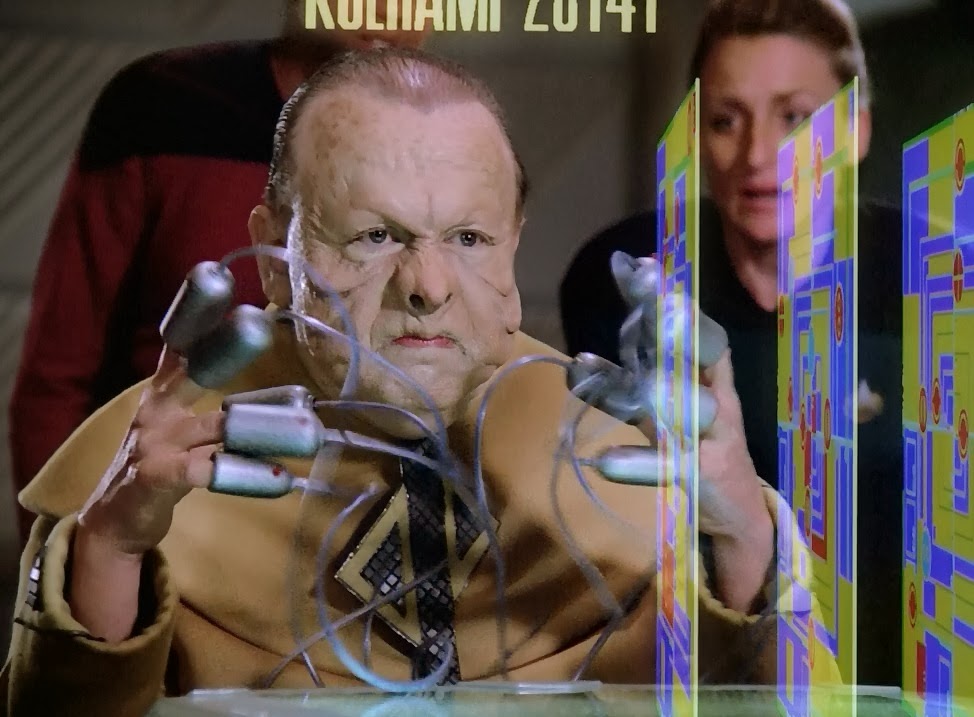
Riker gets in touch with his inner goddess whilst suffering from futuristic, empathic gangrene in this clip show that finishes the second series.

What Happens
In a swamp Geordi sees Riker wounded by something that jabbed him in the leg. O'Brien can't beam him up because of unidentified microbes. Pulaski goes down to examine him then authorises Riker to be transported to sickbay.
Mr Grey got too rough
Riker stays upbeat, cracking jokes even as things looks bad. The microbes move up his body and if they reaches his brain he'll die. Picard orders Data and Geordi to get a sample of whatever stung Riker so Pulaski can examine it. Turns out it was a carnivorous vine that immobilies its prey. Unfortunately the sample doesn't tell Pulaski much. Riker continues to be upbeat and tells Troi that even when facing death he's setting an example. Riker passes out as Troi holds his hands, the illness has gotten to his spinal cord, it will reach his brain within an hour. Pulaski sticks spikes into Riker's brain and Troi stays with him.
Meanwhile, in the dungeon
  • Beardless Riker beams onto a stormy planet alone and calls out for the away team in The Last Outpost
Pulaski's brain spikes are stimulating neural activity and Troi can sense what Riker is feeling.
No grey tie?
  • Riker goes into forest on the holodeck and meets Data for the first time, comparing him to Pinocchio in Encounter at Farpoint
  • Riker and Guinan give Wesley dating advice, but they get really into it and hilariously ignore Wesley in The Dauphin
  • Riker says goodbye to Troi when he's going to leave for a new posting in The Icarus Factor
Teaching seduction
Troi says Riker has relaxed and Pulaski says that reliving memories is a side-effect. The microbe is reacting to his mood, so Pulaski changes frequency to see what happens.
  • Riker and the away team see the adult fun to be had on the bimbo planet in Justice
  • Riker meets Minuet, his ideal holo-woman  in 11001010
    Has she signed a contract?
Troi senses passionate, erotic emotions as Riker's memories of Minuet continue.
Pulaski notices growth rate of organism has doubled. Troi says they've made it worse. Pulaski reckons its something to do with endorphines, she changes frequencies again.
Pulaski notices the growth has slowed and Troi senses he's sad. Negative emotions stop the growth. Pulaski and Troi need to isolate strong negative emotion memories, but the treatment could be bad for Riker
Klingons don't need dungeons
  • Riker is posted on a Klingon ship, taking an oath and having a fight in A Matter of Honour
  • Riker is shown a brain louse by a corrupted Admiral and they fight in Conspiracy 
These memories are about fighting, because of course Rik is fighting the illness. Do you see, do you?
 Troi senses his primal, survival instincts. Troi insists Pulaski does more, the doctor is wary because he's so weak, but there's little choice.
Getting handsy
  • Riker is threatened by a desperate junkie with lightning hands in Symbiosis
  • Riker first encounters hostile Ferengis in The Last Outpost 
  • Riker is dragged into the tar creature and makes a scary face in Skin of Evil
Too much latex
Pulaski is desperate and tightens the pattern further at Troi's suggstion.
  • Riker and Picard set the auto-destruct in 1001001110
  • Riker and others escape a soon-to-explode ship, they nearly don't make it and see ship exploding as they beam out in Heart of Glory
A montage of violent memories:
Junkie attacks, Admiral shoots, Auto destruct, Data fixes, Tar creature grabs, Klingon fights, Auto destruct, Assassin killed, Fighting Klingon, Ship explodes, Ship destroyed, Brain louse queen explodes, Ship explodes
Inner brain louse

Riker's vitals improve and Pulaski confirms the infection is eradicated.
Riker wakes (with puncture scars on his head) and talks to Troi. Pulaski delivers the good news, but has to run lots of tests and warns of possible memory loss.


Riker: adventurer, lover, middle-management... and survivor
Riker's bravery and good humour in the face of death is amazing and it's no surprise that Picard and Troi are impressed. Riker's talk about setting an example and showing good character in this ultimate test is admirable. Having said that the lack of negative emotion gave me pause, surely Riker feels sad or sacred or angry or something? He's gotten worked up and displayed negative personality treats over less, then again perhaps his impending death gave him clarity.
I wholeheartedly agree with Riker's surprise that this kind of thing doesn't happen more often. "After all, we are exploring the unknown." Space is really dangerous and lots of bad stuff goes down there. (Actually that sentence kinda sums up most space-based SF.)

Doctor Doctor
Pulaski is obviously called to assess the Riker situation. O'Brien offers to override the transporter and beam Riker aboard anyway but Pulaski says she'll go down and check on him. Her respect quarantine regs makes me strangely happy (I saw Prometheus for the first time a few months ago and had to be shushed for going on about quarantine - but the lack of sense was maddening to me.) It's also cool that Pulaski beams down herself considering her fear of transporters.
Pulaski tells the Captain that whatever is inside Riker can't be removed without destroying Riker's nerves. It's moving through his body pretty quickly, amputation time surely? It seems the obvious solution. I mean its the 24th century, they must have good prosthetic limbs and losing a leg is surely better than losing his life.

Counsellor Pointless
Troi is given useful stuff to do this episode, which is good. Stuff that is relevant to her skills, her actual job and her relationship with Riker.


The End
Just as Riker is warned of possible memory loss Data and Picard come in. Riker pretends he thinks he is Picard. Picard pretends Data is an admiral. Data takes the joke literally and tells Picard he isn't able to promote him to Admiral. All is jolly once more.

Some might say that it's an odd choice to end a series of an ensemble show on a clip-filled episode that focuses almost entirely on one character, but clearly those people did not get what was going on here.

So series 2 was a slight, if still uneven, improvement on series 1. I'm told it gets better from series 3 (though I recall people saying that about series 2). To finish I'd just like to mention Scroll Down to Riker.


10 November 2013

Thor the Dark World

Thor the Dark World was better than the first Thor film. The characters and world are already established so there's more depth to the story and we get to see bits of the nine realms we didn't get to see before. There are various good character moments and interesting use of the science/magic/alien tech that was introduced but not much explored in the first installment. Thor has developed, he's grown more thoughtful, plus he's less of a fish out of water on Earth. Odin seems pretty much the same, which is kind of a problem. Jane Foster and Darcy seem to be pretty much the same characters, which is no bad thing, especially with Darcy. Jane and Thor's relationship develops, but in pretty much expected ways. Loki is imprisoned for his crimes, but then his unique skills are needed by Thor. Dr Eric Selvig went crazy in the aftermath of the Avengers, but that's no surprise and his sciencing is still important. Also there are dark elves and their leader wants to turn the universe to darkness.

There are two end credit scenes. One halfway through and one at the very end. I personally felt one was better than the other.

Beware, there are spoilers below.

There are some new characters, in the slightly hapless blokes that Jane and Darcy encounter. Ian and Richard are clearly there for comedy purposes, but that works well enough and means that Chris O'Dowd is in a couple of scenes, which is no bad thing. We also see a lot more of Frigga, Thor and Loki's mother, who turns out to be kinda awesome, so its sad that she's killed before we get to see much of what she can do. It is clear that a lot of the illusions and stuff Loki does are things he learned from her, rather than anything to do with being born a frost giant (in fact the whole frost giant thing is never really touched on, it's more about the fact he's adopted).

It's easy to forget how menacing Christopher Eccleston can be, he does a good line in scary bad guys. Of course as Malekith, ruler of the Dark Elves, he looks pretty creepy to begin with and Eccleston's presence backing it up. The premise is that Dark Elves were around before light came to the universe and want things back the way they were, it means there doesn't have to be any character development as far as the villain is concerned (I was reminded of Eccleston playing the Dark Rider in The Dark is Rising - a bad film in which he plays a character with basically the same motivation, but no reason for it). This isn't a bad thing as there's plenty of character development in just about every other part of the film, and of course Loki's position is complicated by not being the antagonist, but not being trusted by the protagonists either.

Loki is less the evil, murdering bastard of the Avengers and more the moody, untrustworthy trickster he started as. What became clear to me is that despite of the lack of genetic link Loki is very much Odin's son, I'm fairly convinced Odin used to be a right bastard, and his gruff, disapproving way with his sons is a real problem. There's tensions between Odin and Thor because Odin, despite his earlier speech to Loki about humanity, is entirely dismissive of Jane Foster as a partner for an Asgardian prince. I reckon Odin might as well allow Thor to have some fun with his human woman, I mean she'll be dead before century passes, but Odin just doesn't want anyone deviating from what he wants. Loki might try to distance himself from his adopted father, but even he points out that he hasn't really done much that Odin wouldn't do, which is fitting given the twist at the end. That is something they will have to explore more in later films.

I liked the scenes in London, partly because (like in Skyfall) the city wasn't glamorised, it had grotty bits and the weather also seemed realistic. I liked the weird gravity/spatial anomalies and how people played with them. That was also something I liked a lot about the big fight at the end. The gravity distortions and random portals had a real impact on the action and were used in ways that made sense and were also comedic. The film balanced its serious bits quite well with the mostly lighthearted tone.

The first end credit scene is clearly a nod to the wider Marvel film plan, and also made Marvel boy (my husband) squeak with excitement as the macguffin of this film is sent to a really dodgy-looking bloke to be guarded - Asgardians lack healthy suspicion it seems. The second shows Thor and Jane properly reunited.

Overall it's a good continuation of the Thor franchise and fits nicely into the overall Marvel film universe.

3 November 2013

Peak Performance

Episode: s2, ep21

A visitor to the Enterprise doesn't create a security breach and Wesley contributes to, but is not responsible for, saving the day.

What Happens
The Enterprise is doing a wargame exercise, to be devised and monitored by a guy whose species have a reputation for brilliant strategies. Picard will have the Enterprise and Riker be given an old ship. Strategy Guy is arrogant, which is the way of his people. Riker challenges Strategy Guy to some game that Strategy Guy is a Grand Master of, Riker knows he won't win but it's an honour to play this guy. Pulaski, who doesn't like the visitor's attitude, says Data should play because of his computer brain. The game looks like 3D Pong and only lasts a few seconds, Riker loses and everyone is disappointed because they were hoping for some entertainment.
Riker and his team (including Geordi, Worf and Wesley) go to the old ship, the engine is damaged so warp will be impossible. Riker gives Wes the option of returning to the Enterprise, but the acting-ensign says he'll stay. Riker asks Strategy Guy why it's a mismatch, but it turns out that's part of the exercise. Strategy Guy doesn't think much of Riker from what he's read in his file. Wesley retrieves a "project" he's meant to be working on from the Enterprise, which he beams to Geordi. Pulaski tries to get Strategy Guy and Data to play the game, Data agrees because Pulaski wants it. Data loses, but is much closer than Riker was. Pulaski doesn't understand, she thought Data was meant to be infallible. Troi visits Data, who takes himself off Bridge duty because he believes he is faulty. Se isn't able to convince him that it's OK to make mistakes.
Riker catches Wesley and Geordi plugging Wesley's experiment into the old ship. Riker claims it's cheating, but Wesley points out that Riker told him to improvise. Pulaski visits Data and accuses him of sulking. She's sorry she got him to do it and feels guilty about how its affected him. Pulaski and Troi tell Picard about Data's lack of confidence and say only the Captain can help. Picard thinks they're fussing but orders Data back to the Bridge. Data tries to figure out how Riker will approach the wargame.
The game begins with Picard using an obvious manoeuver, Worf surprises the Enterprise with a fake Romulan warbird allowing the old ship to attack. Geordi says the old ship can try going to warp, but there's no guarantee it will work. A real Ferengi ship appears, Strategy Guy insists the Enterprise abandons the old ship to save the greater numbers, Picard refuses and speaks to the Ferengi. They want to know why the Federation ships are acting oddly, they assume the old ship has something valuable onboard and trap them. The Federation crews concoct a plan. The Enterprise makes it look like they've blown up the old ship and Worf scares the Ferengi off with another illusion. Strategy Guy sheepishly admits he underestimated Riker.
Data plays Strategy Guy again, stays calm while the Grand Master panics and eventually suspends the game. Data altered his parameters for playing the game and played to draw, not win, thus confounding his opponent.


Guest Star
It's Armin Shimmerman as a Ferengi, again. I guess Quark's cousins really get everywhere.

Oh Captain, My Captain
Picard resisted wargames at first because he believes Starfleet is not a military organisation and is for exploration. However in the face of the Borg threat he decided it would be good to hone tactical skills that might be needed in a crisis.
When Strategy Guy expresses his low opinion of Riker Picard takes him into his ready room and demands to know what his problem is. Strategy Guy studied Riker's file and thinks he isn't up to the job, he's too jovial for a start. Picard warns him against underestimating Riker, who is the finest first officer he's had. Picard also points out that his joviality fosters loyalty among the crew.
Picard is confused when Troi and Pulaski ask him to help restore Data's confidence, he doesn't think Data is capable of the emotion, and Pulaski says it's probably programming but the effect is the same. Though the game starts soon Picard grudgingly agrees to help and orders Data to figure out how to beat Riker.
Picard tries to talk to the Ferengi, to try and resolve things peacefully. Picard is unwilling to leave the 40 crew members stranded on the old ship, though it puts the Enterprise in danger and Strategy Guy tells him there are no other options. He gets the crew to come up with other options which is similar to his approach in the previous episode.

Riker: adventurer, lover, middle-management
Though Strategy Guy is dismissive of him its clear that the rest of the crew are behind Riker. They cheer him on when playing the strategy game he can't win. Picard more or less says that Riker gets on better with the crew than he does. When Picard asks Data how to win Data lists some of Riker's previous battle successes and explains that Riker rarely relies on traditional tactics and uses cunning. It's also true that Riker will be more aggressive the weaker his position because he doesn't give up.
Riker tells Picard to leave him and his skeleton crew in order to save the Enterprise from the Ferengi. He agrees to Data's very risky plan in the hopes that it will save all of them, being cunning and risky its right up his street.

Does Not Compute
Data is persuaded by Pulaski to play Strategy Guy at the game, although Data feels no need to prove himself he wants to please Pulaski. He is shocked when he doesn't win, having been convinced by Pulaski that he will -though he probably didn't realise that was what happened. He stays in his quarters testing himself, convinced he is faulty. Troi tries to discuss ego and making mistakes with him and Pulaski accuses him of sulking and apologises for putting him in that position. Data claims he doesn't have ego, but why else would he be disappointed? Data's confidence restored by Picard ordering him to leave self doubt behind, because everyone else manages to operate in the knowledge that they'll make mistakes. Data's plan saves everyone and at the end he realsies he took the wrong tack in trying to beat Strategy Guy and successfully replays him.

Doctor, Doctor
It's no surprise Pulaski wants to see Strategy Guy taken down a peg or two, he is an arse. Though its rather unfair of her to basically trick Data into playing when Data has no desire to do so. I think she still doesn't see Data as a person for the most part and she just assumes Data will win as she wouldn't with anyone else. At least later she realises that her complete confidence in Data is what makes it so hard for him when he loses, and she apologises for that. I really like that that she compares Data to "Achilles sulking in his tent", because it's nice to have an Ancient Greek reference every now and then. Pulaski is the one who gets Picard to help Data, and though she fully believes Data is sulking she still isn't sure if his reactions are emotions or programming. I guess that's the puzzle with Data, and even he doesn't seem to know. She does seem more perceptive than Troi in this case, but I'm never sure if Troi can actually sense anything from Data, even if he is experiencing emotions.

Klingon Warrior
Worf is not impressed by Strategy Guy, his people are renowned for their tactics, not prowess as warriors. Worf also doesn't see the point of the wargame as there are no stakes. Worf is the one who creates a fake Romulan ship to distract the Enterprise, and later a fake Federation ship to scare the Ferengi (though I'm not sure how he does the latter as it's his familiarity with the Enterprise security tht allows him to do the former). Surely this kind of distracting tactic is not honourable? I mean Klingons are more about hitting stuff than using guile. Maybe it's fine if it's not a real battle, or if you're facing Ferengi?

Wesley
Riker recruits Wesley for his team, for education observation. Wesley is certain they don't have a prayer based on the condition of the old ship, but Riker tells him they're meant to improvise. Wesley hatches a plan and gets back on the Enterprise, using his status as a kid who has homework, to get sneak away a gadget he made. It allows the old ship the possibility of a brief period of warp. This turns out to be vital later when dealing with the Ferengi. It means that in a way Wesley helps save the day, but so do Worf and Geordi and Riker and Picard, and especially Data. It's a team effort and Wesley's involvement is low key way with no smugness or particular acknowledgement. An improvement on some of the earlier plotlines with Wesley smugly swooping in and besting all the adults.


Staff Meetings: 4
1. In the observation lounge Strategy Guy explains how the wargame will work. Riker will have 48 hours to ready the old ship then the Enterprise's weapons will be taken offline and battle conditions will be simulated by modified lasers that count the scores (it's laser tag - in SPACE!). It was at this point (just after the credits) that I was certain real danger would show up during the game, it's how these things work.
2. Pulaski and Troi go to Picard's ready room and insist he help Data get over his profound loss of confidence. Picard doesn't take it as seriously as them, but goes to Data all the same.
3. Data reports on Riker and his likely tactics in the observation lounge. His conclusions take into account Riker's previous record. Troi stops Data from over-analysing and guides him through assessing Riker's character as a fighter, espeically against poor odds. Data asks if that's a human flaw, and Troi says he must dcide that for himself.
4. Discussion takes place on comms between the observation lounge on the Enterprise and the Bridge of the old ship. Picard asks for options, Data explains his plan to make it look like the Enterprise destroys the old ship, allowing it to escape without the Ferengi looking for it.

Security Breach
Not even Worf suggests that maybe it's a bad idea to disable all the weapons. Obviously for the purpose of the wargame they can't really shoot at each other, but if it's that important to the Federation surely a guard ship could be sent. Or else hold the thing in a secure/quiet part of Federation space, not somewhere hostile forces can rock up at any time.

The End
Data plays Strategy Guy again, the scores get higher and it goes on longer until eventually Strategy Guy suspends the game petulantly because he can't win. Data reveals to his friends that he was playing to draw, that way Strategy Guy misjudged his intentions and Data could play for balance rather then victory. Data could have played him indefinitely and though he technically didn't win everyone thinks he's victorious. It's all jolly.


27 October 2013

The Emissary

Episode: s2, ep20

"The Sisko is of Bajor." Oh no, wait, wrong Emissary and wrong Trek series.
This is a Klingon episode, with evidence that Worf used to have a social life. There isn't a B-plot. 

What Happens
The episode opens with a poker game. There's an emergency message from Starfleet. An Admiral orders the Enterprise to rendevous with an emissary, it'll be tricky because the emissary is coming in a 1-person probe, and they'll have to catch it. The music is tense for the intercept, but the probe is beamed aboard and a half-Klingon, half-human woman gets out unharmed.
K'Ehleyr (the emissary) explains that an old Klingon stasis ship full of Federation-hating crew is approaching. The Enterprise is ordered to meet the ship and make clear the war is over, but K'Ehleyr thinks they'll have to destroy it. Picard wants other options and makes Worf work with K'Ehleyr even though its clear they have bad history. Troi and K'Ehleyr discuss different experiences of being half-human. When Worf and K'Ehleyr work together they argue about their old relationship and about whether there's any option besides destroying the Klingon ship. K'Ehleyr smashes a table in anger, Troi arrives and suggests she work her feelings out in the holodeck.
K'Ehleyr uses Worf's "calisthenics" programme. Worf is angry on the bridge, so Picard orders him to go away and relax. Worf sees K'Ehleyr is using his programme, with a jungle setting and monstrous opponents. He joins her in the fighting, then it gets sexual. There's sniffing and bleeding and I'm guessing it's erotic based on the camera angles. There's a scene break, so we have to use our imaginations on what came next.
Afterwards they talk about their relationship and Worf tries to get her to swear a marriage oath, as Klingons do after mating. K'Ehleyr refuses to become his wife and is angry that he tried it. Worf is angry that she will not take the oath as it means she is rejecting the Klingon way and saying that what they did had no meaning.
Worf brings Data to his next work session with K'Ehleyr, though they continue to discuss their relationship rather than working. Worf's honor is offended by her refusal, and she is offended that he would blindly follow honor for honor's sake rather than consider their lives and careers and feelings. Some work must get done as K'Ehleyr presents their conclusions to the senior staff. If they get to the Klingon ship before the crew wakes they can keep them in stasis. If the crew wakes they'll have to destroy them. A ship is detected. It's the old Klingon ship, which shoots at them meaning the crew is awake. K'Ehleyr says they should let the Klingons die in battle at least, but Worf has another option.
The Enterprise hails the Klingon ship, Worf is in the Captain's chair with K'Ehleyr next to him, both in traditional Klingon outfits. He tells the Klingon Captain that he has committed treason by firing on them. Worf says the war is over. He orders the Klingon ship be surrendered to him and it only takes a brief display of force for that to happen. K'Ehleyr is sent over to wait with them until a modern Klingon ship arrives to sort things out. As she leaves K'Ehleyr says the old Klingons will be assimilated into the current century. She admits to Worf that she was tempted to take the oath but was scared by the strength of her feelings.

Klingon Warrior
It's Klingons, so it's about honor, cos that's their thing. We learn that Klingons don't (or aren't supposed to) mate without immediately swearing an oath of marriage. It kinda fits with the honor thing I suppose, but seems odd compared to other common Klingon behaviours. Does this mean that Worf and K'Ehleyr are virgins? Or does it only count with Klingons, so sex with other species is fine? It would explain why Worf got freaked out by the growling Klingon lady that Riker tried to give him that time he was magic. Riker was offering something purely carnal, but Worf's principles wouldn't allow for that. It's clear that this is the first time they've mated, and though it seems odd (especially as they were presumably happy before, but are arguing now) apparently Worf's attempt at post-coital marriage is the Klingon norm. This explains why he gets offended at her refusal, but if that is the system surely you shouldn't have sex with someone without finding out if they want to marry you first? Or does 'honor' state that regardless of their feelings they must marry because they had sex?
Watching this soon after Manhunt I felt an uneasy sense that I was seeing another episode in which the subtext criticises a woman for having sexual desire. Re-examining it that doesn't seem to be the case, it has more to do with tradition than gender. K'Ehleyr is half-human and Worf was raised by humans, so it makes sense that their views might be outside the Klingon norm, perhaps that explains what drew them together in the first place. However, despite his upbringing, Worf tries to stick rigidly to Klingon tradition, which is how his identity works. K'Ehleyr sees the inconvenience of tradition and is angered by the expectations he places on her. As she's mixed-species there's no reason why Worf should necessarily expect Klingon social customs to mean more to her than human ones, especially as she's wary of her Klingon side. At this point in the series Worf is held up as the Klingon example, even though it's already clear that he's quite odd for a Klingon, and has some serious identity issues. I guess if he were to embrace the more human parts of himself then he and K'Ehleyr could have a chance. As it is she was tempted because she cares for him, but knows that she wants to do other things, or possibly she has a fear of commitment.
During the first scene Worf claims that Klingons don't bluff, which is a good notion to spread if you're a Klingon playing poker. Of course his solution to the episode is all bluff.

It has recently occurred to me, in the wake of certain events and after reading online accounts, that Worf (and Klingons more generally) are portrayed in a way that is perhaps reflective of the way some white people view people of colour, especially black men. Now this could just be me over thinking things, influenced by the fact that Worf is played by a black man. Though the attitude that Klingons are other, and that they are not only different but volatile and inherently dangerous, seems horribly fitting with some racist viewpoints. I don't know, just a thought.


Girl Talk
K'Ehleyr and Troi discuss their backgrounds. Klingon-human children are clearly rare enough that Troi didn't know they existed. K'Ehleyr says she felt trapped between two cultures and thinks she got the worst of each. Her human mother's sense of humor got her in trouble and she actively restrains her Klingon side, apparently ashamed of it. Troi on the other hand never felt trapped by her mixed parentage and seems comfortable with both of her parents' worlds. Troi tries to reassure K'Ehleyr about her Klingon nature and the strength it gives her, but K'Ehleyr is determined to see only the monstrous and terrifying part of it. I have to wonder which community K'Ehleyr was raised in and whether her parents' relationship was a happy one.
Troi and K'Ehleyr are talking about themselves, so this scene passes the Bechdel test. I haven't been focusing on that while doing these posts, although the Girl Talk category shows that female-only conversations are unusual enough to comment on.
I like that later K'Ehleyr is mocking of Troi's "finely-honed Betazoid sense", I also like that Troi is entirely unconcerned by this willingly takes part in the joke.

Staff Meetings: 2
1. Riker introduces Special Federation Emissary K'Ehleyr to Picard, who introduces the senior staff to her. She and Worf are already acquainted, he is extra grumpy. K'Ehleyr explains that a Klingon ship set out over 75 years ago during the Klingon-Federation war, and the Klingon High Command have received a message saying it is returning and it's crew will soon be revived from cryo-sleep. The Enterprise is two days ahead of the closest Klingon ship and no one wants the awakened Klingons left to their own devices as there are defenceless Federation colonies nearby. K'Ehleyr believes they will have to destroy the ship because Klingons are killers and won't be convinced by humans. Picard disagrees, assigns Worf to work with her on other options. Worf quietly tries to refuse the assignment, but Picard won't let him as his reasons are personal not professional. While I can see the point Picard is making, it does seem like bad people-management if Worf is concerned enough about the situation to mention it.

2. K'Ehleyr presents the options she and Worf came up with between arguments. If the Enterprse reaches the old Klingon ship before the crew awakes they can extend the cryo-sleep until the modern Klingon ship arrives to take over. K'Ehleyr says that if the crew have already woken they will attack the first Federation target they encounter, she does not believe they will behave reasonably. Picard asks about disabling the ship rather than destroying it. K'Ehleyr points out that if they do that the Klingons will destroy their own ship, Worf agrees that Klingons don't surrender. Picard doesn't want to accept that this is the situation. The meeting is interrupted by the appearance of the Klingon ship.


The End
K'Ehleyr is going to take charge of the old Klingon ship. She's angry that Worf will let her go again without resolving anything between them. She admits that their mating had meaning for her and she considered taking the oath, but she was scared by the strength of her feelings. Worf admits he felt the same way. She's glad it wasn't just a point of honour for him and suggests that if they meet again she might stay. Worf says he will not be complete without her.
It's a meaningful ending without attempts to be lighthearted using cheesy jokes.


I'm guessing K'Ehleyr is the mother of Worf's son, since I can't figure out where Alexander fits into things otherwise. Given K'Ehleyr clearly didn't want a commitment I'm surprised she didn't take some kind of contraceptive precaution.

19 October 2013

Endless Nights

The Sandman graphic novels are intended for mature readers and though this post doesn't go into explicit detail there is discussion of events in the collection, including nudity, sex, violence, despair and delirium. Just so you know.

A full list of my Sandman Summer posts and a bit of an introduction is available here.

Sorry if the images in this post look odd, the precise workings of my scanner are a mystery to me at times and some days it's more co-operative than others.

Death: Death and Venice
Artist: P. Craig Russell
A Venetian Duke on an island conducts an elaborate death for himself involving two virgins and an elephant, and a grand party is thrown. A soldier returns to modern day Venice and stops a street vendor from fleecing a tourist. The Duke orders a day of penitence and monks come to hear confessions and scourge everyone on the island, especially the Duke. The soldier remembers a childhood stay in Venice with his Italian relatives, they went out to a ruin-covered island and he met a young woman who was waiting for a gate to open. His cousins found him hours later, he told them he'd been sleeping, may he had been. The Duke announces a magnificent ball and word is sent to Venice and the other islands. The Duke makes a speech to his guests, dressed gloriously in every colour besides black, about the perfect day he has created, untouched by time or death. The soldier takes a vaporetto out to the island he visited as a child and he finds the woman, still waiting, still the same. He kicks down the gate and they enter the ruins. Inside they are no longer ruins, a palace and gardens, and the soldier and the woman step into 23 May 1751, their outfits change to appropriate ones for a masked ball. The woman walks through the party pointing to each person and describing how they die, each dies and crumbles to dust. The Duke is informed about strangers in black and confronts the uninvited pair with a sword and a speech he composed. He levels his sword at the soldier, who cannot understand the speech, the woman steps forward and describes the fate of the Duke and his island. The Duke sees how beautiful Death is, he missed her and takes her hand. The soldier is woken by the water taxi driver, he fell asleep in the ruins and is guided back to the vaporetto and taken back to Venice. Everything seems "thin and unreal". He'll return to his unit and his work, sending people to her. He knows he'll see her one more time.
A story about someone who was able to avoid Death -for a while- and someone who encountered her and couldn't forget. The Duke is so proud that he has been able to create some kind of groundhog day situation, but for everyone on his island, but when he confronts Death he knows he missed her.

The images of modern Venice are grey and bleak for the most part, presumably that's how the soldier sees it. The soldier's remembrance of childhood is done in warmer, sepia-tones, to indicate memory and a happier time. The images of the Duke's perfect day are colourful and bright, it is idealised.

Desire: What I've tasted of Desire
Artist: Milo Manara
A young woman in an Iron Age(ish) village tells about how she did not care for the cocky chief's son. He was skilled in battle, and very popular with the other girls of the village, but despite what her sister claimed she found him too sure of himself. One morning they were both walking in the same direction and they stood close and talked a bit and at the end of walk she knew she wanted to spend her life with that infuriating young man. He never noticed her after that, and was regularly with other village girls, though he seemed to have little interest in them besides the physical. The young woman visits a witch, but she does not want a man whose love she could buy with a potion or from a god or goddess, she wants him to want her as much as she wants him. The witch says that there is one who can help, with golden eyes. The young man goes to the coast to trade, the chief goes to negotiate with people across the river, they kill the chief and return his head. The young woman dresses as a boy and heads for the coast, on the way she meets a person with golden eyes, and is taken somewhere else. This person admires how much the young woman wants and warns that getting what she wants won't make her happy. When she is returned the young woman is at the coast, which is usually three days walk away. She finds her young man and tells him his father is dead and he's now the chief. The walk back to the village and he suggests they lie together, but she refuses. He proposes, but she says he's just doing it to quench his desire and refuses even to kiss him. At the village he becomes chief and he courts her for three moons. He avenges his father's death and offers her the spoils as a wedding present, and she accepts. Their wedding night is worth everything to her. The village girls whisper he'll be back with them soon enough. He leaves for the coast and while he's gone and the men are out hunting wolves strangers arrive. Hospitality is the way of their people and the strangers are taken to the dining hall. The leader puts her husband's head on the table and the woman seems not to notice it. She feeds her guests and entertains them with music and song, and admires them enough that they start to fight over her. She plays with their desire until the village men return and kill the invaders. She lived the rest of her life not wanting anything else, though she married and had children and grew old.
Another story that shows the range in Sandman, the setting is certainly early-medieval or ancient, but yet the story is understandable. This is a woman's personal tale of her desire, not a saga. Desire makes the point that its brother talks about stories, but the plot of every story is somebody wanted something. It's hard to argue with that point.

The art shows the daily lives of the village people, in the background of the story, cooking and hunting and loving. The drawings are detailed and look like paintings. People receive the same detail as backgrounds, their expressions and body language very naturalistic and nuanced.

Dream: The Heart of a Star
Artist: Miguelanxo Prado
A father tells a story to his child, it happened so very long ago and far, far away. Killalla of the Glow travels through space in a bubble to meet her lover's family, it's an unusual situation. Her lover is Dream and they arrive at an enormous place, not world, but a vast collection of palaces and gardens. Their host Mizar greets them, there is a Parliament of Stars, and the Endless have been invited. Dream wants Killalla to meet his favourite sibling, Desire, who is so funny and kind. Dream thanks Desire for Killalla, which confuses her. Desire explains that Dream was lonely and wanted someone, he believes that Desire did him a favour. Killalla is encourage to entertain herself while the business of the Parliament goes on. The important stars are there, plus a clumsy little yellow one called Sol, who means well. Death turns up and bums everyone out by telling them they'll all be hers someday. Killalla encounters Delight, who seems like a happier version of what she'll become. Mizar introduces Killalla to Destruction, who bumbles and suggests that the family were concerned that Dream needed a companion and Desire sorted it. Everyone goes back to the talks and Killalla is approached by Destiny (who was not expected to attend), he tells Killalla that millennia from then it will be decided that the Endless may not love mortals and she'll come up a lot in those discussions. During a party Sol tells Killalla that when his sleeping planets have life he wants them to look like her. Killalla is approached by a green star who seems familiar and friendly, she asks him about the gathering and he explains that her lover isn't king of dreams, he is Dream. He also tells her that the stars present are not representatives of solar systems, they are the stars themselves. He is Sto-Oa, the star of her world. The truth is to much for Killalla, she tries to get away. Sto-Oa follows and kisses her, she's surprised but kisses him back, then Dream turns up. He walks away without a word, Sto-Oa and Killalla are scared and cling to each other. The original Despair points Dream to Desire. Dream tells Desire about the kissing, Desire cheerfully points out that they've gone past that. Dream is angry that Desire is amused and tells it that they are no longer friends. Desire doesn't understand why Dream is so angry over a joke and Destruction points out that he's never much sense of humour. Sol tells Dream he would like inhabitants for his planets once they wake up and welcomes Dream to his system. Dream leaves. It is revealed that the story is being told by Sol, to his sleeping daughter Earth, who looks forward to when she has life on her surface and the Endless will come to her. Sto-Oa and Killalla were happy, but as a mortal she died and he translated her to his centre to burn inside him.
I think this is my favourite story of the collection. It is by far the oldest story in the series. Humans are a distant dream when the story is being told, and even then the events of the story took place an extremely long time ago. Here are the Endless when they were younger, and often different. In the introduction to this volume Gaiman explains that "it would be several hundred million years before Death would cheer up, and longer than that before Delight became Delirium." This is a story that explains things and is the most linked with the rest of the Sandman series.
Death was moody and made people uncomfortable. Dream and Desire were friends, and this tells of how they stopped being friends. We see the original Despair, for the only time. We see Delight before she changed. It seems that this may have been the first time an Endless fell in love, and it is interesting that the rest of the family noticed Dream's loneliness, though it is unsurprising that Desire meant the whole thing as a joke. I have noticed that Dream surrounds himself with others much more than the rest of his family, his creations and his loves seem to far exceed any connections his siblings have. Destiny reveals that what happens with Killalla informs the prohibition against Endless loving mortals. This prohibition is in place when Dream meets Nada, as told in The Doll's House, and I'm not surprised that the Sun (presumably Sol) is the one who enforces the rule, the stars saw what happened the first time. The fact that Dream keeps falling in love and having these bad ends to relationships suggests that Desire just can't stop baiting him, and Dream never stops falling for it (I'm thinking of Thor and Loki in the Marvel film universe - which have nothing to do with the characters of the same name who appear in Sandman).

The art is detailed here and like the last issue also looks painted. Instead of ordinary life what is seen here is the fantastical, the depths of space and a fabulous palace filled with celestial bodies, literally embodied. Everything is unreal, and yet it is grounded by Killalla who, despite her blue skin and ability to create green light, is an ordinary person and reacts as an ordinary person would, her emotions are drawn with realism, as are those of the other characters.

Despair: Fifteen Portraits of Despair
Artist: Barron Storey, designed by Dave McKean
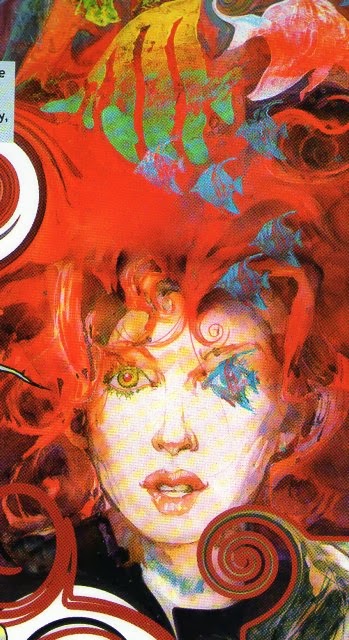
This comic contains a variety of images, mostly abstract. They relate to the text, but rarely clearly, these are not panels containing action, they are images to be interpreted. There is usually an image that could be Despair on the page, sometimes many. The text sometimes describes Despair, the rest of the time it provides a snapshot into the lives of people she has claimed.
A priest being kicked out of the church after an allegation of molesting a young girl years before.
A girl making a list of things that make her happy can only come up with one thing.
A man on disability somehow takes in a horde of stray cats, then locks them in his trailer, then the police come.
A man who secretly collects things from his lover to make a shrine, he watches his lover on TV and imagines meaning that is not there.
A couple enters a suicide pact, but one of them survives and hears the sirens coming.
A man loses his job, pretends to his family that he is still working, starts robbing houses for money and knows the police are asking about him.
A man who raised all the money he could from everyone he knew to get justice for his daughter, finds the legal system has failed him, and knows it has only just begun.
A woman who seemed to have everything ends it all by the side of the road. In the snow she watches them take her body away and waits for happiness.
This is not a story so much as a series of vignettes. It's all abstract, and though some of the writing is clear there is some that is suggestive and what I've written above is my interpretation of some pages, there are others. I expect there's stuff in this I don't get. There is one page which shows Despair, her hands on her face, over the top of this is a sketch of Desire, like something drawn on a mirror.

The art is full of faces, and often female nudes that are, or could be, Despair. There are many different techniques and types of image used and the only thing that unites all of them is that they are not comfortable. I am not surprised that Dave McKean was involved, as the weirdness of composition in a lot of this is characteristic of him.

Delirium: Going Inside
Artist: Bill Sienkiewicz
A catatonic girl is cared for by her mother. A man who sees  conspiracies sees a bird die and follows a dog, writing messages of warning on walls. A woman on the street knows that men have babies really, they stole her babies and her womb and now she is full of lizards. A school janitor, whose mission is to chronicle the Sky-boys to stop them from being stuck in hell, leaves his house before completing his 10 pages for the day, normally he would punish himself but he knows he is needed. A talking dog asks how many they've got so far. A man who sees rainbows after opening all his extra eyes. The catatonic girl rises and leaves home. They all go to an abandoned building. Barnabas asks how many they have Dream (formerly Daniel) says they got 4 or 5, which surprises Barnabas. Matthew, Dream's raven, isn't sure that it will work. Barnabas is unimpressed by their rescue squad, but Dream tells him not to judge them by appearances. Barnabas gives the 5 crazy people a pep talk, telling them to go into the bathroom, find the girl who is hurting and bring her back. Matthew, Barnabas and Dream aren't sure if this will work, but none of them could go in there when she's like that and keep their minds intact. It becomes clear the catatonic girl was raped and went inside herself. The woman with lizards inside her has fish come out of her mouth, the fish lead the way. The man who sees rainbows follows the trail of the fish. The Sky-boys lead the janitor on their mission and they all walk through the bathroom. A shark with one blue eye and one green eye swims towards them. They find Delirium, she went a long way inside because she hurted. They bring her back. Barnabas tells her not to do that again. The catatonic girl's mother called the police, thinking her daughter had been taken. Her daughter walked home, and tells her she's let it go.
In comparison to the previous issue the art and words in this one tell a definite, coherent story. Of course the story is told largely from the point of view of 5 insane people, and the text and images change according to their world views. There are fish throughout, Delirium manifested as singing fish in The Kindly Ones, then later turned her guide into a fish. The most coherent scenes are those with Barnabas, Matthew and Dream, the presence of the new Dream showing this takes place after the Sandman series.

The art in changes for each different point of view. There's a lot of sketches, and impressionistic bits, very little realism. The backgrounds are coherent, because all the images are made of impressions that are overlaid by the various delusions that the characters experience. The angel fish swim across most pages, antagonistic at first until Delirium is restored.

Destruction: On the Peninsula
Artist: Glenn Fabry
Rachel has dreams about disasters, massive disasters, sometimes they creep into her day. She needs a change. She is invited by a friend/colleague/contact to a confidential dig in Sardinia, it is something to do until next semester. There's a hill that wasn't there a year ago and they're digging up pennies minted in the future. It's an excavation of the future, which is why it's so secretive. They go across the bay to drink the cheap, local wine. There are a pair of other tourists there, they've been camping nearby since before the dig began - it's Destruction and Delirium. There was a lot of wine and Rachel sleeps with the guy who invited her along, but she thinks of the red-headed guy she saw at the bar. While she's digging the red-headed guy turns up and helps her remove a device from the rock, she asks him to help out. She finds a load of spent bullets, and one that glows blue. Destruction takes it off her and throws it far out to sea, where it explodes, it was still live. One evening Rachel goes to the camp and finds Delirium, who explains that her brother was asked to watch her as a favour to the rest of the family, because she was sick and shouldn't be on her own. She reckons the hill is there because of them, but it's not the future they're digging up, just a future. She tells Rachel she doesn't know her brother's name anymore, but Rachel can call him Joe. Rachel finds "Joe" and they discuss his sister, who probably got her feelings hurt somehow. Helicopters arrive, men in suits take over the dig and try to detain everyone. Rachel says she has info about the dig ready to go online if she doesn't leave and stop it. She sees Destruction and Delirium from the boat, but when she gets to the bar they aren't there. As she sits drinking the hill explodes cleanly in a single flash of light. She returns to her life and dreams of the man who is not called Joe.
This story follows on from the last, they are the only two in this collection that are connected. Rachel's dreams of mass destruction remind me of something in Fables, where plans to destroy humanity are discussed. Destruction minds Delirium after whatever happened to her, it's suggested that she got her feelings hurt and Rachel assumes it a bad romance, though this isn't confirmed and there are no details.

The art is naturalistic and we are back to pictures in panels with clear page layouts and basic illustration of the story. There's a lot of images of characters and their expressions, and these are clear. The colours are bright, and seem almost bold compared to some of the other issues. The backgrounds are detailed, grounding them in the clutter of the modern setting, or the natural spaces surrounding the dig site.

Destiny: Endless Nights
Artist: Frank Quitely
Destiny walks his garden. He walks past the statues of his siblings. He walks past his gallery, which contains drawings of his siblings. There is a description of his book, which holds everything, and people exist in the pages of his book. There are patterns in his book known only to him. There are galaxies and atoms in his book, he sees little difference between them. One day he will lay down his book and what comes next is unwritten. He walks, with his book, and inside his book is the Universe.

This does not seem like a story, so much as a description of what Destiny is and what he does. There are few words and no panels, everything is a full page of art. The picture of humans standing on Destiny's book is diverse, the animal carcass surrounded by flies is detailed. Destiny and his realm are drawn in fine detail -the grain of wood, the stubble on his chin- though the backgrounds fade into a creamy whiteness. It is short and beautiful.

That's all folks. I hope you've enjoyed it. I feel like I've rediscovered a lot and discovered a few things I hadn't noticed/realised before.

Last week: The Wake

7 October 2013

The Wake

The Sandman graphic novels are intended for mature readers and though this post doesn't go into explicit detail there is discussion of events in the collection, including death and grief. Just so you know.


Chapter One: Which occurs in the wake of what has gone before
Destiny, Despair, Death, Desire and Delirium receive a message and they gather at the Necropolis Litharge. They are treated respectfully by the ruler who opens the gates to the catacombs. Despair has never done this before. The siblings create an envoy, named Eblis O'Shaughnessy to go down to the room and retrieve the book and cloth, for not even Death can enter. In the Dreaming Cain demands that Dream of the Endless restore his brother, Cain's identity as murderer, as part of a duo, is clearly important to him. Dream recreates Abel, and states that he is no longer Morpheus. Matthew grieves and sulks in Eve's cave, refusing to answer the requests of the new Dream and ignoring Eve's attempts to comfort him. Dream recreates Merv Pumpkinhead. Familiar characters fall asleep: Nuala, Rose Walker, Richard Madoc (CalLiope's captor from Dream Country), Hippolyta Hall, Alexander Burgess, Robert 'Hob' Gadling. Dream tries to recreate Gilbert, but Gilbert declines the offer of life. Titania leaves Faerie, Remiel and Duma leave Hell, Bast gathers power and enters the Dreaming. Humans, gods, fairies and others gather. Hob looks as he did when Dream first met him, and angrily disbelieves his old friend is dead. Alex Burgess is a child again. They are all dreaming, "where else should the wake for the dream lord be held". Towering above the mourners the five giant figures of the remaining family loom.
   "If you bring me back to life, my death will have no meaning."
  • Eblis O'Shaughnessy is sent into the catacombs of Litharge to the room found by a young Mistress Veltis in the deeply nested Cerements story in Worlds' End, the font of the Voice is the same
  • As she falls asleep Rose Walker is surrounded by books and holding a skull, no doubt the final effects of Zelda, who died in the previous volume
  • Lyta is looking in a mirror as she goes to sleep, she is often shown in mirrors, only when she's being Daniel's mother is she not shown in reflection
  • As he falls asleep Alex Burgess holds a ring, probably the ring that belonged to Unity, and Rose found and gave to Alex while he was still in a coma

Chapter Two: In Which a Wake is Held
The giant Endless building a huge brick structure. Everyone gathers, including you and the palace staff come down to join the crowd. Dream watches them go, Lucien explains that according to the book of ceremony he cannot attend the wake. Eblish O'Shaughnessy asks Lucien who the lord in white was, and Lucien says he was Dream of the Endless. When asked who, or what, they are mourning Abel explains that the deceased as a point of view. Cain threatens Abel, but Lucien tells him not to kill on that day. Calliope talks about her marriage to Oneiros, the ending of it, and the way he saved her. Matthew is confused by the gathering and distressed to see Merv alive and cheerful. He goes to Dream, who confesses to fear, he is old as time but yet everything is new to him. Nuala sees Cluracan, who denies removing her glamour or telling her a poem. A hooded figure approaches and reveals himself to be Cluracan's nemesis, the one he accidentally created when he visited the Dreaming, it was he that removed Nuala's glamour and inspired her to leave Faerie. Queen Titiania speaks briefly of the Lord Shaper. Dream tells Matthew that when he was still little Daniel he saved the raven from the Corinthian by distracting him. Matthew is still not accepting of the new Dream and asks about his options. Matthew encounters the gatekeepers, include the gryphon, but this gryphon was not resurrected, he is a champion sent from another land. Rose Walker, and her brother Jed, encounter a grim Lyta Hall, Jed tells Rose that she and her husband used to live in his head. Matthew speaks to Lucien and Eve, still figuring things out. Matthew reckons Morpheus let it happen and Lucien insightfully points out that he did more than that. Thessaly describes her relationship with Morpheus and its ending. Matthew encounters the Endless (now in scale with everyone else), Barnabas and Eblis O'Shaughnessy just before the ceremony. Death is wearing red, just for that day.
      "I think... sometimes, perhaps, one must change or die. And, in the end, there were, perhaps, limits to how much he could let himself change."

  • Two human dreamers talk, they seem to be the people who were serving food at the banquet in Season of Mists
  • Dream's former lovers speak of him -Calliope, Thessaly, Titania (whose relationship with him was a source of rumour)- standing near them is a Chinese child, is this Nada in her current form?
  • Mad Hettie, who has appeared only once in Sandman, but is in the Death miniseries and (I assume) other DC works, delivers a speech
  • Rose Walker joins her brother Jed who is older and looks a lot like Shaggy from Scooby-Doo now (is this a phase younger brothers go through?) Rose doesn't know Carla died
  • Lucien is drinking with an old friend who is the Indian gentleman from the sea story in Worlds' End, he was a king and became an immortal
  • Clark Kent, Batman and the Martian Manhunter chat, as do three guys in trench coats, one of whom is John Constantine
  • Jed tells Rose Lyta and her husband used to live in his head, so Jed (or his dreams) was kinda the gestational environment for the new Dream

Chapter Three: In Which We Wake
More people than can be perceived enter an enormous mausoleum. Eblis O'Shaughnessy takes his part in the ceremony. Destiny speaks, then Bast, then Desire. At the castle Dream strokes the new gryphon and the hippogriff. The hippogriff explains that this Dream is different to the old one already. A traveller approaches and Dream invites him into the kitchens for refreshment. He recognises the traveller as Destruction, who won't go to the ceremony but wanted to offer the new Dream some advice. At the ceremony Despair speaks, so does Wesley Dodds (the original DC Sandman superhero), the angel Duma sheds a tear, and Delirium speaks. Destruction tells his new brother that he could leave, Dream declines but thanks him for all his advice. Destruction says it's best not to tell the others he was there, but suspects they'll meet again. Matthew speaks at the ceremony, and so do many, many others. The mausoleum is a bridge -because this is a dream- and Death, in her red dress, speaks and gives everyone peace and meaning. The bier is on a boat now and travels down a black river. A small Chinese boy throws blue roses into the water and the boat falls off the river and down into a sky where it becomes a huge star. The ceremony over people return, gradually. Lyta appears in the throne room and tells Dream/Daniel that she did everything for him. Dream tells her that he is not Daniel and that she has lost her son forever, he explains that grim fate of the man who murdered the first Despair, says her crime was worse but marks her as under his protection. Matthew tells Dream his family are waiting to meet him and offers to stick around and help for a while. They encounter Alex Burgess as a lost child and send him back to himself. Alex wakes to see Paul who has just returned from a funeral, probably for Jack Holdaway. People wake as the Endless siblings chat about meeting their new brother. Despair reveals how scared she was in the same situation and resolves to be good to this one, though Desire is more grudging. Dream opens the door to meet his siblings. You wake up.
 "You can't kill dreams. Not really."


The Wake: An Epilogue Sunday Mourning
White, Englishman Robbie Gadling is taken to a Renaissance Fair by his Black, American girlfriend Guenevere. He is not looking forward to it and moans about how historically inaccurate it all is. Gwen ignores his moodiness and refuses to believe him when he tells her Catherine of Aragorn was black. Despite his grumpiness it's clear he really cares foe Gwen. She tells him a book-binder at the fair wants to meet him because there were a few long-ago Robert Gadlings, one was a book-binder. Robbie talks about how one was a slaver, gets really guilty and apologises about slavery, describing it in terrible detail. Gwen reassures him that he's not responsible and calls him out on his white guilt, she thinks it's crazy he's taking it so personally, and correct guesses she is the first black woman he's dated. Robbie explains that he didn't used to think slavery was so bad until a now-dead friend of his put him right. Gwen comments that he has so many dead friends she first assumed he was gay. Robbie visits the book-binder, and sees a book he made. Feeling morbid he goes to the pub and pays to the waitress to bring him a lot of beer without any fake English accents or pseudo-olde-worlde speak. Whilst drunk he goes into a condemned building and chats with a woman who tells him she is Dream's sister, and he realises is Death. She offers to take him, but he refuses. Gwen finds him asleep after the fair and is amused that he talks as though he was actually there in the past. He falls asleep under a tree while Gwen and her Renaissance Fair friends drink and talk in modern clothes. Hob dreams of Morpheus and a friendly-but-crap pavement artist he once met (Destruction) walking happily into the end of the story. He tells Gwen about it as they drive away.
"Trust me, If Catherine of Aragon had been in Alabama in the 1950's they'd have made her ride in the back of the bus."

Exiles
Master Li, an old man who has advised two emperors, is crossing the desert to the village of Wei, he is to be prefect in the farthest outpost of the Empire. He has been exiled by the Emperor because his son got involved in forbidden magic. On his journey he picks up a small, white kitten, it is foolish as the desert is harsh and there is little enough for him and his groom. On the journey he composes letters in his mind and reminisces. After being blinded by sand he finds himself alone, he encounters his son, who was killed for his studies into the magical art. Master Li berates his son then turns his back on him to follow the white kitten to a tent. In the tent he encounters a lord, who speaks to the kitten and describes the desert as a soft place on the edge of the Dreaming, he claims to be from hundreds of years away from Master Li's time. He gives Master Li a cup of wine he has been dreaming of and asks him about grieving for dead sons. Master Li delivers his thoughts then follows the kitten through the sands, past strange things he does not recognise. After using dream-logic to make a bridge over a chasm he and the kitten approach a familiar tent. Outside is a young lord, he looks like the brother of the previous lord, but he tells Master Li that that was him a long time ago. A group of riders approach the young lord and ask how to leave the desert and what will happen to them, the young lord permits then to leave but provides no explanation. The young lord speaks to Master Li of opening cages, of tools being subtle traps, and he asks Master Li to come to his castle and advise him. Master Li is honoured but will do as he was commanded and go into his exile. The young lord accepts this but tells him that he can send a message via the kitten if he changes his mind. Master Li is woken by the kitten biting his hand, his cry attracts the groom, who had thought him lost.
"Everything changes, but nothing is truly lost."

  • Morpheus asks Master Li a hypothetical question that is clearly about his reaction to Orpheus's death, it is not clear at what point in Morpheus's timeline/the series aster Li encounters him
  • New Dream tells Master Li about traps, especially those we make ourselves while feigning ignorance  and says he knows he must destroy the emerald one day, he is clearly reluctant, but at least he knows he must do it
  • "Tools, of course, can be the subtlest of traps" this is a line from the prologue prose section in The Doll's House, suddenly I wonder if Daniel is narrating that section as there is clearly a narrative voice

The Tempest
In 1610 William Shakespeare writes a play about a shipwreck at home in Stratford, and is questioned by his daughter Judith, who is on the brink of becoming an old maid. His wife Anne has little use for him writing plays and filling Judith's head with silliness while there are chores to be done. It seems that when Anne was Judith's age she got herself pregnant and Will had to marry her, there is something like affection between them despite their differences. He goes to the local inn, where two wet sailors are charging the locals to take a peek at the corpse of an Indian. As he is writing The Tempest, Will is visited by his London friend Ben Jonson, and they discuss writing and religion. Ben has experienced a lot more than Will and believes this makes him a better writer. The discuss the attempt to blow up King and Parliament by a group of misguided Catholics, and together compose a rhyme to mark the bonfire celebrations. Judith is being courted by a local lad Will doesn't much like, and Judith tells him how much she and the family missed him when she was young and he was in London. Going over his old plays Will sees his shadowy patron and explains the practical artifice behind the art of his plays. In winter he speaks to a member of the clergy about what to do if a man were to bargain with dark powers, how might that man save his soul? The answer is to abandon magic and renounce it. One completing the Tempest Will is visited by Dream, their deal is concluded, Will has written 2 plays glorifying dreams at either end of his career. He insists on having a drink in Dream's parlor, and talks of how much of himself he sees in his plays and how he has changed over the years. Drinking in Dream's throne room Will asks what would have happened if he had not struck that bargain, Morpheus says that he would have written less, probably gone to Stratford and become a school master. Will describes watching his own life even as he lived it and using it for material.Morpheus says he wanted a play of graceful ends, of a magician who turns his back on magic. Will wakes, writes the epilogue, and it is done.
"I am Prince of stories Will; but I have no story of my own. Nor shall I ever."
  • That quote from Morpheus at the end is clearly what he believes and just as clearly nonsense, or what else have we been reading?


Art
The first 4 issues are pencilled by Michael Zulli and colored by Danny Vozzo, in complete contrast to The Kindly Ones the images are done with a lot of fine detail, subtle and naturalistic colouring and shading. There is a richness to the art, although it does mean that many of the characters who have appeared in previous volumes are harder to recognise being drawn so differently. However this is part of how comics work, different artist's have different styles and so it is the attributes we look for rather than the specific likeness; Lyta's white hair, the superhero's costume, Thor's hammer, Herakles' lionskin - this way of looking at art has been going on a really long time.
The detailed drawing style works well for the funerary issues, where there is formality and ceremony, as well as partying and a huge host of weird beings. The style also works for Sunday Mourning, a far more mundane setting full of humans. What's interesting is that the fineness of the art, and that fact that what we are viewing is a picture same as the other pictures we've seen, makes the Renaissance Fair costumes look as authentic as the scenes in the series that were actually set in the past. We know the Fair is full of fakery, but that fakery isn't shown in the drawings it's in Hob's reaction to it. That's another thing about art, everything in a picture can have the same level of reality, it depends on how the artist shows it.

Exiles is rather beautiful, mostly black and white, ink and paper, with colour having all the more emphasis when it appears. Inked and colored by John J. Muth it has no pencils, that would go against the Eastern aesthetic. It is interesting that here Morpheus' speech is not indicted in it's usual heavy white-on-black word balloon, possibly the only place in the series where this happens. Instead he and Daniel speak in the same font, black-on-white or white-on-black depending on the background colour.

The Tempest is pencilled by Charles Vess, Bryan Talbot, John Ridgway and Michael Zulli, inked by Vess and coloured by Danny Vozzo. Charles Vess is the artist of the previous Shakespeare issue, A Midsummer Night's Dream, which appeared in Dream Country, so it is fitting that he returns. In this issue there are levels of reality, of course the historical sections are real -for all that this is fiction and imagined by Gaiman- or exist in a real time and place, Stratford-upon-Avon in 1610. The sections in Dream's castle are real as far as the series is concerned, and real to Will, but could also be described as a dream (though of course the series teaches us that dreams aren't the same as the not-real). Then there are the scenes from the Tempest, clearly Will's imagination, these panels are done by Vess. These could be said to be the least real, and yet it is clear that Will's work, the products of his imagination, are real to him, perhaps realer than the world he actually occupies.


Last week: The Kindly Ones
Next week: Endless Nights