30 May 2014

The Hunted

Episode: s3, ep11

Imagine if Captain America was sent to prison. In Space!

What Happens
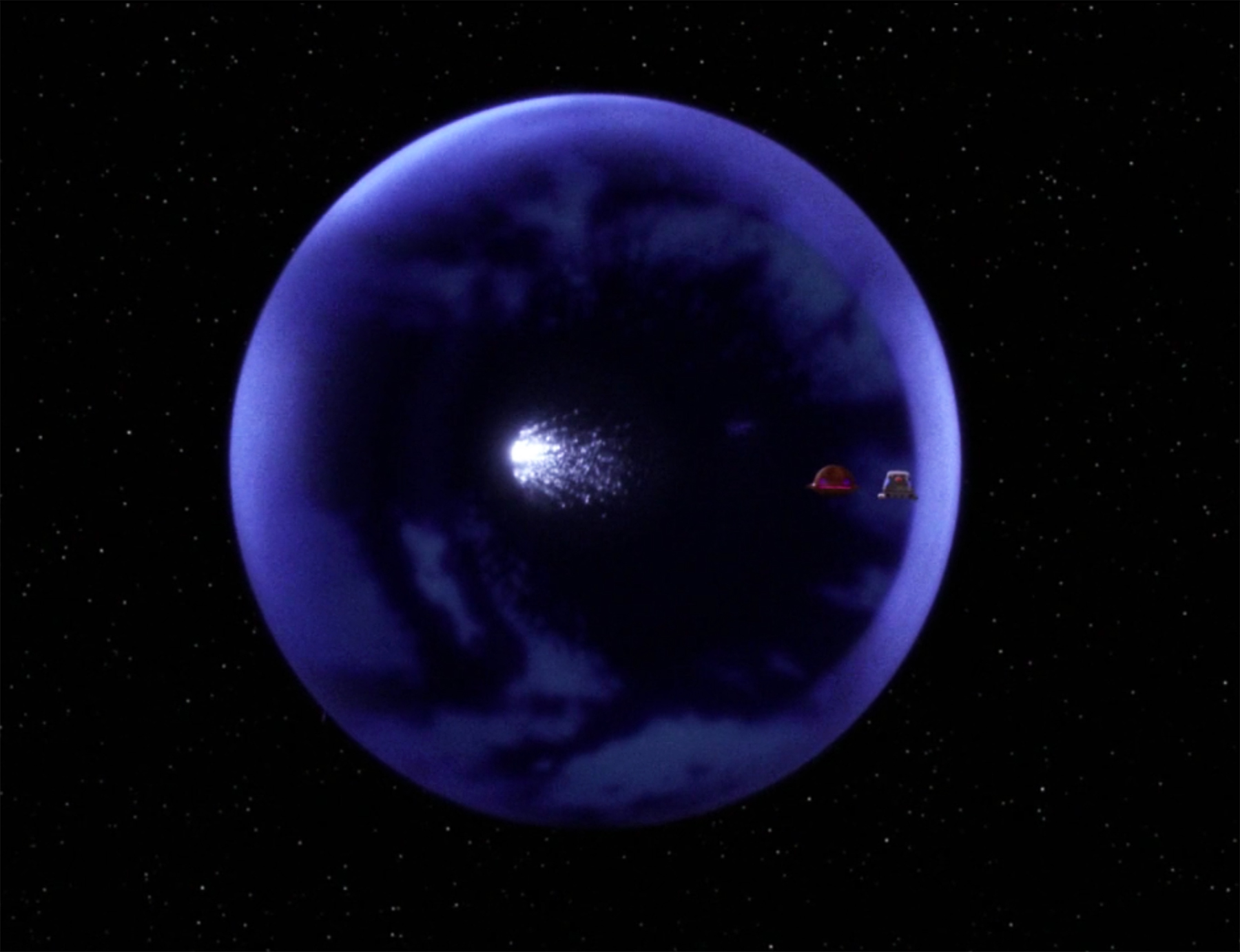
The Enterprise visits a planet applying for entry to the Federation, the society successfully rebuilt itself after a terrible war. A violent prisoner escapes from a lunar colony and the Prime Minister asks if the Enterprise will intercept him. It should be easy, but the prisoner cleverly uses an asteroid and the magnetic field around the pole to evade detection. Data figures out what he's up to and he's beamed on board from an escape pod. The fugitive viciously attacks security and Worf has to restrain him. He's taken to the highest security cell. The PM says the prisoner is incredibly violent and suggests he is sedated until they can fetch him. He is somehow able to mask his lifesigns, so sensors can't detect him. Troi senses the nightmares of the prisoner and goes to see him. They have an odd conversation and he states that he killed 3 men to escape, but Troi is convinced that despite his actions he is not really a violent man. Troi and Data check the records the planet gave them as part of their application, the prisoner has no criminal record and he was a decorated soldier.
Troi's research and conversations with the prisoner reveal that he enlisted during the war. He and other volunteers were altered to become super-soldiers. They're normal until the programming kicks in, then they will ruthlessly fight any perceived threat. When the war ended they did not fit into peaceful society and were ordered to the lunar prison and left. Data talks to the prisoner about being programmed and whether it can be reversed or changed. Picard speaks to the PM, who claims the prisoner told them half-truths and refuses to discuss the matter, saying it's internal business. Picard tells the prisoner he has no right to keep him from the authorities, and the prisoner warns that he will do whatever is necessary to escape.
The prisoner somehow resists being transported and escapes with a phaser. He escapes and roams the ship, getting into tubes that belong to some guy called Jeffery, which are the starship equivalent of vents (he's in the vents!). He takes out security teams and causes distractions by setting phasers to explode, it looks as though he's heading for a shuttle. He seems to be trapped in a cargo bay, Picard orders gas to be pumped in. When Worf goes to retrieve him it looks as though the prisoner has stolen a space suit and gone outside. While attention is focused on the shuttle bays the prisoner, unaffected by the gas, beams away using a cargo transporter.
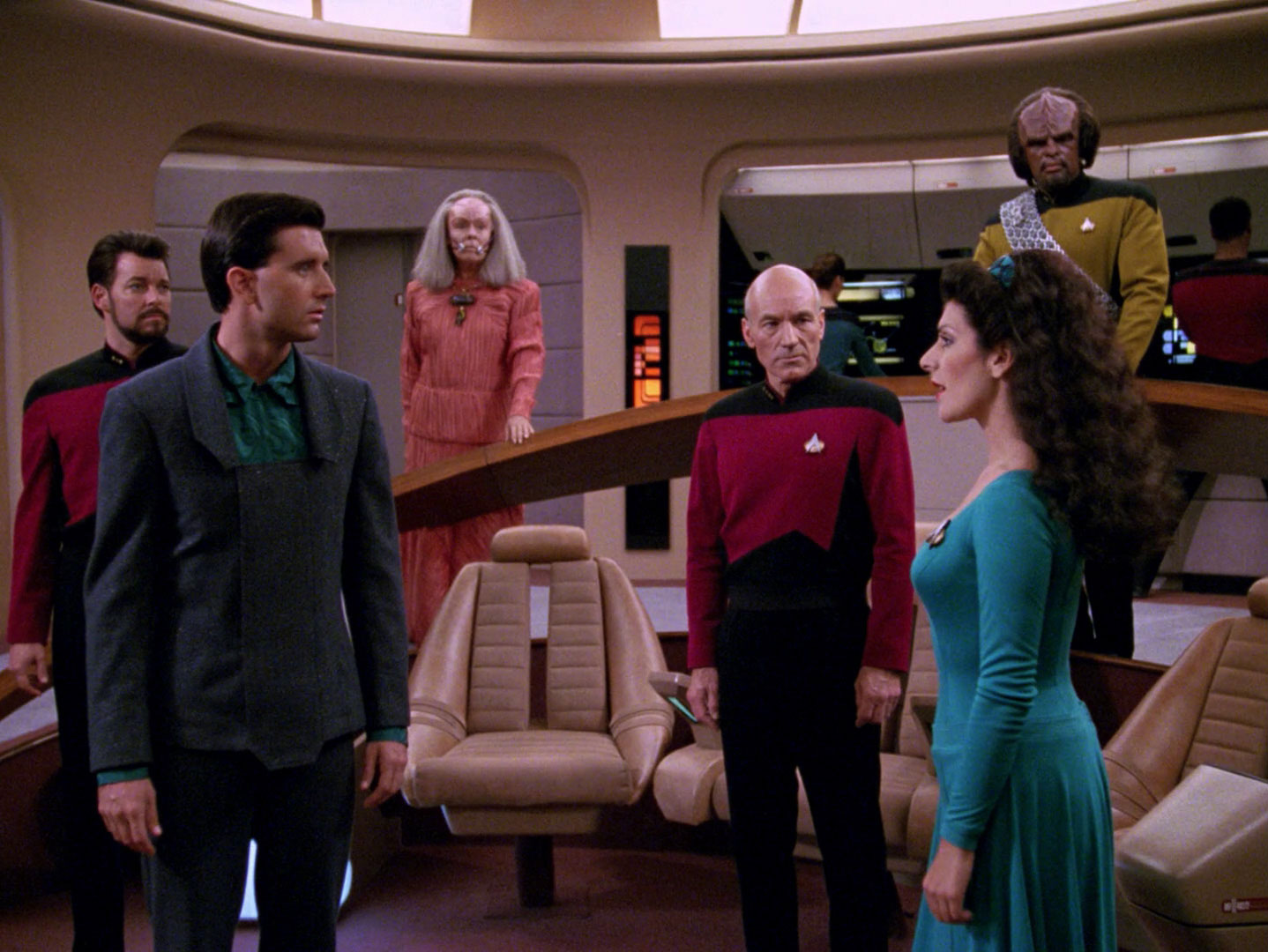
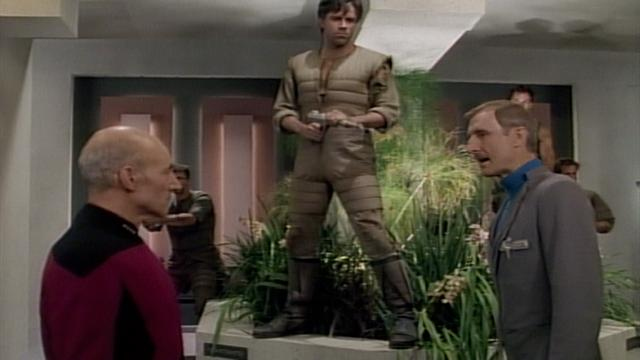
Prime Minister Hoggett calls to say the prisoner attacked the penal colony and released other prisoners who are now on the planet and heading to the capital. Their people are not equipped to deal with violence, that's what they programmed these soldiers for. Picard agrees to come and takes Data, Worf and Troi. Riker tells Worf that he is personally responsible for the Captain's safety. The PM is shocked by the small away team, government officials are nervously being given weapons. The away team tell the PM it's his responsibility for making the soldiers what they are, and ask if the process can be reversed, it's clear that hasn't really been tried. The soldiers burst in and surround the frightened officials. Picard tells everyone to remain calm; the soldiers are only conditioned to kill if they're threatened. The soldiers demand to go home, they refuse to be imprisoned anymore. The PM tells Picard to do something, and Picard says the only thing he can do is leave, this is internal business after all. Picard suggests that their society is likely to change rapidly in the next few minutes, and when that's settled they can reapply for Federation entry.

That'll do super-soldiers, that'll do.
Guest Star
It's Farmer Hoggett! I mean Zephram Cochrane, inventor of the first human warp drive. Er, I mean actor James Cromwell plays the Prime Minister.

Oh Captain My Captain
Picard likes the planet, they are rational folk who go on about intellect, which Riker finds a bit stuffy. I think Picard sees himself as something of an academic, and fancies the idea of a life of the mind. However if he actually lived such a life he would probably miss the excitement of being a starship captain. Picard is happy to help when the PM asks them to detain an escaped prisoner, seems easy enough.
Despite being inclined to like the people Picard trusts his staff -especially Troi- in their judgement about the prisoner. When the PM refuses to discuss the soldiers who were modified in the war Picard wisely says "Matter for internal security. The age-old cry of the oppressor." It's a difficult sentiment to argue with.
Picard personally tells the prisoner that they have to return him to his own people, showing an appreciated level of respect. Despite Picard's obvious disapproval of this particular aspect of their culture, the PM contacts the Enterprise to help them when the escaped soldiers go to the capital. Picard realises that the situation with the soldiers needs to be resolved and the best thing he can do is nothing.

Does Not Compute
When the sensors can't pick up the prisoner's life signs Picard suggests he's an android and Data points out the sensors can detect artificial life. I expect I imagined the disgruntled note in Data's voice, but seriously if anyone is going to account for an android it's Data.
On learning that the prisoner has been programmed Data talks to him about that. The prisoner is one of the first people in the series not to realise what Data is straight away. Though are yellow eyes so unknown in all of the humanoid species that the prisoner feels the need to ask about that? During their conversation Data reveals that he's been programmed with military strategy, which was how he was able to catch the fugitive, but that he is not programmed to kill. I wondered if Data is Three Laws compliant? Then realised he wasn't. I don't think he's ever harmed a human, but I do think that he has by inaction allowed a human to come to harm. Does not being programmed to kill mean Data can't? Is his phaser always set to stun? I suppose we don't really know what Data can do until he does it, so perhaps he could kill but his programming discourages it? It's probably best to discourage death-as-a-solution in a being that has no feelings and would therefore feel no regret.
Besides if you were creating an android for combat you would totally put weapons in there somewhere, like maybe laser-eyes. Data doesn't have anything cool like that.

Klingon Warrior
Worf is the best at tracking the escaped prisoner through the ship and scuffles with him a couple of times. When the prisoner's cunning is revealed Worf wonders if he has Klingon blood. I'm never sure if Klingons are supposed to be cunning, or if they're supposed to be straightforward. This guy is actively avoiding combat, which seems distinctly un-Klingon and in a previous episode Worf claimed that Klingons don't bluff. So are they master strategists keen to get the upper hand in a situation, or are they warriors who like the simplicity of direct confrontation? The show can't seem to decide, but hey maybe Klingons are in fact people who have a variety of different traits.

Counsellor Pointless
Troi senses the nightmare of the prisoner, it's strong and strange enough for her to go and see him. He's understandably suspicious of her; the people who altered him were also called counsellors. He plays mind games and is very angry, but that's no surprise. In these interactions Troi realises that her sense of him is entirely at odds with what the PM said and with what he has done. Her insistence leads to the prisoner revealing what was done to him. In a staff meeting Troi insists that he is not inherently violent and that he doesn't demonstrate what would be found in a criminal personality.
I don't consider violence or criminality to be inherent, it strikes me as a dangerous idea. But if they are, what happens (or should happen) to those who do have those qualities? The prisoner admits to violence and murder, but yet something about him means that Troi can't believe his crimes. The outcome seems to be that he should be judged on his personality rather than his actions. This seems like an attitude that should be explored, but it isn't. I suspect Troi's lines aren't meant to carry the weight that they do. Then again she says 'inherent' twice in a few lines, and that feels at odds with what I thought the message of the programme was.

Poor O'Brien
When transporting the fleeing prisoner from his escape pod the transporters are able to disable his weapon, but he still takes out the 2-man security team sent to fetch him. When O'Brien tries to get him into a headlock he is attacked and stunned with a stolen phaser.


Staff Meetings: 1
1. Troi explains that the prisoner was an ordinary man who volunteered to fight in the war, but wasn't told what that would mean. At Troi's request Crusher has examined the prisoner and found that he has been altered physically and chemically as well as psychologically, which is why his life signs can't be detected. His own government altered him and other volunteers to make them perfect soldiers, including programming them to survive at all costs and attack whenever a threat is perceived. After the war he was sent to the lunar colony with his comrades, they couldn't be safely reintegrated into society. Apparently no one tried to reverse the alterations

Security Breach
Someone besides Worf emphasises that high security needed, and that's accepted for the most part. The guy's lifesigns are masked, so the Computer and sensors can't track him, making him a greater threat than most visitors. They don't go as far as sedating the guy, as the PM advised. Worf gets to be suitably suspicious and sticks security teams anywhere the prisoner is going. If only that had been enough. It's like these guys aren't used to people attacking and trying to get away from them.
The most secure cell on the Enterprise doesn't look so bad. There's a supply of water and a sink and mirror. I get the feeling they aren't concerned about suicides.
The prisoner manages to take out Geordi and the rest of Engineering single-handed. I guess that the crew in that area don't have weapons, even after the events of Heart of Glory.

The End
Picard returns to the Enterprise and tells Riker to update the report to say that if the government survives the night the Federation will help them reprogramme their veterans. Picard seems confident they will choose to survive and orders Wesley to take the ship away.

24 May 2014

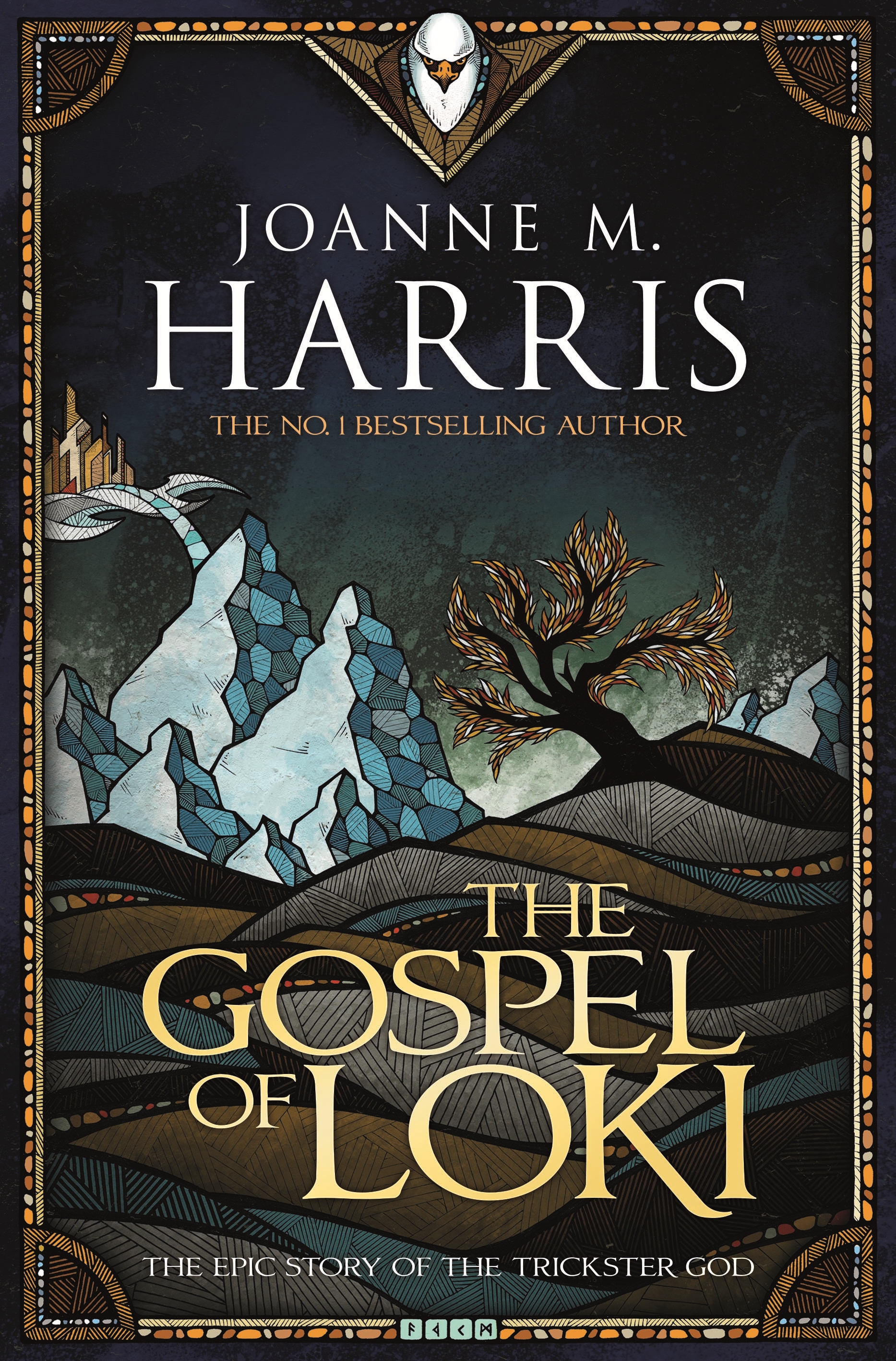
The Gospel of Loki

The Gospel of Loki
by Joanne M. Harris


In this book Joanne Harris (with added M) retells various Norse myths from the viewpoint of the much-maligned trickster Loki. It goes from the creation of existence (which Loki did not personally witness), to Loki leaving chaos, coming to Asgard and his various tricks and adventures there, through to ragnarok. Loki narrates the whole thing in first person with his own acerbic, personal take on things in a modern voice. This isn't a comprehensive retelling of Norse myths, but it sets up the world of Norse myths and deals with the bulk of those stories that involve Loki


I was expecting something a bit more revisionist than what I got. At the start of the book the suggestion is that we've all heard is the official version, whereas Loki is going to tell us the truth, or at least his version. The book is a retelling of Norse myths, with the spaces in between vaguely filled in with the prose equivalent of pages flipping off a calendar to mark the passage of time. Loki skips over the boring periods of his time in Asgard, which is fair enough. Even interesting bits (like him giving birth to an 8-legged horse) are skipped over. It felt as though if it wasn't in Norse myth, then Harris isn't interested in talking about it.* There's no suggestion of Loki doing things differently to what the myths say he does, or of the stories being purposefully manipulated by Odin. The real change is the tone, going from the usual serious, epic legends, to some guy talking conversationally about his life. I kept expecting a twist or trick, which didn't come.

I found it amusing that although the entire book takes place within the context of Norse legend, there's a modern feel to the sense of humour and the way Loki narrates. For example his wife is described as wearing aprons and making a lot of sponge cake. There's no sense that the narrative voice feels it's necessary to keep to period appropriate language or imagery, meaning that the legends feel removed from time and space, which I assume is purposeful. However this approach made me think that the story was going to extend into modern times, with updated/modern-dress versions of Norse myths going on in the present day. Or perhaps a here's-what-happened-next type of story. So I was a little  disappointed to find that all trips to Midgard, even in the late stages of the book, seemed to be early-medieval Scandinavia. Again I think I had different expectations of what the book would be.

The voice of Loki was entertaining, there are a lot of cynical and amusing asides that are highlighted in each chapter heading. However Loki was not written to be likeable. In fact once I stopped reading I realised that far from setting out his own point of view and explaining why his motivations might be different or alien to the usual narrative, he was mostly whining. The fact that the story doesn't deviate from the myths that have been handed down to us** means that Loki does a lot of bad stuff. His main motivation for any/all of it seems to be that no one liked him, that he's chaos and so it's in his nature, everyone refused to acknowledge how great he was because he was different, so it's not his fault. If you think these sound like the excuses of a child, or very self-involved adult, you'd be right. There are times when Loki clearly realises, as he's telling his story, that he did stuff that was foolish or rash or plain wrong, but he always finds a reason why we shouldn't blame him. I am entirely convinced that this was intentional on Harris's part, and she trod the line well, making Loki unlikeable but still interesting and amusing.

I do not know Norse myths as well as I know Greek ones, but I've read various bits and pieces in the past. I think there was a roughly 60/40 split between stories I already knew and ones I'd not heard before. I'd never had much direct information about Ragnarok before, I knew it was all about prophecies, and there are references to it in various other things I've read, but this is the first time I've seen it described. I thought it was meant to be the end of the world, but I'm not sure it's that clear cut and I was interested to hear about it.

If you are expecting anything like Marvel's The Mighty Thor, don't. Marvel have always taken huge liberties with the source material. If you are expecting something like what you read in a children's collection of Norse myths, that's pretty much correct. Joanne M Harris has made it all sound a lot less educational and a lot more entertaining and fun.


For a fantastical and modern(ish) version of Norse myth try Eight Days of Luke by Diana Wynne Jones. It's children's book first published in 1975, but it really works.


* I could be wrong here, as I said I'm not familiar with all of Norse myth, but it didn't feel like there was much that stepped outside of the collected myths I'm aware of. My husband knows more about Norse myths, and he thought roughly the same thing, though he didn't read the entire books.

** The Norse myths that we have are largely from post-Christian sources, meaning that the earlier pagan beliefs may well have been altered by time or design - but that's a different topic and not addressed in this book other than occasional lines that equate Loki with Lucifer.

21 May 2014

The Amazing Spider-man 2


The Amazing Spider-man 2 opens, as the first did, with the events surrounding the flight of Richard and Mary Parker. This time we see things from a different viewpoint as Richard has to destroy his research, before recording a video about it then dropping young Peter off with May and Ben. This time we see why Ma and Pa Parker never return, though the secret they are protecting is not entirely lost. Then we cut to Spider-man and his present-day adventures. Peter Parker and Gwen Stacey are having an on-and-off relationship, mostly due to Peter apparently guilt-dumping her on a regular basis. Electro turns out to be a really sad-sack version of Syndrome (from the Incredibles) who goes crazy with power. Harry Osborne returns to New York in time for his father's deathbed scene, and is reunited with childhood friend Peter. Then he finds out more about his friend and the projects his dad had in the basement. The Rhino also turns up a bit.

There are mild spoilers for Amazing Spider-man 2 (and mention of Iron Man and Man of Steel, because comparisons).

I liked the character of Spidey more in these films than the Raimi ones, as I said when I reviewed The Amazing Spider-man 1. We still never really see Peter and Gwen having a normal relationship, there's clearly been, and continues to be, a fair bit of breaking up and getting back together. Saying that I really liked the way Gwen handled things in this film. She takes action to protect herself emotionally, makes advances in her scientific career, doesn't let Peter push her to one side for her own safety. In fact at one point she yells at him that it is her choice whether she endangers herself for him. Something that has been sorely lacking from traditional superheroic relationships. I also liked the uneasy relationship between Peter and Aunt May. Both are grieving for Ben, and both are keeping secrets from the other. I liked this because Aunt May clearly has her own life and her own things going on, plus she feels protective of Peter when it comes to his parents. After all she's the one who stuck around and raised him.

Ah yes, Spider-man's daddy issues. Those are back. In fact there's a plotline with Peter finding out yet more about what his father was working on and how that affects events now. Not much was done with the info discovered in this film, the focus at the end being on fighting the villains, but I feel that a picture is slowly being built across the franchise. Though as Aunt May asks, why does Peter still idolise the father who abandoned him? I concur, and have to ask, what about his mother? Mary Parker also left her son in order to help her scientist husband with his great work, but there's little sign Peter is bothered about her absence or reputation. I can't help but draw parallels with Lara-el (Superman's mother) from Man of Steel. She too endangered herself to help further her scientists husband's work, painfully giving birth to their son (which was a weird thing to in their culture) and she didn't get any holographic life-after-death like Jor-el. Still at least Supes and Spidey have mothers. Much like fellow billionaire-tech-brat Tony Stark in the MCU, Harry Osborne apparently doesn't have a mother. There's some talk between Peter and Harry about how they bonded as children in grief, suggesting Harry's unnamed mother died, which is more mention than Ma Stark has ever gotten.* The eventual fate of Harry holds up a dark mirror up to Tony Stark, and both own similar looking buildings with their names on.

There were lots of little things in the film that worked quite nicely, comedic moments and stuff that gains significance later. For example Spidey saves a small boy from bullies and later the kid's faith in Spidey makes him magically appear (OK, it doesn't, but that's kinda what it seemed like). Peter desperately offers to do laundry in order to hide the Spidey suit and Aunt May does the same to hide her nursing scrubs. Gwen slapping her hand over her mouth after shouting "Peter!" at Spidey when he races off in the middle of an argument. It's just such a natural thing for her to do. A brief email from the still-unseen JJ Jameson. I also found it amusing that when Gwen is going to an interview for Oxford University (which aparently has an embassy in New York?) Peter is entirely unable to talk normally to British people. Made all the funnier because Andrew Garfield is British.

The main issues with the film were perhaps in the villains. I could see very quickly what Electro's story-arc would be and it was predictable as it was diminishing to the character. The Goblin was alright, but like Electro he went eveil really quickly for no particularly good reason. The Rhino is introduced but little used, but at least his motives were clear and made sense. The fights looked impressive and had actual damage and weight to them, without being ridiculous slug-fests full of destruction, of course Spidey is a smaller scale hero when it comes to that sort of thing.


* For all the info the MCU gives us Tony Stark could have gestated in the thigh of his father, a la Dionysus.
What's more likely is that Howard Stark was an older father (based on the timeline I quickly figured out in my head while watching Captain America), and as all good fictional millionaires are also playboys (because reasons) it's likely that Tony's mother wasn't even a Stark. Though respectability politics will presumably disallow this too, meaning Ma Stark is conveniently gone and entirely forgotten.

18 May 2014

The Defector

Episode: s3, ep 10

This episode was good and surprised me and the ending was appropriate to the tone. Things are looking up.

What Happens
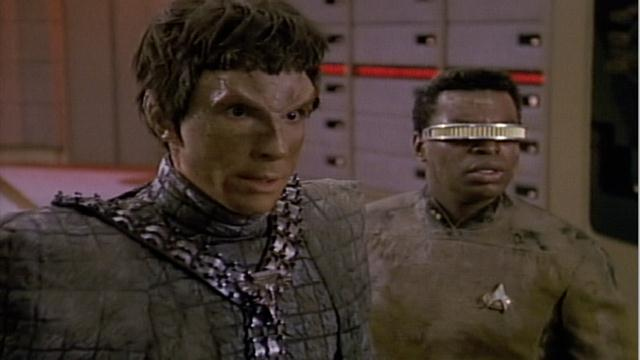
Data performs lines from Henry V (or so the internet tells me) in full costume, in the holodeck, while watched by Picard. It's part of his becoming-human project. Riker calls them to the Bridge. A Romulan scout ship is racing through the Neutral Zone, chased by a Romulan warbird. The Scout sends a distress message and the Enterprise moves to intercept it at the border. When challenged about entering Federation space the warbird turns and leaves without response. The injured Romulan from the scout ship is beamed aboard and says he has vital info. He's a low-level logistics officer defecting to the Federation with news of a secret Romulan invasion force massing in the Neutral Zone. The senior staff are suspicious of the whole thing, especially after his ship explodes, which he claims is standard procedure. He wants them to stop the invasion, but he won't sell his people out. When he's alone he pulls an orange disc from his boot, the music suggests it's suspicious.
Star Fleet tell Picard the Romulans are angry and they've convened an Emergency Council, but it'll be Picard's decision about whether to take action. He could be preventing or starting a war. Troi and Riker interrogate the defector, who is frustrated by the lack of action and won't give them extra info. Geordi tries to detect if there's any sign of a secret fleet, its not clear. He explains gut feelings to Data. Data talks to the Romulan, who wistfully describes home and all he's sacrificed. Data shows him a holodeck recreation of Romulus, which prompts the defector to reveal that he's actually an Admiral. He demands to see Picard.
Star Fleet confirms the Admiral's identity, they don't trust him either. Picard questions him and demands evidence. The Admiral had a daughter recently, made him rethink war and the future of the Romulan Empire. He became unpopular by trying to push for less aggression and was posted to a distant command. When he saw information about the secret fleet he knew he could only prevent war by warning the Federation. He doesn't want to be a traitor, he just wants peace. Picard pushes him until he agrees to give them whatever they want.
Picard orders the Enterprise into the Neutral Zone, breaching the treaty. (They've breached it before, but this has greater weight.) At the planet there's no sign of any fleet and the Admiral is brought to explain. He can't believe it, he saw the paperwork. Picard suggsets he was fed bad intelligence. Just as they're about to leave two warbirds de-cloak and they are hailed by Tomalak, the Romulan Captain from The Enemy. He is smugger than ever, it was all a trap. News that his sacrifice was in vain breaks the Admiral. Tomalak demands they surrender as POWs. Picard refuses and 2 Klingon birds of prey de-cloak, with weapons pointing at the Romulans. Tomalak is bitterly forced to let them go.


Guest Star
Andreas Katsulas, G'Kar from Babylon 5, returns as the Romulan Captain, Tomalak. Last seen two episodes ago in The Enemy.


One of the two holo-Shakespearean guys, who perform with Data in the first scene, is played by Patrick Stewart. He's using his Yorkshire accent and wearing a wig, beard, make up and costume. If you're going to have lines from Shakespeare in the episode you might as well use your Shakespearean actor.

Oh Captain My Captain
Picard believes Shakespeare will help Data learn about humanity. Data does well but Picard lightly rebukes him for wanting to imitate well known performers, the point is that he should make it his own. Picard is happy with his progress, but not ready for him to perform in front of the crew yet.
Picard's communications with Star Fleet are pre-recorded messages with a 2 hour time-delay, even though in other episodes there are live conversations. Is that a sign of how far they are from Star Fleet? Picard is told that the decision to act against the Romulans will ultimately fall to him. Picard asks Data about the disposition of the crew and points out that unlike King Henry he cannot easily walk unknown amongst them. He quotes a line from Henry V about the King's responsibility if his men die in a bad cause.
After the Admiral has admitted his true identity Picard and Star Fleet are still not convinced of his honesty. Picard grills the Admiral forcefully, making him explain his situation and his motive. The Admiral suggests that Picard has sacrificed family for his career, and he couldn't possibly understand because he's not a parent. (He doesn't say it like that, but it's kinda what he means.) Picard refuses to act unless the Admiral fully sells out his people, it clearly breaks him a bit. It seems pretty harsh, but Picard has little reason to trust him and much reason to be wary.

Does Not Compute
It seems Data needs little prompting to get into costume. It's pretty funny to see him take the wig off as he and Picard go through the corridors. Data asks why the King would disguise himself and talk to commoners when he should be leading. Picard says that Shakespeare is telling the audience that the king has feeling for his men and he wants to share their fears, but cannot do so publicly. Picard later asks Data to keep a record of all that happens, because he isn't human and therefore can be objective about events. There's a sense of him wanting a record for history.
Geordi discusses gut feelings with Data, who doesn't understand how humans can feel their way to making decisions. Geordi has some difficulty explaining the concept, but Data seems to grasp that the unknown is filled in by the individual's personality and instinct. It is interesting that Geordi's gut feeling -that the Romulans are up to something- proves wrong. Of course this may be him picking up that the Admiral truly believed what he was saying, and/or based on his opinion of Romulans.
Data stares at the Romulan as he sits in 10 Forward, in an attempt to develop a gut feeling. The Romulan knows Data is an android - people always seem to know, even though androids are supposedly super rare, even people who don't understand androids. They state in conversation that each side doesn't know much about the other, couldn't Data just be a really pale human? I suspect the issue is that Brent Spiner just looks too human. The Romulan wistfully tells Data about home, he knows how much his actions have cost him. Data takes him to the holodeck and accurately recreates Romulus, a planet Data previously stated their Computer had very little information on. (There's no way our replicators could figure out how to create that drink you like, but hey, here's an entire valley.) This blast of home-that-isn't-home prompts the defector to reveal his true identity.

Klingon Warrior
It seems the events of The Enemy are common knowledge among Romulans (although as this guy was an Admiral I don't know how 'common' the knowledge is). I can't imagine that any Romulans could know about Worf's refusal to be a donor. The only Romulan who knew died, and its not information that was discussed by anyone other than Picard, Riker and Crusher, though it's likely some of Crusher's staff knew. This means that the looks the defector throws at Worf are just racism. He insults Worf in Klingon, apparently to bait him. Worf is restrained in the face of this and it's Riker who also uses Klingon to tell their unexpected guest that his behaviour is out of order. After Worf has gone the defector says he understands him, he has regards for warriors, but knows the danger of those who will leap into a fight.
Picard calls Worf to his ready room after hearing from Star Fleet, but we don't see the meeting. Later Worf is sent off the Bridge to take a message for Picard from the security chief of a Klingon vessel. Despite these clues I didn't see the Klingon aid coming. I guess I'm not used to Star Trek being this subtle, or maybe I was just being slow. I'm sure my husband would've got it, he's very good at that sort of thing.


It's A Trap!
Yeah, that. At first they think the defector is a Romulan trap. Then it turns out he came with good intentions but is being trapped alongside the Enterprise. Then Picard reveals the secret Klingon support, not quite trapping the Romulans, but tricking them.

Future is Better
The replicators use Celsius metric system, Romulans don't (no reason they should). This means that in the future I will understand the temperatures. Or at least I understand temperatures on Star Trek, as opposed to other US TV.

Security Breach
The Romulan defector is followed around by a security officer at all times, even when he's with a member of the senior staff. This is what sensible security procedure looks like, glad they're aware of it. Maybe they should take that approach a little more often.

Staff Meetings: 4
1. The defector tells the senior staff about the Romulan legion that's been built up at a secret Romulan base in the Neutral Zone, which will attack Federation sites in 48 hours. He urges then to destroy the base first, remove the threat and prevent war. After Worf takes him to sickbay Picard, Riker, Data and Geordi discuss his story, it could easily be a ploy, they need more info. Riker and Troi are to interrogate him, Geordi to check out his scout ship. Data asks to watch the interrogation, but Picard needs him on the Bridge. The scout ship explodes.
2. Geordi shows Picard, Crusher and Data that the warbird slowed with the scout ship, chasing it when it could have caught up. It suggests a Romulan plan, chasing a spy in. Crusher isn't sure as the defector was badly burned and she doubts his wounds were self-inflicted.
3.Geordi and Data report the results of a probe to Picard. There are odd signals coming from the planet. They don't seem to be a mass of cloaked Romulan ships and a base, but its hard to be certain.
4. After the Admiral has told him everything Picard tells Riker, Data, Crusher, Geordi, Worf and Troi that he has full information on Romulan tech and fleet positions. This resolves Picard to go in, though he's aware it could still be a trick.

Continuity
This episode directly follows on from the events in The Enemy. This is a good thing as previous encounters that seemed like they should have repercussions often didn't (or haven't so far). Presumably this is a loosening of the format that required everything to be wrapped up neatly in a single episode.

Won't Somebody Think of the Children?
Picard could be leading the Enterprise to war for all he knows. Shouldn't he maybe send the kids and non-combatants off the ship as a precaution? That he doesn't suggests he has lots of faith in their Klingon escort.
The Admiral does think of the children, or rather his new baby daughter. From being a military man he sees that warmongering should be resisted at all costs for the benefit of future generations.

The End
Admiral quietly killed himself, turns out that orange disc was a suicide pill. He left a letter for his wife and daughter. There's no way that it can be delivered by the Federation. Picard says that it can't be delivered yet, but if there are others with the Admiral's courage there might one day be peace and the letter can be sent home.I hope that that's what the Admiral was thinking, it's a small ray of hope in a bleak ending.

This is the 2nd episode in a row with an appropriately downbeat ending. Also there hasn't been a jokey ending since the first episode of this series and the last corny joke was the final episode of series 2. I'm counting this as a positive, the forced jollity of previous series didn't always fit.


12 May 2014

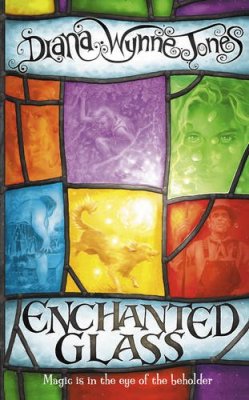
Enchanted Glass

Enchanted Glass  
 Diana Wynne Jones


Andrew Hope inherits Melstone House from his grandfather, along with the old man's field-of-care, which stretches into the countryside around the house and the local town of Melstone. Unfortunately Andrew does not fully understand the implications of what he has taken on. When orphaned Aidan Cain runs away from his foster home and turns up at Melstone House, having been told by his grandmother to go there if he's ever in danger, he brings changes in his wake. Andrew is made to remember some of the magical things his grandfather told him, and comes to understand a dangerous deal made between his ancestor and reclusive neighbour Mr Brown. How does this connect with the beautiful stained glass in Melstone House, and why are there so many people who look similar turning up.


I'm a big fan of Diana Wynne Jones, having discovered her books as a teenager and reading loads of them, even when I guess I was technically too old for most of them (not that that should be an issue with books, they are designed to be enjoyed whatever your age). Enchanted Glass is a standalone children's book set in a fictional part of rural England, with a brief diversion into London. As with many of Jones's books the setting is one where there seems to be magic, but it is not quite out in the open. Many of the main characters have some form of magic that is inherently linked to their personality - another staple of Jones's work. In the case of Stashe O'Connor it only manifests in small ways, but both Andrew and Aidan have a lot of magical talent, even if neither fully understands what they can do and they have to help each other to discover their powers.

Andrew Hope and Aidan Cain (whose name no one can get right) are the main characters. Man and boy have quite a few similarities. Both had a close relationship with a magical grandparent, both have family issues that are only partly explored. Both can do powerful magic, but aren't quite sure of themselves. Academic Andrew seems very passive and non-confrontational, causing him to have a reputation as an absent-minded professor (not that he is a professor at all). When in fact he arranges things to avoid confrontation and has a very solid presence that he doesn't always reveal. Aidan is a brave kid who runs from London to strangers in Melstone House when weird forces pursue him. He is able to show Andrew a child's-eye view of things, and reminds him of things that he had forgotten when grown up and preoccupied with adult concerns. Stashe O'Connor is the main female character, who is manipulated into helping in Andrew's house by her uncle, but soon proves invaluable at spotting when odd things are happening and sorting out problems.
The book is full of supporting characters from the small town of Melstone. Most of them have the surname Stock (Jones rightly shows that in some parts of England you do find people who aren't directly related who all have the same surname). Andrew's housekeeper and gardener are both determined to keep doing things their way and scheme against him and each other to gain the upper hand. The conflict between these characters is domestic and well written, providing much entertainment as well as contributing to the plot as much as the actions of the main characters. They are perhaps caricatures, but they are bold and memorable.

This is a fun book, full of personality and magic. The plot is well paced and rarely falls into obvious or predictable patterns. It has many of the elements often found in Jones's other stories, including an antagonist who is not immediately apparent, a modern link to folktale characters, magic in unexpected places and people getting on with their lives in the face of the unusual.

6 May 2014

The Vengeance Factor

Episode: s3, ep 9

Riker doesn't (quite) get the girl and Picard plans to stop space raiders using civilisation.

Goodby yellow brick road
What Happens
An away team beams down to a derelict Emerald City, which has been raided. Bloodstains at the scene belong to a race of raiders called the Gatherers, who're being a bloody nuisance. The Enterprise goes to a less-rowdy group of the same race. The Sovereign explains that they used to be a violent people, then 100 years ago they became civilised. At that point the Gatherers split from the homeworld (splitters!) and became space raiders. She says they've tried to bring them back into the fold, but the last attempt 18 years ago was rejected. Picard urges her to try again, because at that this point their problem is inconveniencing the Federation. Plus peace and unity and all that jazz.
The Sovereign and her servants come on the Enterprise, including her young, blonde chef who catches Riker's eye. There's little use for a chef when they have replicators, but she says she'll make Riker a traditional meal. An away team beams down the grimy building site where the Gatherers live, they've boosted a lot of tech. Worf smells an ambush, because Gatherers have poor personal hygiene, and the away team ambushes their ambushers by cunning use of smoke and pretending to leave. Riker brings the Sovereign to speak to the leader of this group, which looks like every stereotypical, unwashed biker gang on US TV. Each side insults the other, so Picard has to play teacher and make them sit down and play nice. The Gatherer leader will negotiate but doesn't want to appear weak so he sends his men away. The Chef quietly approaches an old Gatherer and kills him with a touch, it's a clan thing. The old man's body is found and Crusher pronounces a heart attack, but isn't convinced. The Gatherer leader agrees to take the Sovereign and the Enterprise to a higher Gatherer authority to negotiate peace.
The Sovereign reiterates to Picard their old obsession with vengeance, clan wars and escalating violence. Chef asks for leave to go make a meal for Riker. Chef brings food for Riker, Troi takes the hint and leaves. Riker is uncomfortable with her servile manner, he wants to them to be equals. She isn't used to that and isn't good at conversation. She confuses him by talking in riddles about having no freedom and being stuck on her path. Crusher calls Riker to sickbay, she's discovered the old man was killed by a tailored micro-virus that targeted his DNA, so it was murder.
Chef comes to Riker's quarters for "dessert". She offers to do anything for him, but he's put off by her submissiveness. She claims to have lost the ability to feel pleasure or passion. Riker is tender with her and they kiss, but a red alert spoils the moment and Riker is called the Bridge. A Gatherer ship is firing on them regularly, even though it's much smaller. The Gatherer ship won't respond to hails, so Picard has Worf knock out their shields. The Gatherer ship hails the Enterprise, Picard says they're there to talk. The Gatherer captain doesn't want to talk, but Picard, Sovereign and Gatherer leader beam over anyway. Gatherer Captain is suspicious that the deal will make them slaves or prisoners. The Sovereign offers land, but Gatherer Captain wants autonomy and won't agree to anything until their rights are set out.
Riker requests the medical database for the entire planet/species, and gets it sent to Crusher. Crusher's
research shows the micro-virus has killed people from the same clan as the old Gatherer. A photo from a long ago trial where someone died from the virus shows Chef in the background. They realise she's from a clan that was assumed to be entirely wiped out. Gatherer Captain is the last one of the attacking clan left.
At the negotiations Picard points out that Gatherer Captain and Sovereign are alike, neither is happy with that. Chef brings brandy and Riker beams in to knock it from Gatherer Captain's hand. Riker points a phaser at Chef and warns her not to move. She admits that she was altered to stop aging by the last of her clan and long ago set on a path of vengeance, she became Sovereign's chef to get to her enemies. Riker tries to talk her out of it, but has to shoot her and then kill her to prevent murder. The Gatherer Captain declares himself in Riker's debt. In the last scene Riker is sad and thoughtful and Picard says that the truce between the two groups is now in effect.


Oh Captain My Captain
Picard decides that peace must come to this alien species, because their renegade group is raiding and attacking Federation bases and basically being a danger to shipping. Picard uses his speeching powers (though not at full force) to convince the Sovereign that she should try for peace again. After that he refrains from speeching at the Gatherers, determined that any negotiation or settlement should be decided between the 2 groups involved. However his role as mediator seems to mostly involve stopping people from getting worked up and resorting to insults and squabbling. It looks annoying, but Picard and the negotiations are really the back story here. He refuses any escort when beaming to the Gatherer ship because he must be a mediator not an enforcer

Riker: lover, adventurer, middle-management
In this episode Riker gets to demonstrate all 3 of his roles. He leads both away teams into danger. He's
behind the smokescreen and the fake order to beam up during ambush. When the Gatherers think they've gone they drop their guard allowing the Federation team to ambush them.
I immediately assumed Riker and Chef would end up sleeping together, but the episode actually subverted my expectations. He wants to, but her submissiveness and servile nature puts him off, he tries to explain equality to her but she claims it's unfamiliar. I give Riker credit here, she offers to do anything for him but he refuses because he doesn't want one-sided sex. Even now there's this damaging idea that sex is something that is done to women, rather than something they take an active part in. Nice to see a positive message about sexuality here. I was surprised that Riker didn't actually get to sleep with her, but given what happens later it makes sense. I guess they don't want a repeat of Kirk's curse. I'm told a lot of Kirk's sexual conquests end up dead, which seems like a bad pattern.
Riker requests and is given all the medical records. He sources this data for Crusher, which makes you wonder why he has more clout than someone who used to be head of Starfleet Medical. He's (sensibly) concerned about Picard going to a hostile ship alone, and the Gatherer Captain does suggest taking him prisoner.

Doctor Doctor
Crusher is immediately suspicious when looking at the body because although it looks like a heart attack the victim has a strong heart. She gets the medical records of an entire, non-Federation planet. None of the data is anonymised and there's even a 50 year-old photo from some guy's trial. I feel like they have a very different attitude to data and privacy than we do. How do they know the Federation won't try to sell them drugs or medical insurance?

Not-quite-an-Ensign
When the Gatherer leader come on the Enterprise he scoffs that they have a child flying their ship, which seems like a reasonable thing to be concerned about. He gives Wesley a heading that leads through an asteroid belt, Wes comes up with a safer alternative course. The Gatherer seems unimpressed by this too, but if you are going to have someone underage flying the ship it's probably good that they're cautious.
In 10 Forward the Gatherer leader interrupts Wesley's homework and says Wesley doesn't like him, but that doesn't stop them being friends. I don't get why the leader of a band of space raiders would want to be friends with a prim teen who's good at maths, I think he's bored. Wesley calls him a thief. Gatherer leader talks about survival and freedom, but says he's interested in the deal because he wants better for his children. Wes is surprised the leader has children, but it seems his eldest is Wesley's age, except he's not good at maths.


Planet of... Splitters
The Gatherers seem to have abandoned their homeworld when everyone else was civilised by whatever civilising influence they had. However the split doesn't seem to have happened down clan lines. The constant, bloody clan wars don't seem to have been carried on by Gatherers, anymore than anyone else (except Chef). I get the impression that it was a form of controlling, centralised government that brought about the change. The lack of freedom or autonomy was what drove the Gatherers into their roaming existence. Gatherer Leader talks wistfully about answering to no creature, and Gatherer Captain laughs at the idea of having land and being farmers. The way Sovereign treats Chef (and presumably the other, unnamed servants) suggests a caste system. Chef says she isn't a slave and can leave when she likes (except for her quest), but it seems that she's conditioned to be servile. It's hard to tell much more as she proves to be atypical and we never see interactions with other servants.

Death by Space Misadventure
The old Gatherer was Volnoth of the clan Lornak, killed by a targeted micro-virus that looked like a heart attack, at first.

Chef was Yuta of the clan Tralesta, last survivor of a massacre, altered to stop aging and set on a oath of vengeance she will not deviate from. Killed by Riker while trying to murder her last victim.


The End
Riker sits pensive at the bar in 10 Forward. Picard comes over, talks about routine matters and suggests extending shore leave on their next stop. Riker dully says he will pass the message along. I think that maybe this was meant to be a comforting moment, but I'm not entirely sure. Neither brings up the subject. Either Picard thinks that work-talk will help, or else he doesn't want to make things awkward by mentioning it. You feel as though Riker wants as little communication as possible. At the end Riker just looks sad as Picard walks away. I'm gad they didn't try to lighten the mood with a joke, this ending feels appropriate


30 April 2014

Promise of Blood

Promise of Blood
by Brian McClellan


General Tomas has just killed the King and his Council of Privileged magicians in a coup, to stop the country from being sold to their enemy the Kez. Now he and his powder mages must try to keep order in the nation and capital. Investigator Adamat is called in to find out what the dying words of the Privileged meant and later to discover who among his allies is trying to assassinate the General. Tomas's son Taniel, a legendary Powder Mage, is sent to track down and kill his old friend, the last of the King's Privileged. What he finds proves a greater and stranger threat to his father and the nation. Promise of Blood has magic, warfare, politics and myth and is an impressive open to a series.

Set in a world of revolution and gunpowder this story has a different setting and a different feel to a lot of secondary-world fantasy. The existence of gunpowder and muskets, not to mention magic-users who rely on them, changes the traditional sword-based epic fantasy dynamic. Adra is an early-modernish setting, which I found satisfying as it's a period I'm roughly familiar with. There's suggestion of a world beyond Adro and the Kez, and of a history that stretches back into the myths that many modern folk have dismissed.
The magic is interesting. Privileged are traditional wizards, with power over elements. They've long been part of the upper classes and are bound to the rulers of nations. Powder Mages are a newer kind of magic-user, discovered along with gunpowder. They snort gunpowder to gain strength, can direct bullets and explode powder. Their existence is a threat to the Privileged and in neighbouring Kez Powder Mages are hunted. Then there are people with Knacks, one magical skill that people are born with apparently at random (a bit like a mutant power). The investigator with a perfect memory and the bodyguard who doesn't need sleep are examples of the Knacked. One thing that is interesting (but I can't go into too much detail about) is how a very domestic seeming form of magic ends up being used very powerfully to affect large numbers of people.

Tomas, Adamat and Taniel are the main viewpoint characters, though we also see through the eyes of a servant who protects her young noble charge from the bloodshed of the revolution and its aftermath. Through Tomas we see the political, the weary, difficult, dangerous work of a man who tried to do what's best for his country and found its all more complex than he thought. From Adamat we see a street-level view of the capital, and its covert, criminal world. The investigator uncovers the motivations behind the key players in revolution and the sinister forces that lie behind that. His loyalties are torn between his work and the threat posed to his family. Taniel, who has been abroad on campaign for a while, and is quickly sent away from the capital again so he doesn't have to face his fiancee who cheated on him. He heads to a sacred mountain to hunt down his oldest friend, who may pose a threat to his father and discovers he's on the front line of a possible invasion, from armies and magic. The characters, viewpoint and otherwise, are all complex with understandable motivations and they have backstories that crop up naturally throughout the story. Adamat tries to do what's right and protect his family, while Tomas and Taniel have a chilly father-son relationship.

The story was engaging, although different to what I expected. I thought it would be more about warfare and was pleasantly surprised by the investigation and political plotlines. There was also more magic and mythology than I expected. The myths and legends of the area are spelled out gradually and are far more present than I -or most of the characters- would have expected. This is an interesting read that tells a good story and sets up interesting and surprising events for the next book in the sequence.

24 April 2014

The Price

Episode: s3, ep 8

Troi gets involved with a guy I think is sleazy, but she seems to like him for a while.

What Happens
Picard asks Troi join the guests looking at the wormhole. The premier of a planet has just discovered the first stable wormhole. She's holding negotiations on the Enterprise in the hopes that the wormhole will bring prosperity. The negotiators are mustached-human (Mendoza) for the Federation; a tall, big-headed guy for tall, big-headed aliens; a non-mustached-human (Ral) a freelance negotiator. Ral is accompanied by a woman everyone pretends they can't see, and Troi can't keep her eyes off him. Everyone watches the wormhole become visible. Unexpected Ferengi crash a meeting between the premier and negotiatiors and make an unneccessary fuss about chairs before offering to top anyone's offer.
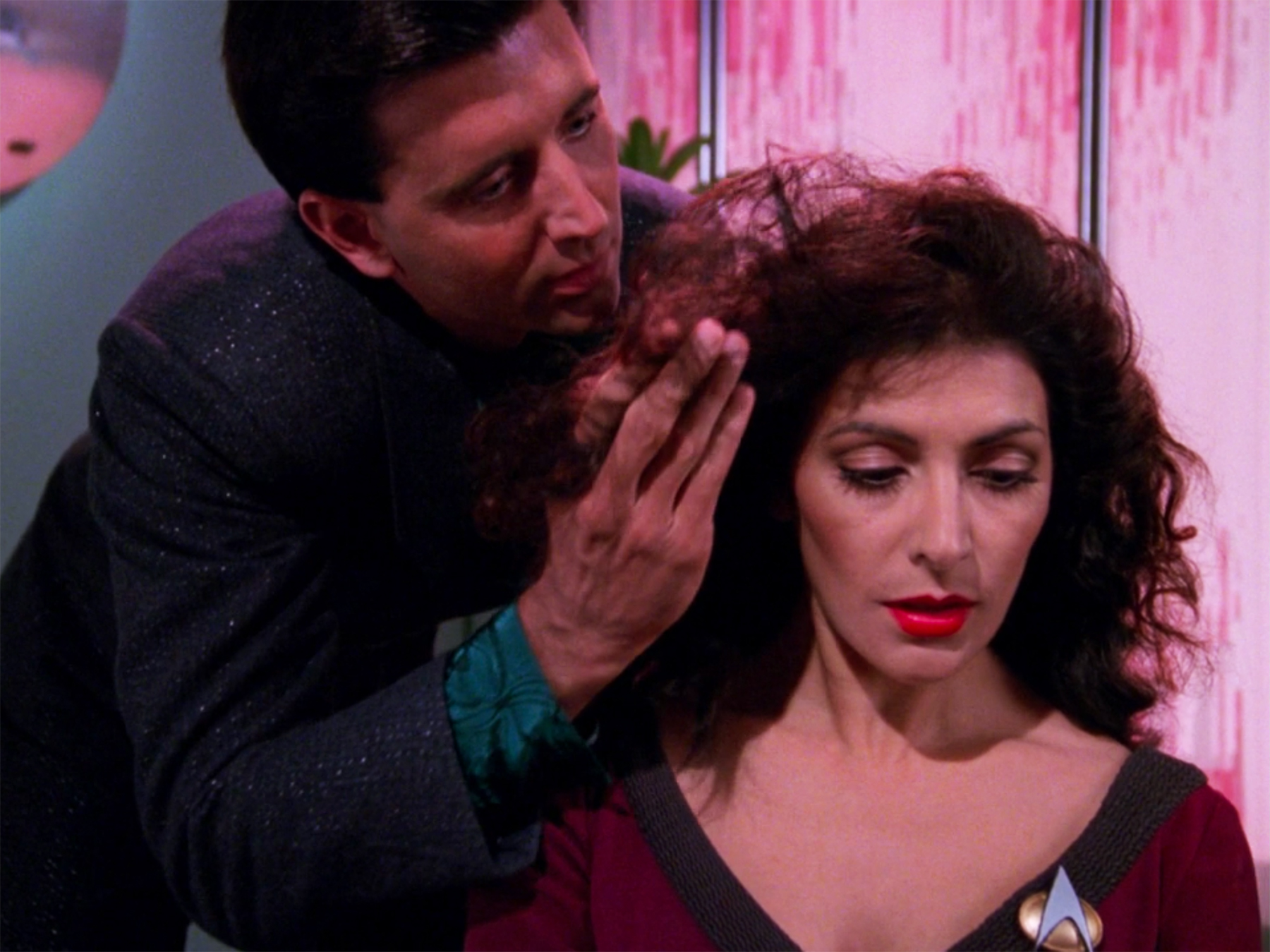
Troi looks up Ral's personnel file, it's the Star Trek version of Googling him. Ral arrives, there's flirting and weird hair stroking and Ral invites himself back. When he comes back they skip dinner, though its faster than Troi normally goes. Picard, Mendoza, Riker and Data discuss the wormhole. Picard is concerned that the wormhole hasn't been tested yet and asks about sending a manned probe. The Ferengi doctor administers a poison that will give a severe -but non-lethal- allergic reaction to anyone who shakes the lead Ferengi's hand. He plans to go after Mendoza and later the Federation negotiatior collapses. The Ferengi demand to send a manned probe into the wormhole too. Picard orders Riker to take over negotiations for the Federation.
Geordi and Data go into the wormhole in a cramped pod, accompanied by a Ferengi pod. On the other side Data realises they aren't in the right place. The wormhole is supposed to come out in the gamma quadrant, but they're in the delta quadrant. Geordi, who can see the wormhole when it's not visible, sees that its being strange and they have to go back straight away. They warn the Ferengis to return, but they don't listen and after the Federation pod has gone they watch the wormhole zoom away from them. Ral and Troi get closer, and Ral confesses that he's secretly part-empath too. Ral is able to open up to Troi in a way he hasn't with other people. Troi and Crusher discuss quick and intense relationships. 
The tall negotiator pulls out, the wormhole will take up too much admin and resources. Riker asks if Fed can come to an agreement to add their resources to Fed bid, but tall alien already agreed to do that with Ral, which flummoxes Riker. Troi accuses Ral of using his empathy to gain an unfair advantage in his work. He says that she does the same because she uses her empathy for her ship's advantage because she doesn't announce her abilities to everyone they encounter. In 10 Froward Ral compliments Riker's skills then tries to rub his relationship with Deanna in Riker's face, but Riker just says she'd be good for Ral.
The Ferengi ship moves and is about to fire on the wormhole, destroying the pods in the process. Picard tries to stop them. Ral comes in and talks the lead Ferengi down by announcing he's won the bid and will give the Ferengi exclusive access. Troi announces that Ral is an empath and she thinks he's been using his abilities. She also points out that the exchange between him and the Ferengi was contrived. The pod returns with Data and Geordi; they announce that the wormhole is only stable on one end and that might destabilize eventually. Though the deal is bad Ral is philosophic, there are always risks and his clients know that.


Riker: adventurer, lover middle-management
Sometimes it seems like there's no new skill to which Riker can't apply himself. This week, negotiation. Turns out it's basically poker but with higher stakes, and no cards, and no chips, so Riker will be fine. I guess. As soon as Mendoza praises Riker's observation skills you figure he's going to have to take over.
Riker displays a very sensible attitude towards Deanna and Ral, he certainly better behaved than he has in the past. *cough*Haven*cough* Ral tries to use his relationship with Deanna to rile Riker, but as Riker points out he's fine with where he and Deanna are now, and if Ral brings her happiness that's fine by him. Riker also shrewdly points out that Ral could be improved by Deanna's influence, but doubts Ral will see that. I wonder if Ral's realisation at the end means he was influenced by Riker's words?

Blind Engineering
The wormhole is only visible every 233 minutes when the radiation builds up. Geordi is the only one who can see the wormhole all the time. This saves him and Data from being trapped in the delta quadrant.

Counsellor Pointless
Troi's empathy is useful in revealing the 'scene' between Ral and the Ferengi. She points out that neither was tense during the supposed standoff, as if they were reading a script. Ral is tense as soon as it looks like she's about to reveal his secret. Ral himself points out earlier that empathy isn't much different to simply reading a person, which is what I suspect Troi usually does.

Why I don't like Ral
1. When we first see him Ral has a mute, nameless, female on his arm like an ornament. How sleazy. He apparently sends her away after meeting Troi, she might as well have been a pair of cufflinks.
2. Ral criticises Deanna for being 'Counsellor' Troi, suggesting she is too devoted to her work. He's only just met her so I don't think he can judge, especially considering his devotion to his own work. He may also be using it as a distancing technique, trying to stop her finding out about him.
3. He's overly forward and the hair stroking is weird. I'm not even sure Troi enjoys it. Then he says he's coming round later and she doesn't say no, WHICH IS NOT THE SAME AS YES! Stop promoting creepy/presumptuous behaviour as romantic, BAD TV!*
4. He suggests he used his empathy to influence her at first, which I don't think is right. Though Troi doesn't seem worried by that, so maybe among empaths that's fine?
5. Ral tries to rub his relationship with Deanna in Riker's face, after finding out that Riker is her ex.
6. When she raises the question of empath ethics in relation to his work he immediately turns it round on her. Not sure if he's defensive, trying to get the upper hand, or actually believes that. Still it seems like he must have a reason for keeping his empathy so secret.

Why their relationship works
1. Deanna's definitely attracted to him. Though is that because he used empathy to influence her?
2. His attitude towards her work may be a way of getting her to focus on herself as a person outside of her job. He says she must get tired of hearing others talk about their lives and doesn't want to add to that.
3. Ral makes Deanna happy. It's different to other relationships she's had, but she's enjoying it.
4. He is attentive to her. In one scene he's massaging her feet and offering to prolong negotiations so they can be together longer.
5. He makes himself vulnerable by telling her his secret. He says he felt isolated and hardened his heart until he met her, and he talks about himself and his family honestly, which I don't think he's used to doing.
6. He eventually realises that he wants to change, and it's being with her that has made him examine himself. He asks her to stay with him and help him change, he knows he needs her.


Planet of ... new wormhole
As a DS9 fan I may be biased, but the wormhole in this episode doesn't look as good as the one by Bajor. Of course this may be to do with changing special effects tech.
The Premier infodumps about her planet. "And as you all know"... why say it again then? The planet is inhospitable to most other races, which is why the negotiations are on the Enterprise. Their species have long relied on others. They have no natural resources. Not sure how that works? It's later revealed that they don't have manned spaceflight and discovered the wormhole with a probe. It sounds like they're pre-warp, so surely they should be left to themselves? Except they clearly know about the interstellar community, it sounds as though they've already had contact with space-faring races. They can't use the wormhole themselves, but the premier seems to think they can become prosperous selling the rights to it. It's actually really sad for her when it turns out to be no use. The episode doesn't seem to care about that, but I thought it was a shame.

Girl Talk
Deanna joins Beverley in a room with two parallel mirrors and they do, I dunno, some kind of exercising with stretching and hand holding. I don't know if there's another use for that room. They discuss Deanna's relationship with Ral. Deanna is happy and out of control and seems confused that there's nothing rational to their relationship. Beverly points out that you don't always need rational. Troi isn't used to this kind of relationship and asks if it's possible to fall in love in one day. Beverly says she did, but that relationship only lasted a week. It took months for her to figure it out with her husband. Troi considers whether she should slow down and catch her breath, but she and Beverly both say no. I think this means it's more serious for Ral than Troi. Nice as this chat-while-stretching is (I'm not sure if this is meant to be sexy, is it?) it definitely doesn't pass the Bechdel test as they're talking about men.

The End
Ral is leaving, he's been recalled to explain. He doesn't seem worried about his job, his employers understand the stakes and he's done good work for them before. He admits to Troi that he sensed the premier was going to go with the Federation so he did whatever he could to change that. He says he's examined himself and wants to change. He asks Troi to come with him and be his conscience. She says she already has a job as Counsellor.

It's cool that she knows what she wants and is proud of her work despite his initial criticism of it.


* I wish I could say that that was the 80s and today this doesn't happen, but it still does.

18 April 2014

The Wise Man's Fear

The Wise Man's Fear
by Patrick Rothfuss


This sequel to Name of the Wind returns us to the stories of Kvothe. The main narrative starts with Kvothe  studying at the University, barely able to scrape by financially and dealing with continued enmity from a rich student. He is encouraged to take a break and travels to another country to help a nobleman court his preferred bride. Events take a turn for the strange as Kvothe encounters a magical character from folklore and spends some time outside of the world. Further travel sees him tested by folk from a completely different culture to his own. Each event adds to the reputation and legend of Kvothe, which we have snippets of from the framing narrative, which also moves forward. The framing narrative is Kvothe, living incognito as an innkeeper, telling his own story to a chronicler who has tracked him down. They are joined by Bast, Kvothe's magical and mysterious friend.

This review gets a bit spoilery, just so you know.

This was a very long book, it had many pages and small print, but I got through it fairly quickly. Kvothe tells the story of his own life well, not surprising for someone raised as a musician and travelling performer. I didn't always agree with Kvothe's decisions or actions, but I always understood why he was doing what he did. There are references to the previous book, but not a lot and they information is dropped in fairly naturally. It had been a while since I read Name of the Wind, so a lot of the details weren't clear in my mind. Kvothe's story doesn't have quite the change in status and fortune as the last book did, but there are much stranger changes. Kvothe's life at the University involves Kvothe having friends for the first time, and a feeling that seems like home, even if Kvothe doesn't think of it that way. The magic learned at the university is a mixture of scholarship, engineering, science and medical training. I did love the descriptions of the University's huge and idiosyncratic library, or anywhere in this world that is where I would like to visit.
The book explores more of the world Rothfuss has created. Kvothe visit a country that is similar to the one where the University is, except that they are a lot more suspicious of magic. This shared culture and language is commented on a little, but the main change is that for the first time in his life Kvothe is living among the upper classes, as one of them. The real change comes when Kvothe takes an unexpected trip to the little-known mountain land of Adem, after learning some of their language and customs from a mercenary he travels with. Adem is entirely different to the countries Kvothe has previously travelled through, and Rothfuss has created a different kind of society, culture, language and even understanding of biology. It was interesting to see it through Kvothe's eyes, as he learns more.

There was one section that initially made me roll my eyes, when Kvothe runs off with a legendary sex-fairy. It did seem as though Kvothe's ability to overcome her wiles was a function of his status as Protagonist, he must've used a lot of plot points. However, as what I initially took to be a brief diversion went into more detail about the mystical other realm, and the events that took place there became more plot-relevant, I found myself enjoying it, and seeing that it did fit with the big -but so far vague- reputation Kvothe has later in his life.

Another slight niggle I had about worldbuilding comes from Kvothe's time in a very foreign culture that doesn't believe in fathers. Which is to say that they do not believe sex = babies and therefore have no concept or understanding of "man-mothers", which are known in other lands. Now, it's not unheard of for societies to believe that babymaking is something that women are able to do by themselves. This is found in various ancient cultures, so I got why the author wanted to use the idea. It was funny for a girl to point out to Kvothe how unconvincing his arguments for fathers were. However what is never mentioned, let alone explained, is how a culture with no sex taboo (which makes sense as they don't believe in conception) and no contraceptives actually operates. There's no suggestion that the women are pregnant a lot, and one has had sex loads without pregnancy, and I found that omission odd and unconvincing. I can understand the problems with trying to write modern sexual mores in a culture without reliable and easily accessible contraceptives, but it felt as though the author had just shrugged and decided not to cover that. Which I found bit odd, I was waiting for the explanation, especially as this section came after he'd managed to convince me about the validity and personality of the sex-fairy.

I liked the way that stories are using within the narrative. Of course the bulk of the story is Kvothe telling his own life to the Chronicler. There is also a story around that telling, as macabre creatures invade the life of a sleepy, rural community - who have no idea a legendary hero is in their midst, even when Kvothe tries to confess his true identity to a farm lad. Also there's Bast, now revealed to be from the other realm, he is able to comment on Kvothe's time there and add an extra dimension that that part of the tale. There are many stories within Kvothe's story, those told by travellers, some of which foreshadow what is come (the sex-fairy for example) and some which I suspect foreshadow later events in the series. Kvothe himself actively uses stories to boost his reputation, something that is less necessary after he does some truly incredible things. I also really liked that Kvothe entirely skips over a major part of his story because he finds it dull. The chronicler pulls him up on this, apparently his trial is amajot part of his legend and well renowned. Kvothe points out that in that case enough people know it, and from his point of view it was tedious. That subversion of the chronicler's expectations is great.

The Wise Man's Fear is a good book, with a great use of viewpoint and story. The writing is good and the characterisation is great. The plot is engaging, some unlikely events and their consequences are mixed with routine aspects of life in different settings and situations. The pace wasn't always fast, but that worked well, allowing the reader to settle down and get a bit comfortable in the less dramatic parts of Kvothe's life. The world is full of the ordinary and mysterious. The issues I raised above are small in the scheme of things and did not spoil my enjoyment of a fascinating read.

12 April 2014

The Enemy

Episode: s3, ep 7

Romulans are suspicious and unpleasant folk, and it's not just those slanty eyebrows.

What Happens
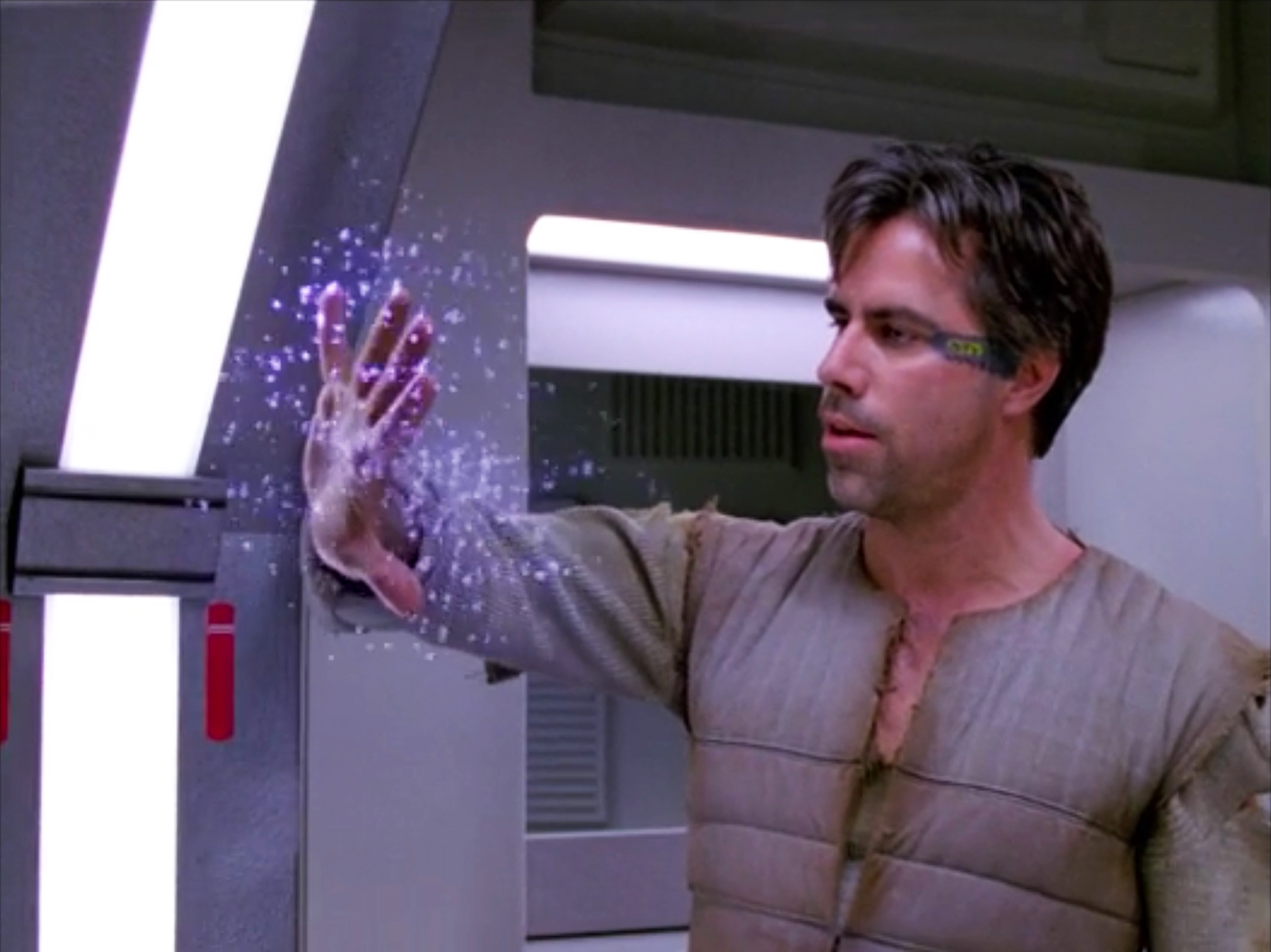
Riker, Geordi and Worf beam down to a really stormy planet where their equipment doesn't work. They find the remains of a Romulan ship, which shouldn't be in Federation space. Worf finds an angry Romulan who tries to strangle him, so Worf punches him out. Geordi falls down a deep hole. Worf and Riker can't hear him and have to beam back with the injured Romulan.
There are a few Romulans in this episode, so I'm giving them handy abbreviations.* Crusher has trouble with the biology of Enterprise Romulan (ER), the radiation on the planet damaged his brain and she needs to find someone who can donate some biobabble stuff. Riker tries to question ER, but he refuses to say anything. Attempts to find Geordi are foiled by the electromagnetic storms. Wesley suggests sending down a probe with a beam that cuts through the storms. Geordi will see it with his visor and can alter the beam to let them know he's there. The Enterprise intercepts a Romulan transmission assuring the crashed ship that help is coming. Picard hails the ship and tells them they've recovered one Romulan and will bring him to the Neutral Zone. Picard tells the Romulan Captain (RC) he can't enter Federation space. RC expects them to arrive in good time.
Geordi sees ore in the rocks, melts it into picks with his phaser and uses the picks to climb out of the hole. The probe with the beam lands and Geordi heads towards it. A Romulan sneaks up behind him and knocks him out. He wakes as a captive and the planet Romulan (PR) refuses to listen to Geordi when he says he has an escape. A rock fall hits PR, who is briefly stunned, Geordi carries him to a nearby cave and DOESN'T GET THE PHASER. Geordi asks if PR is OK and gets a phaser in the face for his efforts. Geordi and PR talk at odds. They're being badly effected by the radiation; Geordi has trouble seeing and PR can't walk, but he still won't let Geordi move. Eventually PR's resolve/health weaken and he agrees to move, but by then Geordi can't see anymore. Geordi is close to giving up, but PR goads him and suggests Geordi use his visor and tricorder together. Geordi can't make the modifications by touch and has to talk PR through it. When it's done Geordi carries while PR navigates and they find the beacon. Geordi has to guide PR through altering the beam.
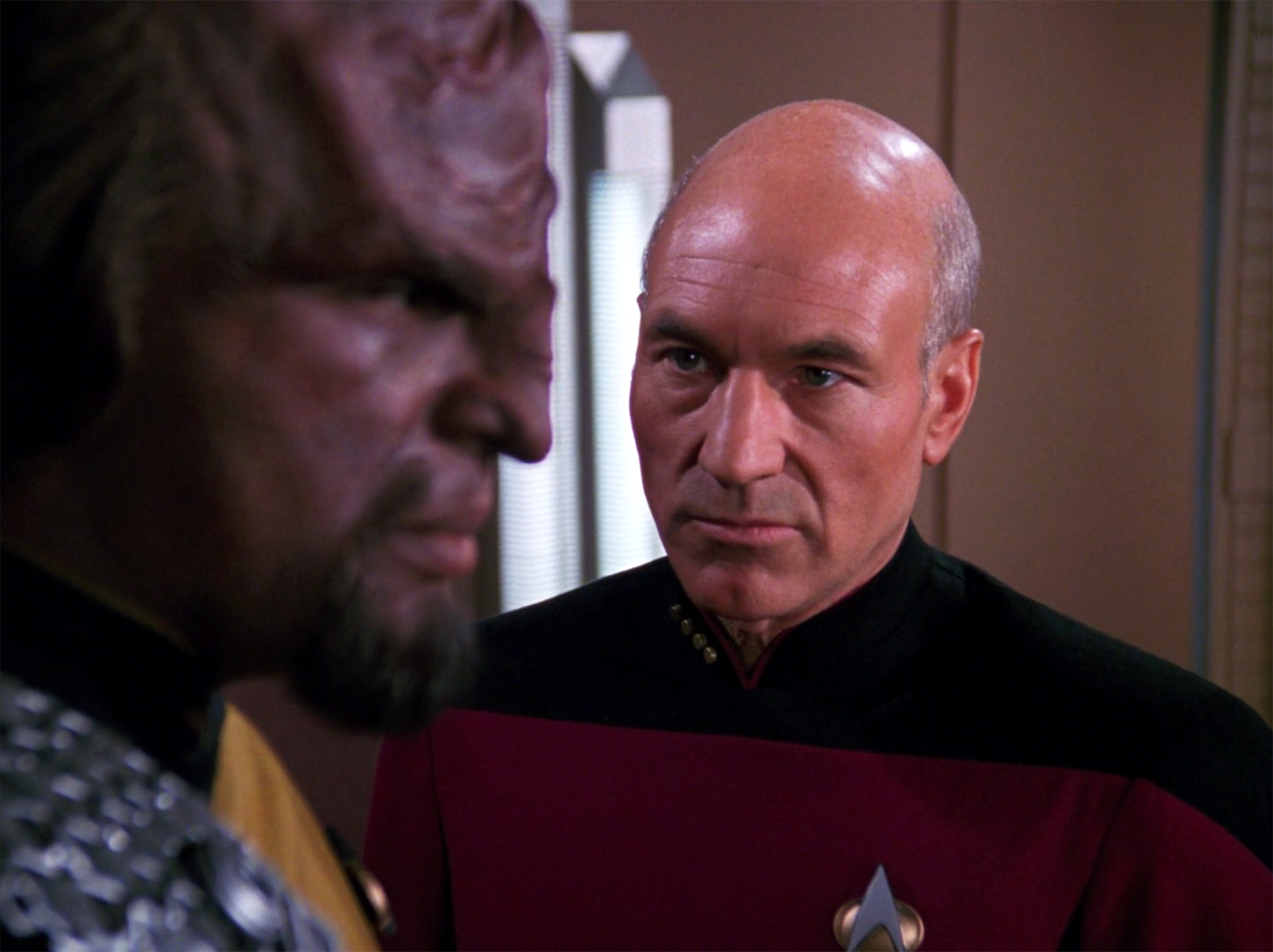
Crusher tells Worf that he's the only crewmember with the right bio-whatsit to save ER. Worf's parents were killed in a Romulan massacre and he refuses to donate, preferring to let ER die. Riker speaks to him about it. ER gets worse, but he would rather die than get a transfusion (or whatever) from a Klingon. The Romulan ship sees that the Enterprise is not at the Neutral Zone, Picard explains they have crew stuck on the planet. RC doesn't accept the delay and says he's coming to them. Just as Picard is about to send down an away team for Geordi the Romulan ship breaches the border and the Enterprise goes into red alert. Picard speaks to Worf about donating, but he won't order him, so Worf won't donate. Then ER dies.
The Romulan ship arrives during a brief window in the storm. RC demands his man, Picard tells him he shouldn't have left the Neutral Zone. Picard says the man is dead, the transmission ends with a threat from RC. Shields are raised, weapons are locked when Geordi alters the beam. They detect 2 lifeforms and assume that there's a 2nd Romulan. Picard hails RC and speeches about trust, saying there's another Romulan and advises that he will lower the shields in order to beam both their men. Of course RC has the option to fire on them. Picard's speeching works and RC asks for his man back. Geordi and PR are beamed to the bridge and PR tells RC that Geordi saved his life. Picard tells RC to power down his weapons and the Enterprise will escort them back to the Neutral Zone.


Guest Star
The Romulan Captain is G'Kar from Babylon 5. It's different alien makeup, but once the internet told me it was him I could totally see it. The actor Andreas Katsulas sadly died a few years ago.
I was listening to a podcast about Babylon 5 recently and there have been more deaths of Bab5 cast members than Star Trek TOS (which aired nearly 30 years before), which is strange and sad.

Oh Captain My Captain
Picard tries to rescue Geordi, even though he's got an impatient Romulan Captain heading towards the border. Picard explains the delay to RC, but describes a 'team' stuck on the planet, not one man. I expect that's him being diplomatic. As usual with these communications Picard is portrayed as reasonable and the other side are angry, untrustworthy and hostile. In this case RC does attempt to be diplomatic too, pointing out it's a mission of mercy, but that doesn't last long. Of course everything's from Federation point of view (one of the reasons I miss DS9).
At the tense point when Picard must choose between rescuing Geordi (and a Romulan) and the safety of the ship, he speeches at RC. Stuff about trust and repercussions. He puts the ship in a position of weakness, but morally he's in a position of strength. Though the transmission isn't accepted it must get through because the speeching works, as usual.

Blind Engineering
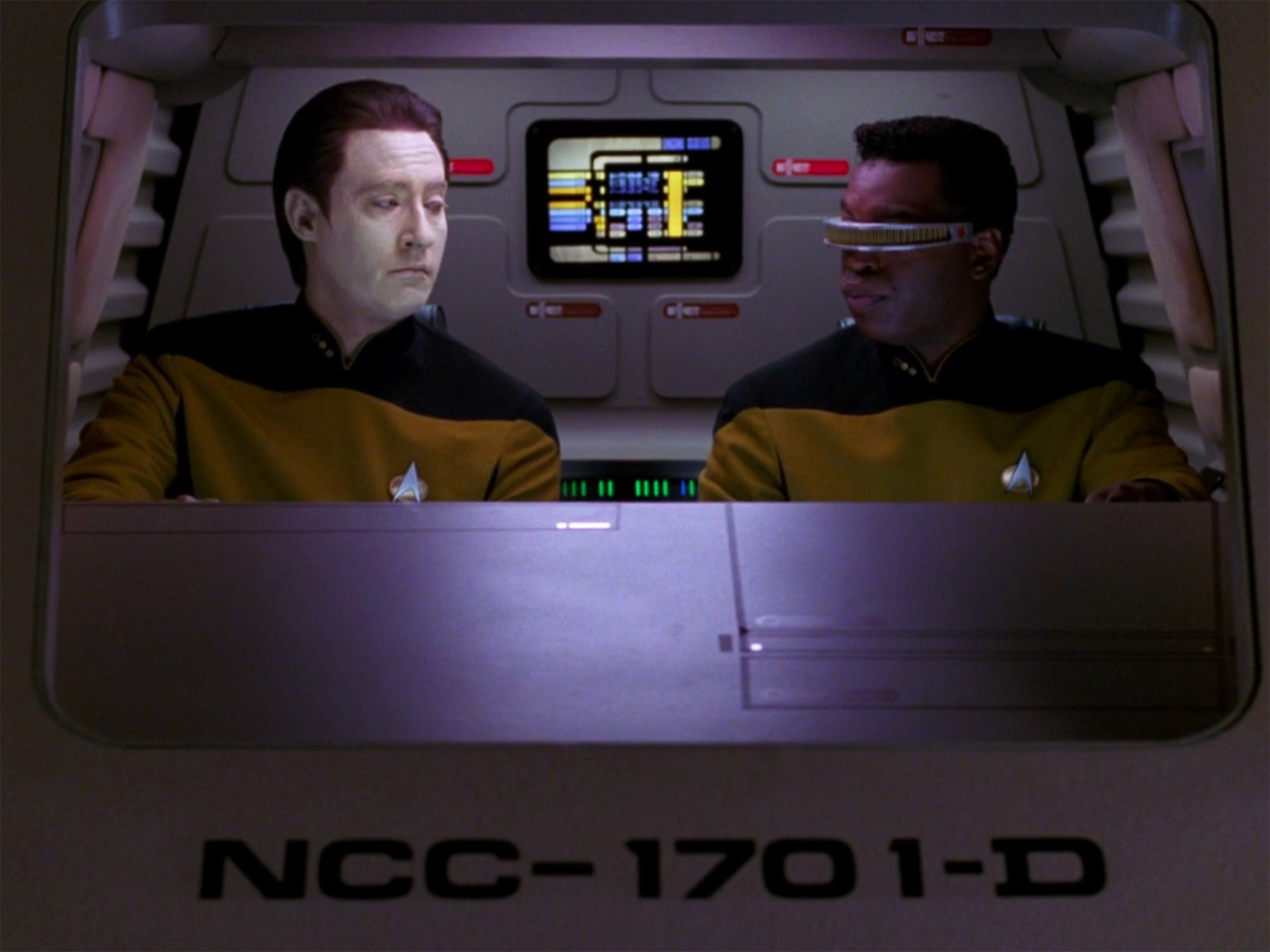
Geordi is really resourceful, managing to get himself out the hole using only his wits, his bare hands, his mineral-detecting visor and his mineral melting phaser. Still it takes lateral thinking to come up with that plan and climbing out of the hole took strength. Geordi understands the neutrino beacon and immediately knows Wesley did it. Of course, as demonstrated in the previous episode, there are no other engineers on the Enterprise, so it makes sense that Wesley is the only person on board who could have come up with that.
Geordi is too friendly to the Romulan who knocks him out, steals his phaser and takes him prisoner. I get that Geordi wanted to help the guy after he was stunned, but either he forgot to grab the phaser or he decided not to take it back on principle. In one version he's a bit daft, in the other it's just to Pollyanna for words. Of course Geordi's attempts to reason with PR don't work, cos non-Federation folk are angry, untrustworthy and hostile. It's only once pain and/or radiation have weakened his resolve that PR sees sense. Then teamwork, yay!

Visor-vision
We get to see Geordi's rainbow-coloured view of things for the first time since Heart of Glory (that Klingon episode) in series 1. It certainly makes the drab storm planet a lot more visually interesting. The visor allows Geordi to see the hidden minerals that he uses to escape from the hole. Of course it would have been nice if he saw the hole before falling in, but you can't have everything.

Klingon Warrior
Unlikely as it is (since Romulans are most like Vulcans and certainly look more like humans than Klingons), Worf is the only person on the ship with the right biological whatsit to save the dying ER. Worf is also (as far as we know) the only person on the ship whose parents were kiled by Romulans. I think that's some sort of irony.
Worf makes his feelings plain to everyone who asks,  he will do it if ordered, he will not do it of his own accord. Crusher calls Worf to see ER's condition and Worf tells him the situation. ER says he would refuse Worf's bio-whatsit anyway, on grounds of racism. After that I'm not sure there's so much of a dilemma. Worf won't give his stuff, ER would rather die than have his stuff. If Worf had been persuaded and ER saved surely that would have been going against the patient's wishes? Though I did wonder for a moment whether Worf would donate just to spite him.


Guide Romulans for the Blind
The Romulans, being the Federation's enemy, are unpleasant. If Vulcans are elves, then Romulans are dark elves. If Vulcans have no emotions besides smugness, then Romulans have anger, arrogance and suspicion.
ER, lying shipwrecked on an inhospitable planet, immediately tries to strangle Worf rather than welcoming possible rescue. He refuses to answer Riker's questions, and is scornful and bigoted towards Worf as the sickbay staff try to save him.
RC won't admit to any wrongdoing, no matter how much he's caught out, and though he tries to be tactful t first he gets evasive and angry. Troi points out that behind his smile is hostility and determination. (This piece of obviousness is pretty much Troi's only line, apparently no one could think of a single thing for her to do this episode.) RC claims the crashed Romulan ship was a one-man vessel and went off course by accident. He says he's entering Federation space on a rescue mission. He makes demands of Picard, while not listening to what he says. Even after Picard is open with him and acts in good faith RC is still grudging.
Through PR we learn that Romulans (being a bad lot) do not waste their time on disabled children. It seems blind Romulan children do not survive to adulthood. PR is determined not to reveal information and not to give in to the Federation, even if it means his death. He won't allow Geordi to try and rescue them both until he's succumbed to great pain and can't move himself, though at first I think he doesn't believe Geordi.

Staff Worf Meetings: 3
1. Crusher tells Worf that he's got the only bio-whatsit that's compatible with the Romulan. Donating poses no risk. Worf refuses. Crusher tries to empathise with Worf's feelings, but points out that it's not relevant now and this Romulan did not kill his parents. Worf says his feelings are always relevant and he will let the Romulan die.
2. Worf goes to Riker to discuss the situation. Riker says he understands Worf's bitterness and asks if he'll always blame all Romulans, what if there were peace in the future? Riker points out that used to be that attitude between humans and Klingons, should generations hold on to biterness.
3. Picard summons Worf and explains that if the Romulan dies then RC will likely use it as an excuse for an incident. Worf says that he has thought about the situation. Picard explains that command morals aren't always clear, he has to balance indiivudal needs against wider ones.Worf says he'll donate if ordered, but Picard doesn't want to order him. Worf refuses when Picard asks.

Won't Somebody Think of Children
When the Romulans have breached the border, suggesting upcoming conflict, that would have been a good time to split the ship and save family members from facing combat.

Death by Space Misadventure
 A Romulan found on an inhospitable storm planet, near the wreckage of his ship (which shouldn't have been there), is rescued by his enemies but dies of his injuries.

The End
Picard welcomes Geordi back, and the engineer gives credit to PR. Picard orders Geordi and Worf to take PR to the transporter room so he can be returned to his people. Riker comments that it was a close call, and Picard agrees that brinkmanship is dangerous.


* Enterprise Romulan = ER, Romulan Captain = RC, Planet Romulan = PR.
I know these initials all stand for other things too.