28 June 2017

New Ground

Episode: s5, ep 10

This episode is relevant to me, as I'm a new parent myself. Going to have to figure out being a working parent in a few months.

What Happens
The Enterprise is helping test a new propulsion system which lets a ship surf on a big space wave rather than use a warp engine. Geordi is super excited. Worf gets a call from his mother, she wants to visit while he's near. She arrives with Worf's son, Alexander and it's soon clear that she and Worf's father want Worf to take his son. Worf is resistant to the idea, but doesn't say no. He tries to navigate being a working, single father, though he isn't keen to give up his duties. Troi asks Worf how things are going and pushes him to join in parent-child activities to socialise with other parents. On a trip to see some animal displays (turns out to be in one of the ship's labs, but that's not explained until later so I had no clue where they were at first. A holodeck? A planet?) Alexander and Worf are aloof and not socialising. The teacher tries to gently correct Alexander's behaviour when he takes something, but Worf makes a big thing out of it. Worf has a serious talk with Alexander about honour and then tells Troi that it's all sorted now. Oh no, dear sweet Worf, no.
Meanwhile the propulsion test means the Enterprise has to follow close behind the test ship on the wave. At first it works and the results are amazing, but it swiftly loses energy and the test ship explodes. They have to make minor repairs before they can follow the wave again. Worf is called to see Alexander's teacher, who says Alexander is very bright but also disruptive and bullying, plus he lies when he's caught misbehaving. The teacher suggests chatting together with Troi, but Worf goes off to find his son, who is using Worf's holodeck programme without permission. Worf tells him off and says he'll send him to a Klingon school. Troi talks to Worf about how he feels about sending Alexander away, and suggests he consider how Alexander might have felt when he was sent away the first time and how these feelings might explain the boy's actions. She also talks to Worf about Alexander's mother, and how Worf left things with her.
The space wave has grown bigger and stronger and will destroy a planet because it's too powerful to be stopped as planned. Geordi has 2 plans, the more likely one means going through the wave to get ahead of it. The shields are still damaged, so it'll be bumpy and risky. Worf is called to a meeting and tells Alexander to stay in their quarters. Alexander goes to look at the animals again (well, duh), and he's in the lab when the ship is damaged. There's a fire in the lab and the Computer reveals to the Bridge crew (including Worf) that Alexander is there. Worf and Riker are allowed to go save him, but Picard warns that they have 3 minutes before that part of the ship will be flooded with radiation when the wave is stopped. Worf has to lift a beam to saves his son, and Alexander persuades Riker to save some endangered animals. Picard deploys the torpedoes before he knows Riker, Worf and Alexander are safe.


Oh My Captain
Picard makes allowances for Worf being late to a meeting and being interrupted by calls about getting Alexander settled on board (I guess comm badges don't have a Busy setting and it's not standard practice to check where people are before hailing them). The Captain says Worf should care for his son ahead of security matters. It's nice that the Enterprise seems to be an encouraging and helpful environment for parents, and Picard is super understanding.
The other side of this is that space is dangerous, they encounter trouble all the time and in extreme situations Picard must prioritise lives accordingly. He can't delay stopping the wave, for Riker, Worf and Alexander, because a whole planet is in danger. He does warn Riker and Worf of the short timescale, and you can see he's worried and tries to hold off giving the order as long as he can.

Blind Engineering
Geordi is super excited about the space wave propulsion experiment and squees at Data and Worf. Neither are particularly responsive. Geordi compares it to when the sound barrier was broken, or the first warp drive test.* Geordi decides to find an engineer to geek-out with because his mates just don't get it. Later Geordi is super pleased that Riker points out this technology could make Engineers obsolete. In a utopian society like the Federation it seems people aren't afraid of how new technology will impact their livelihoods, because I guess everyone is taken care of. Plus there seem to be various ways to live your passion even if it's an old-fashioned skill, that's presumably why bars and restaurants still exist even though replicators can feed everyone.

Klingon Warrior
Worf is totally not ready for parenting, and admits that he would rather face combat. Of course he's from a culture that praises fighting and he's trained for combat, whereas parenting isn't something Worf has prepared for. Also I have no idea how it's viewed in Klingon culture, but they don't strike me as nurturing folk. At least Worf doesn't push back on his mother, it's understandable that his parents didn't plan on another bout of child rearing when they were older. He tries to lecture her about raising a Klingon boy, though I expect no human woman knows more about that than Helena Rozhenko. Worf's parenting style is kinda confrontational, but again that's what he's prepared for. The teacher tries to gently correct Alexander's behaviour, giving him space to admit what happened and framing it as a misunderstanding; then Worf blunders in being stern with the teacher and Alexander. Worf thinks that a single lecture about honour will make Alexander behave. He's told that Alexander is smart but aggressive at school (after like day? timescales are unclear here) and continues to lie when caught misbehaving. Worf tracks him down to the holodeck and seems quietly proud of his son's physical skills. He doesn't let his pride show and tells Alexander off for lying and says he'll send him to a Klingon school. Shipping the kid off once seems to be his only threat, he needs to expand his repertoire. It's only after a conversation with Troi that Worf is able to consider Alexander's feelings and acknowledge his own. I'm not sure if ignoring your feelings is a Klingon thing or a Worf thing.

It's Not Easy Being Troi
Troi is in her primary role as Counsellor here, which is where she excels. She suggests Worf goes on a father-son field trip (I don't really understand why seeing animals is segregated by gender) to meet other parents. Later when she checks in with Worf she tries to warn him that kids don't usually change their behaviour after a single conversation, and offers her help. Worf doesn't resent her getting involved, and doesn't seem uncomfortable with her checking in. That said, he's not very forthcoming with his feelings, so even after the teacher suggests talking to Troi counselling isn't Worf's first instinct. After a confrontation where Worf tells Alexander he'll send him to Klingon school he finally goes to see Troi. She asks him if he discussed this with Alexander, but Worf doesn't think you discuss things with kids, you just tell them how it's gonna be. Troi asks questions in aneutral tone and says it's not her place to approve or disapprove of his parenting when Worf gets defensive. Troi asks Worf to consider Alexander's feelings when he was sent away right after his mother died, and Worf concedes that the boy might've felt abandoned. She points out children don't know how to deal with their feelings, so they just act on them. Then she switches to talking about Alexander's mother, and how Worf felt about her before she died. He admits that he was angry and they argued because she didn't tell Worf about their son. Troi validates Worf's feelings, of course he was angry, but that doesn't mean he didn't love her. She points out that both father and son have healing to do and should try to do it together.


Staff Meetings: 2
1. The Doctor running the propulsion test explains it to senior staff. The Enterprise will need to stay really close to the test ship to get the readings.
2. Geordi explains that wave is growing, Worf arrives late having been called from a discussion with Alexander. Geordi has 2 plans for stopping it: (a try and create an inverse wave with their engines, or (b get ahead of the wave and create an explosion in front of it. (a means they'd have to match the wave exactly and it keeps growing, so that would be very difficult. (b is more likely to work, but dangerous to the ship because they can't go over it, they can't go under it, they can't go around it, so they'll have to go through it. With the shields damaged from the explosion it will be risky.

Won't Somebody Think of the Children?
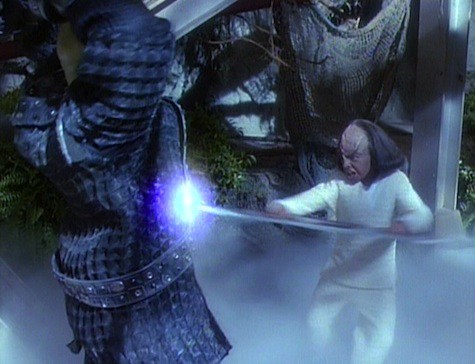
Been a while since I used this heading, but as the episode focuses on a child it's appropriate. I understand Worf's concern about having Alexander on board, space is really dangerous, but Star Fleet is fine with it and lots of crew have their kids with them. I think my main query is, who's looking after Alexander when he isn't in school? Despite Picard giving Worf time to be with his son it seems that being Chief of Security involves being on duty outside school hours. (What are the school hours? There are obviously different shifts, but there's no natural day and night, so are there shofts of crew/families/classes that operate on different times to others? Or is there an arbitrary day/night shift, so some folk are forced to be a bit out of sync? Based on [night shift in Data's day - link?] I suspect it's the latter.) Is there a creche or childcare service that allows crew with unpredictable hours to leave their children with someone qualified/familiar? There's no sign of such a thing, though could be that Worf doesn't use it. When Worf is called to an important meeting he instructs Alexander to stay, even though he's just been told the child is defiant. How often are kids just left unsupervised? Or is this just Worf being careless? There doesn't seem to be a Computer setting or AI that monitors children and lets parents know where they are or what's happening. Alexander took his father's weapon to a holodeck unaccompanied, and Worf wasn't alerted until he asked where Alexander was. Plus Alexander was in a lab that should have been evacuated, and had a fire in it and the air was almost vented before Data noticed there was a life sign there. Shouldn't the Computer have flagged up that there was a person -a child- in there? Seriously all this future tech and young kids are just wandering around unsupervised, armed and able to wander into dangerous places.

The End
In sickbay Crusher confirms Alexander has few injuries. The boy asks if his father is in trouble, and then if he's in trouble. Worf gently tells him not to worry about that now. Alexander promises to behave at Klingon school and make his father proud, but Worf suggests that it could be a greater challenge to live on board but they can face it together. Alexander agrees. It's a sweet scene.


* Geordi even mentions what it would be like to actually see Zephram Cochrane and the first warp drive. Sound familiar? I recall that a few episodes ago Spock did a brief compare and contrast between Picard and Kirk. Is this the series where they got the ideas for the films? What next? Will Romulans "unsucessfully" try to clone Picard? Or... y'know, something about Insurrection?

14 June 2017

A Matter of Time

Episode: s5, ep 9

What Happens
The Enterprise is going to help a planet that has climate problems after being hit by an asteroid, when they encounter a temporal disturbance and a strange, small vessel. A gangly, eccentric man beams onto the Bridge and introduces himself as a Professor from 200 years in the future. He's fascinated by everything, makes odd comments and has frenetic energy.* Picard expresses surprise that he's of interest and others ask the Professor why he's there, but the time traveller tells them he can't give hints because he must preserve the timeline. He wants them to fill out questionnaires for his historical research.
Unlike in many episodes they get to the place they were originally going, the planet is rapidly cooling as dust from the impact (which was luckily on an uninhabited continent) fills the atmosphere, blocking heat from the sun. Geordi's plan is to use the ship's weapons to release underground carbon dioxide pockets, creating a purposeful greenhouse effect. It seems the Professor is there to witness this mission, and he asks Geordi various things before sneakily stealing a pad. Later the Professor hangs around the Bridge watching Picard with a weird intensity while orders are given and the planet's atmosphere is monitored. The mission seems to be successful as the planet warms again.
Troi tells Crusher that she doesn't trust the Professor. He knows Troi is suspicious of him and cheerfully talks to her about it. He then flirts with Crusher, but she isn't buying what he's selling. On the Bridge they realise that they've created geological instability resulting in eruptions that will make the atmospheric problems worse. After running the numbers by Data, Geordi reckons the only viable plan is to burn off the dust and use the Enterprise to vent it, but if the calculations are slightly off they could burn away the entire atmosphere. Picard is tortured by decision, which could save thousands or kill millions, and tries to get the Professor to tell him the outcome. They have a long discussion about timelines and ethics. The Professor seems serious and emotionally distant for once. Picard decides to try and takes the decision to the planet's leaders.
Geordi stays on the planet while they do the thing, it works! The Professor is keen to leave; Picard and Worf confront him outside his vessel, they've noticed things have been stolen and want to look inside. The Professor agrees that only Data can go inside, where he sees that the Professor has stolen various small things. The Professor pulls a phaser on Data and reveals that he's actually from the 22nd century; he encountered a real 26th century time traveller and stole his ship and outfit. He plans to take things back and "invent" them, but now that he has Data he can figure out cybernetics. The phaser doesn't fire and Data makes the "Professor" leave the ship. Data explains the truth, Picard reveals that the sensors couldn't penetrate the time vessel until the door was opened, when the Computer disabled everything inside.


Oh Captain My Captain
Picard wants to go back and look at the temporal disturbance after Worf notices it. He delays their arrival at the beleaguered planet by about an hour, which doesn't seem like the best choice, even if Geordi says it's OK. He's so easily distracted by shiny space phenomena, he's like a cat or something.
When faced with the difficult choice Picard tries to get the Professor to tell him the outcome. They debate time travel philosophy and ethics with the Professor pointing out he can't do what Picard wants. The Captain tries arguing that this is a real situation involving people's lives, not a hypothetical and references his own prime directive breaches as examples of doing the right thing. It's all very eloquent and impassioned, naturally. The Professor points out that everyone already died from his point of view, then accuses Picard of trying to manipulate the future. This line will be parroted ironically back to him when Picard learns of the truth of the Professor's plan.

Does Not Compute
The Professor refers to Data as the Gutenberg Bible or Model-T of androids, suggesting there are more in the future. Data corrects him as he's actually the second prototype, not the first. Then Data asks if he's still around in the future, seeing as how he doesn't have a limited lifespan the way everyone else does. The Professor chides Data for curiosity, while also getting him to dry his hands like a servant, it's a very weird moment. Though this does tie in to my theory that everyone who meets Data knows he's an android (rather than an alien) even if they have no reason to think androids are possible, like in this case. Also curiosity about his future existence seems like a pretty human instinct on Data's part.

Doctor Doctor
Dr Crusher is fascinated by meeting someone from the future. She doesn't ask about herself or her future, but wants to know if a plague is ever cured. Later she invites the Professor to join a group in 10 Forward and is friendly towards him (though I'm not sure everyone else is necessarily talking about him, the regular crew mostly haven't met this guy and no doubt have their own stuff going on). He's attracted to her, but either she doesn't notice or ignores it. He observes that she sees history throw the filter of medical advances. Later she's eager to help with his research and gives him a neural scanner, but when he starts flirting she shuts it down straight away, suggesting she could be his ancestor (super unsexy).**

It's Not Easy Being Troi
She knows the Professor is hiding something straight away, but not even Crusher thinks that means much. Later she gets even more suspicious, sensing purposeful misdirection, but doesn't tell anyone besides Crusher, who's still not taking her concerns seriously. The Professor confronts Troi cheerfully and tries to disarm her with charm and vague references suggesting that her reaction is predictable and of no real concern to him. He also calls her "Picard's empath" not entirely wrong, but not her title nor necessarily how she would wish to be addressed. It all seems to me like a way of diminishing her and putting her down. He suggests they're similar, then he pulls the "some of my best friends are empaths" nonsense. This is not a good idea for convincing people and soon after this Troi decides to stop being polite and leaves.


Staff Meeting: 1
Near the start the Professor sits down with senior crew and explains that he can't tell them anything about the future, before giving them their assignments. Everything seems friendly and cordial. After Data takes the Professor to his quarters the conversation becomes more cautious with Picard seriously listening seriously to Worf and Riker's concerns. Picard says he's checked the Professor's credentials (as someone who has to check the authenticity of documents for a living I don't know how you could verify something from the future) and says everyone should treat the Professor well. Worf is dismayed about the questionnaires, clearly he does not respond well to surveys.

Future Is Better
Picard mentions that the climate/atmosphere issues on the planet could be like the nuclear winters of the 21st Century. This is not what I want to hear, that's where I live! Though honestly now warming is a greater threat than cooling, it's the only global measurement that is currently looking really bad for humanity. It's interesting that the scientist on the planet said they'd been so careful to avoid a greenhouse effect.

What we learn about 26th Century:
-They have time travel
-The time craft is very metallic and shiny on the inside, like it's trying to look even more futuristic
-There are still garments that look like they're made from old curtains (no idea how fashionable the time traveller was), but they have big pockets which are useful for stealing things
-A time traveller went back 400 years but didn't think to take precautions against crime

What we learn about 22nd Century:
-Humans don't have medical scanners, quarantine fields, phasers, androids, warp coils or  pads (What happened to Apple et al? Did all those nuclear winters destroy tablet technology?)
-Earth still uses the Western, Christian-based way of counting centuries.*** As opposed to whatever star dates are.

Security Breach
Oh look, another troublesome visitor. The Professor is an accomplished con artist, so even when he's explaining the truth to Data I don't believe that he was an actual inventor, that's just the persona he's now stepping into. What I don't understand (though I admit it's a niggle that could ruin the fun of the episode) is how the Professor knows who everyone is. It's fun the way he acts knowledgeable and excited about everything, whilst cleverly not having to give any definitive "future" info. He could have read the name and number of the ship on top of the saucer section, but that doesn't explain how he knows to be there at that point or who Picard is. I'm sure he's a quick thinker, skilled at picking up on things and improvising, but even so he knows a hell of a lot already. Also where was Guinan? There;s even a 10 Forward scene and she's not there, she would have seen through him super quick and probably said something awesomely cutting.
I wonder if the 26th Century guy was even more susceptible to deception than the Enterprise crew? Maybe people get less suspicious over time? It's far from the first time the crew assumed good intentions; though I think they're getting better. Riker asks about him being an imposter, because they've dealt with that before. Picard tells Worf he shares suspicions and has the Professor medically scanned to determine he's human (which they also could have done with Q at one point, so that's no guarantee of anything and it's not as though humans are inherently honest) plus the time vessel is put under guard.
Wait, the Computer can disable phasers and other devices remotely now? Picard says that they couldn't scan inside the time vessel until the door was opened, but then everything could be disabled. It seems like having the Computer disable phasers or other weapons is super useful and surely something that may need to happen again. Though I suppose there may be wiggle room there if you assume the Computer can only disable phasers belonging to the ship.

The End
The fake Professor is distraught as the auto-timer on the time vessel triggers and it returns to the 22nd century. He argues that he doesn't belong there and Picard says that actual historians will be fascinated by his 22nd Century perspectives. He ends by welcoming him to the 24th Century, which is kinda badass.


* There aren't a lot of staid and sober time travellers are there? This guy, Doc Brown, various incarnations of the Doctor, a whole lot of oddballs.
** Surely time travellers need to check their family tree carefully before going back in time. That just strikes me as good sense.
*** I get that BCE/CE (Before Common Era/Common Era) is a way of secularising BC/AD (Before Christ/Anno Domini - the year of our Lord), but it's still based on a presumed birth date of Jesus.
2017 AD is 5777/5778 AM in the Hebrew calendar (which sounds futuristic) and 1438/1439 AH in the Islamic calendar (which sounds historical). It's just occurred to me that I only know anything about calendars based on Abrahamic religions, obviously there are various other ones around the world. Time's a funny old thing, really.

7 June 2017

Ghostbusters (2016)


I was going to do a more general film catch-up post, but it turns out I have a lot to say about this film. I saw Ghostbusters a while back when it was in the cinemas and I very much enjoyed it (I didn't go to the loo during the screening even though I was pregnant). It's one of those rare films where the more I think about it the more I like it and notice stuff that was clever (usually it's the opposite way round and reflecting upon a film exposes its flaws).


The film is a fun, action-packed summer blockbuster, with lots of humour and great chemistry between the characters. There are strong themes of friendship, which feel very solid and some of the performances are incredibly fun, the portrayals of Holtzman and Patty especially. I loved the characters, and even though the comedy was goofball at times I always enjoyed it (goofy stuff can be kinda hit and miss for me). The only thing I didn't enjoy so much was how much Kevin was mocked for being stupid, and how his stupidity got very over the top at times, but that's a minor niggle and I know that that characterisation was included for a reason. Plus it looks like Chris Hemsworth is having a lot of fun with the part and that does shine through. The film absolutely works on this fun, entertaining level, but it also does more than that if you want to look deeper.


The story is about a group of scientists (and a colleague without a science background) struggling with credibility who discover that ghosts are real and then work to capture them both for their own research and to help the people of New York. Put like that it is similar to the original film, and features a lot of nods to the originals with loads of cameos, in fact there were more references than I was expecting. What I want to talk about though is the differences, because I found them very revealing.

There are some spoilers below, but I'm talking about themes more than plot points.

First off, the main characters are all women, that this was a point of contention shows just how messed up some things still are. In fact the way women are treated becomes a massive theme in the film, in both subtle and obvious ways. The first act feels a bit choppy in places, like it was heavily edited, and there were reshoots to include scenes which poke fun at some of the real-life, misogynistic detractors. It's a funny and creative reaction to awfulness. Erin is terrified of her past indiscretion -publishing a book about ghosts being real- destroying her serious, academic career, which it absolutely does. While a male academic who's close to tenure might well be as nervy and awkwardly eager to please, depending upon his personality. But would he have his entirely-appropriate outfit choices critiqued by a superior? Almost certainly not! This is just the setup and background for Erin's character, but it occurs to me that she's in a precarious position that perhaps a man in her position wouldn't need to worry so much about. She's made sure to fit in and stick to what is mainstream and ignore her past findings/research/belief in order to get ahead.

"Too sexy for academia?"
Secondly, I've heard people say that the villain isn't very epic, which is true. He's just an angry little man who's disappointed in his life, got obsessed with ghosts and enacted a plan to destroy the boundaries between worlds in order to make himself feel big (both physically and emotionally). The thing is, women have to deal with small-minded men all the time, the reaction to this film just existing is proof of that. Maybe they aren't fighting a gribbly, extra-dimensional being because their time and energy is filled by the enmity of an angry guy and they have to deal with that before they're able to get much else done. Also Rowan isn't shown to be specifically a misogynist, he's generally unpleasant because he has no joy. His life didn't turn out the way he felt it should and he decided everyone else must be to blame and therefore deserved punishment. Patty is the only character who is nice to him early on. She doesn't mock him for being weird and off-putting towards her, and though that is a requirement of a public-facing job (believe me!) Patty is very genuine in her interactions. We see that she tries to be friendly to everyone even though she's ignored and rebuffed she doesn't let it get to her (she's like an anti-Rowan). Later on the Ghostbusters try to save Rowan from himself and the sad thing is that he actually shares a major interest with them and was inspired by Erin and Abby's work. In fact he probably took it more seriously than anyone, so even in the execution of his plan he's inspired by/relying on the work of these women. Had they met under better circumstances the Ghostbusters would have probably seen him as a valuable collaborator.


The other big difference in this film is that although the authorities (the Mayor and the FBI especially) believe the Ghostbusters and already know that what they're saying is true, they absolutely will not acknowledge this publicly. Compare this to the reaction towards the original Ghostbusters team, the respect they receive, and the difference is massive. A PR lady from the Mayor's office makes very clear that all attempts to publicise their work and the existence of ghosts will result in them being derided and called crazy. All they are offered is the opportunity to continue their work discreetly and give the results to the authorities, who will of course disavow them while benefiting from their research. Basically doing useful and important work entirely for others while receiving no credit and being mocked in the process. Hmm, I wonder if this is based on real things that have happened?


While characteristion is a big factor within the story I found that parts of the plot stem from these differences in the character's status, respect and the treatment they received. IIRC the original Ghostbusters were laughed at, these ones are threatened and suppressed. It's a great example of how taking an existing story and changing significant things about the main characters can give you a very different tale and one that examines more things.

I just hope that the sequel moves the story along from here, expanding the ideas and letting us really see what these ladies can do.


30 May 2017

Unification Part II

Episode: s5, ep 8

What Happens
Previously: Picard was sent after Ambassador Spock who ran off to Romulus, and the Enterprise discovered an old Vulcan ship was stolen from a Federation scrap yard.

Picard confronts Spock in a cave, asks why he came to Romulus and tells him his father is dead. Spock says he came in the cause of reunification; an underground group of Romulans are interested in Vulcan culture and Spock thinks that the two long-divided cultures could come together again. Although this movement is suppressed by the Romulan government Spock's friend, Senator Pardek, says there's a reforming proconsul who is sympathetic and wants to meet Spock. Picard and Spock also discuss the latter's difficult relationship with his father and Spock accuses Picard of speaking with Sarek's voice. Data asks their Klingon escorts for computer access so he can hack Romulan intelligence systems and send a message to the Enterprise.
Meanwhile Riker is in a seedy bar talking to a four-armed, pianist who is the ex-wife of a smuggler somehow connected to the missing Vulcan ship. The investigation is not important enough to be filmed (I suspect they ran out of time). The pianist indicates that a fat Ferengi who frequents the bar was involved with her ex-husband's dodgy dealings. Later Worf reports the Ferengi has arrived, then Riker makes him reveal where the old Vulcan ship went. It was given to people who trade with the Romulans.
Spock meets a proconsul who seems happy with the idea of reunification and is prepared to publicly endorse opening talks. Spock is surprised this is going so well. The underground Vulcan-sympathisers are super excited, but Picard suggests caution. Spock says he will continue seeking reunification, even though he agrees with Picard that this all might be a trap. Spock helps Data hack into Romulan systems and they discuss their differing views on humanity. Now able to contact the Enterprise Picard learns from Riker that the people who had the old Vulcan ship sent the Romulans a coded message. The info in this message tells Spock that the proconsul has a plan that involves the stolen ship. As they realise the deception Sela (half-Romulan daughter of alt-timeline Tasha Yar) appears from the shadows and captures them. She reveals that she and the proconsul plan to invade Vulcan.
There are 3 stolen Vulcan ships, the start of an invasion. Sela tries to get Spock to give a speech saying the ships are peace envoys, but he refuses. She plans to use a holographic Spock instead. Picard, Data and Spock are left in the proconsul's office under guard, the Romulans haven't realised their computers were hacked, and Spock has a plan. When Sela returns her hostages are gone, then Riker and Star Fleet security officers appear. The Romulans shoot them and discover they're holograms, then Spock appears from a holographic wall and disables a Romulan guard, Data gets a Romulan weapon and trains it on Sela. She thinks the invasion will still be successful because of her fake-Spock message.
The Enterprise sees the 3 Vulcan ships coming out of the Neutral Zone, but they don't seem to match the one they've been tracking. At the same time Crusher gets a distress call from a planet that needs evacuating. They're about to go help when a broadcast comes from Spock, who says that the ships are actually a Romulan invasion force. The evacuation call was fake and so the Enterprise goes to intercept the "Vulcan" ships, but a Romulan ship de-cloaks and destroys their own forces rather than allow them to be captured.


Oh Captain My Captain
Picard acts according to his orders from Star Fleet, but also as a proxy for Sarek. He believes what he's saying, but his duty, his memories from Sarek and his own personality all line up very neatly, so there's no internal conflict. Instead he argues with Spock's course of action, causing the Vulcan (who is much older than him) to treat the Captain as a father-figure, and it's likely that Picard is expressing feelings he got from Sarek. It really is hard to tell where Picard ends and Sarek's influence begins, which explains Spock's reaction to him. Picard points out during a heated discussion that he is not just a mouthpiece for Sarek, which is nicely reflected at the end of the episode when Picard calmly and sympathetically offers to be a conduit for Sarek's memories to help a grieving son. Although Picard counsels caution, is compared to Sarek at various points and even described as Vulcan-like, Spock somehow also compares him to Kirk. Presumably the writers couldn't resist the temptation. I thought Picard is meant to be a very different kind of Captain, though his character contains enough range that he can be both Kirk-like and not as episodes require.

Riker: adventurer, lover, middle-management
In a brief log Riker explains why he's at the bar, which seems like both a cop-out and a relief. On the one hand much more investigating would've slowed things down. On the other hand it feels like cheating for the careful investigation of last episode to have magically tracked down someone useful off screen when all we knew before was that the ship stealing supplies was mysteriously unidentifiable and then exploded. There's no connection between where they were and where they get to; it definitely feels like something got cut. I can mostly forgive it for the scenes in the dodgy bar, with the pianist. Plus the pianist is cool and Riker is charming with her. After he got Troi to be placatory on his behalf last episode I notice he's fine with a charm offensive when he feels like it. He threatens a Ferengi and follows his lead to a place near the Neutral Zone, after which the hole-filled investigation is overtaken by events. I get the feeling that Riker was suspicious about what's happening, which is why he's skeptical about orders not to interfere and the evacuation elsewhere. I find it odd that Riker doesn't disguise himself while seeking information, he's doing it officially and presumably the bar is in Federation space (or somewhere friendly), but it's pointed out that it isn't exactly a Star Fleet place. He has no need for the kind of subterfuge Picard and Data had to employ behind enemy lines, but it seems like Star Fleet uniforms would attract unwanted attention and probably deter potential leads.

Does Not Compute
This episode bluntly compares and contrasts Spock and Data; it is only logical. There's little subtext to the exchange where they discuss how they relate to each other. Each has qualities the other aspires to and they both point this out. Data is more Vulcan-like than Vulcans, yet wants to achieve humanity; while Spock has chosen a Vulcan way of life, turning his back on his human heritage. It's not the first time someone has expressed confusion that Data is dissatisfied with himself (which seems like an emotion and a strong one as it's his driving motivation). This feels like a meeting of equals, which isn't surprising as Data was clearly designed as the Spock stand-in. Data points out that Spock's claim of "no regrets" is a very human thing to say, leaving the Ambassador deep in thought.


Security Breach
Shouldn't Spock wear a hood, or a hat, or something when visiting the proconsul? He's a very famous Vulcan and he's just wandering into a Romulan government office like it's no problem. The main trait we've seen from Romulans is that they're suspicious, and that's not just the military ones the Enterprise has encountered in space, there's the lady from the cafe last episode who felt the need to quiz out-of-towners. The furtive nature of the underground shows how oppressive the regime is, books and toys are objects of danger because they promote knowledge the government doesn't want people to have. I know that the security forces are in on the plan, but it seems like Spock should be taking more precautions when he's out and about.

Future Is Better
We don't get to see the seedy side of the Trek universe much, but it's nice to know it exists. The Federation and Star Fleet are so wholesome and shiny, and even when bad stuff happens within it, there's a sense that it's an anomaly. Nice to see that there are folk just getting by as best they can, even if they haven't got a fancy job. Having said that I kind wish this section didn't have decorative ladies, because they probably have interesting stories but we aren't supposed to care.

The talk about progressive reform on Romulus sounds good. Pardek says young people won't allow old men like him to "hold on to ancient prejudice and hostility". The young proconsul says "The old leaders have lost the respect of the people. ... Times are changing, and leaders who refuse to change with them will no longer be leaders." It is all lies. Just goes to show you can't necessarily trust people who talk the talk. Pardek betrayed Spock, but it's never made clear how long he was in on the plan. He's been friends with Spock for years, the Vulcan praises his unique viewpoint, and his political record certainly suggests he's an unorthodox Senator. Plus the underground clearly know and trust him, though they didn't show him all their secret caves, suggesting he might be new to them. Was he just recently used by Romulan security forces, and do they have leverage over him? Or has he been cynically playing at friend, ally and man of the people for decades in order to subvert the Underground and monitor a Vulcan ambassador? I think the show wants us to think the latter, though I think the former would have been more interesting.

Girl Talk
Troi has 6 lines, Crusher has 2, neither do anything of much import. The episode doesn't come near Bechdel-Wallace requirements, I'm not sure 2 female characters even share the screen. We do have the return of Sela who, as I commented  before, is a mastermind and a strong antagonist, though she doesn't feel as impressive this time. Her background was revealed at the start of this series and gave her some complexity, but the novelty of her appearance has worn off. Here she's a returning adversary and really just another devious Romulan strategist, though perhaps more bold than previous ones.

Amarie the fat, four-armed pianist is amazing and the kind of woman we don't usually see on this show (and not just because of the arms). She's not there as decoration and she's not treated as comic relief or looked down on. She's confident, flirty and a talented musician, who knows the music of various cultures, even a bit of Klingon opera. Plus she's had multiple husbands, so she's probably quite a catch. She thanks Riker for killing her ex and she's not at all intimidated by Worf, which is kinda badass.


The End
The rebel Romulan underground must go further into hiding after Pardek's betrayal, but say they'll keep teaching Vulcan ways to their children. Spock tells Picard he'll stay to help these people, though reunification is a long way off. Spock reveals that he never mind-melded with his father, so Picard offers Spock to mind-meld with him and see what Sarek shared with him.


15 May 2017

Recollected Reading: Novels

Being pregnant then having a baby has had a bad impact on my reading and book blogging. In no particular order here are thoughts on some of the novels that stood out to me in the last year.

Lagoon by Nnedi Okorafor 
Set in Lagos this is the story of aliens coming to Nigeria. Although the story focuses on 4 people who are changed by the aliens it features a broad spectrum of characters (mostly human) from across the city and beyond. The joy and skill of the book lies in the way that such a massive and diverse set of characters are all depicted realistically as people (even those that are beyond traditional personhood) and so that their very divergent viewpoints are understandable. The story spreads from the arrival of the extra-terrestrials and radiates out along familial/friendly/religious/political connections to encompass those who are touched in some way by the extraordinary events in the lagoon. I have very limited knowledge of Lagos or Nigeria, so I found myself learning a lot from the book. It is a story filled with the vibrancy, danger and joy of the city, with the setting becoming like an additional character.


The Vagrant by Peter Newman
A silent, hooded man with a baby and sword crosses a wasteland corrupted by demonic forces. This science fantasy starts off rather bleak, but the story becomes more engaging as the eponymous mute encounters allies and makes friends on his quest to take his charges to those distant lands untouched by the blight of invasion. The central relationship is strong, if a little ambiguous (which I assume is on purpose), and I began to like the Vagrant as I saw him through the eyes of his companion Harm. It can be hard to engage with a character who has no dialogue, but the characters surrounding him work well. Some levity is provided by the goat and the baby, though I suspect now that I have a baby myself I would find this a harder read as there's a lot of darkness. As well as following the unusual central party the reader sees the viewpoints of the antagonistic forces arrayed against them. These are mostly different factions of the infernal force that invaded the land and also the people who live and survive on the edges of this twisted world. The nature and variety of these characters shows a lot of imagination, and there's much that is both unusual and gruesome. The setting reminded me of Alan Campbell's Deepgate Codex, though this book is neither as weird nor as gory as that series. The Vagrant is the first in a trilogy and the final volume was launched recently.


The Galaxy Game by Karen Lord
This is the sequel to The Best of All Possible Worlds (which I loved), but it's a different sort of story. It follows on from the previous volume to an extent but focuses on Rafi, nephew of Grace Delarua (the protagonist of the previous book). It starts with Rafi at a school/institution for people with psionic abilities, and then becomes a story about him leaving the planet he's always lived on and setting himself up in a very different society. The thread running through Rafi's plotline is a Game that turns out to be more important than entertainment. The story also centres around Rafi's friends and there are continuations of events in the previous book. In some respects this books fills in details that were in the background of the last book, so I now have a better understanding of the different humans featured and the wider Galactic politics and factions in play. I didn't love this the way I loved The Best of All Possible Worlds, but that would have been a hard book to top. I felt with was a good read and a strong story, though it felt distinctly more melancholy there were lighter moments. The way the author pulled so many threads together was intriguing and again the characters were very convincing.


Otherbound by Corinne Duyvis
Whenever Nolan closes his eyes he is transported into the mind of Amara, a girl who is forced to be the companion of an exiled, fugitive princess. Nolan is basically absent from his body whenever he closes his eyes, even blinks, which makes it difficult for him to live a normal life in our world. Amara has no idea Nolan is there, has always been there, until he is suddenly able to control her. Then they can communicate and Amara is angry. As they discover more about their situation the harsh realities and secrets of Amara's world come to the fore. This is an interesting concept, and feels like a standard what-if taken to extremes to create a compelling story. The author has clearly researched the real world implications of this seemingly-fanciful notion. Nolan's health problems and the burdens they place on him and his family (they live in the US, so there's financial stuff as well as the emotional/social impact) are as important as the other world with its politics and magical scheming. I enjoyed this book and engaged with the characters. The author manages to make the characters engaging, their situation feel grounded and as the story intriguing.

8 May 2017

Unification Part I

Episode: series 5, ep 7

You can tell it's a 2-parter, there's a lot going on and the A and B plots don't dovetail.

What Happens
Picard has a confidential meeting with an Admiral because Ambassador Spock disappeared and was spotted on Romulus. Picard must follow Spock and find out if he has defected. Picard has feelings about this because he mind-melded with Spock's father, Sarek, and knows about their difficult relationship. Sarek's wife meets with Picard; she doesn't get on with her stepson because he publicly disagreed with his father. She's certain Spock wasn't captured because he wrapped up his affairs, but she's angry he didn't say goodbye to his father. She allows Picard to see Sarek because of their bond. Sarek is ill and pained, but lucid enough to recall that Spock had a Romulan contact called Pardek. Sarek refuses to believe Spock is a traitor, but he disapproves of his son's actions. He asks Picard to tell Spock that he loves him. It's a super sad scene.
Info on Pardek shows he's a Senator who advocates for peace. He's with Spock in the intelligence picture. To follow Spock Picard needs a cloaked ship, so he goes to Klingon leader Gowron who owes Picard for helping him get his position. Gowron ignores Picard's call and Worf says Gowron has been claiming he won the recent civil war by all himself. A junior Klingon official tries to laugh off Picard's request for a cloaked ship, but Picard uses diplomacy to send a message to Gowron and a cloaked ship arrives. Picard and Data are made to share quarters on the Klingon ship. While they're travelling through Romulan space a message reports that Sarek has died. Data is a difficult roommate.
Meanwhile, pieces from a Vulcan ship were found in a crashed Ferengi ship, the Enterprise is asked to investigate. The original ship is identified and, after Picard and Data leave, Riker takes the Enterprise to a Federation scrapyard run by an officious Quartermaster. They discover that the decommissioned ship is missing and that the storage ship which held the recovered parts is also gone. The Quartermaster is shocked as they beam stuff to the storage ship daily. The Enterprise powers down and hides among the hulks until the next scheduled shipment. An unidentified ship arrives where the storage ship should be, it looks to be full of weapons, and receives the beamed supplies. Riker hails the strange ship; there's no response and the other ship fires on them. Riker has Worf fire back and they damage it then it explodes.
On Romulus Pardek is told by security forces that Picard is expected to arrive. Picard and Data, disguised as Romulans, find the place where the picture of Spock and Pardek was taken, it's near an office belonging to Pardek's relative. They try to ask about the office at a local eatery, but the staff are very suspicious and paranoid (apparently Romulans are like this even at home). They see Pardek and try to follow him, but two soldiers apprehend them. Picard and Data are taken to a cave where Pardek says he had to get them off the streets and assures them they're among friends.


Oh Captain, My Captain
Picard's relationship with Sarek is unusual, Picard saw into the old Vulcan's mind and felt his strongest emotions when his control was weakened by disease. Though Picard has only met Spock once he knows about him from history and has seen him through his father's eyes, it creates an odd picture of a person. Sarek's wife Perrin is full of tension as she discusses her husband and stepson, she's angry with Spock on his father's behalf and protective of Sarek. Now she's suffering as she watches her husband dying and wanting to reconcile with his son. The scene with Sarek is heartbreaking, Perrin has to be firm to bring him round then he just dismisses her. Picard talks to Sarek about Spock and his Romulan contact, and Sarek gets confused. He's pained by his relationship with his son and tries to be strong in the face of his turmoil, but cannot hold himself together for long. It's a very emotional scene.
Picard expects Gowron to help him, as the Captain was Arbiter of his Succession (he has a lot of important friends) and helped in the recent civil conflict, but the Klingon leader keeps distant as the debt he owes to a human doesn't fit with his propaganda. Picard tells the functionary that if Gowron won't help him he could always ask someone else in the Empire. I assume that Gowron's much-contested rule is still weak and he doesn't want his former ally approaching other factions.
The Klingon captain tries to make Picard and Data uncomfortable, which seems to be common when Federation people travel on Klingon ships (they are awful hosts). Picard brazens it out as this is the best way of dealing with them. Picard tries to sleep, but with Data sharing his quarters and looming over him it's difficult. After news of Sarek's death Picard feels the mission has changed as he still has Sarek's memories and must not only send Sarek's message of paternal love to Spock, but also tell him his father has died. Picard doesn't say it, but in a way he's the last vestige of Sarek. Data asks why Spock wouldn't be logical about his father's death, and Picard points out that it's not that simple to remove emotional barriers especially when you're too late to change things. I wonder how much Picard is thinking of his own relationship with his deceased father? This is a situation where Picard feels the emotions on both sides and it's all sadness.

Riker: adventurer, lover, middle-management
When Picard first tells Riker about Spock and Sarek's difficult relationship they both pause, presumably contemplating their own father issues. After all Picard's deceased father seemed to be a Luddite vineyard owner and Riker's dad is a jerk. Riker doesn't try to protect Picard from this super dangerous mission, but then the orders came from an Admiral.
Riker takes command when Picard leaves and has his own investigation into The Mystery of the Twisted Metal Fragments. Riker gets very irritated with the fussy Quartermaster of the scrapyard. I don't really understand the ranks but I'd guess the Quartermaster and Riker are at a similar level? I know the Quartermaster is a jerk, but it isn't as though Riker never became a stickler for protocol when he decided he didn't like someone. Riker decides Troi can deal with the Quartermaster after she suggests a more submissive approach, he's gleeful at palming this off onto her. That is being a bad ex, Riker, you suck at this! I imagine Troi was the social secretary in their relationship. Riker acts decisively regarding the missing ships where the Quartermaster is just shocked. I guess that makes Riker victorious in this pissing contest.

Does Not Compute
It turns out Data's ears aren't detachable and Dr Crusher considers how her team will change his pigmentation to appear Romulan. When Data created a child she chose which species to look like, so surely Data has something that can accomplish this? Of course he's unlikely to have a Romulan setting.
This feels familiar
When sharing quarters on the Klingon ship Data offers Picard the bed-shelf because he doesn't sleep. Then he stands there, looming silently over Picard, which is super uncomfortable. Even when Data turns so he doesn't seem to be looking at Picard it's still too weird to be a good sleeping environment. The scene is kind of funny, but the framing of the shot echoes Picard's earlier scene with Sarek. Data asks about Picard's changed demeanour after Sarek's death and wonders whether a Vulcan would even be saddened by his father's death. Data would fit in well with Vulcans I think (he is basically the Spock stand-in for this series), but he was designed by a human and so that presumably shapes his aspirations. When they're on Romulus Data looks the part but Picard says he still moves like an android (well, duh). Data may have a lot of files about Romulans, but he doesn't have the knack for blending in or making normal conversation.


Future Is Better
I think this is the first time we see the process behind inter-species disguise/transformation. Dr Crusher considers the challenge that Data poses and measures Picard very exactly for facial prosthetics. She also mentions that Picard and Data will have to go see the ship's barber to get their hairpieces designed. I wonder if this is a way of acknowledging the work of the real hair and makeup artists who are obviously an important part of the show? If so, that's really nice. Having said that prosthetics and hairpieces don't sound very techy. I know that such transformations are used later in TNG and DS9, but they always seemed more surgical to me. Plus prosthetics don't explain when characters (Quark and Dukat for example) have their physical features reduced in size.
Perrin comments that it's been a long time since she's tasted real mint tea as the Vulcan version of mint isn't recognisable. Don't they have replicators on Vulcan? I mean Picard hasn't made that tea out of real mint that's grown somewhere on the ship, he's just got it from the replicator. I could see Vulcans deciding that flavours are illogical though, so maybe their replicators aren't good at making things taste like real food? One look at Perrin's outfit shows Vulcan fashion is still super illogical.

Girl Talk
I'm glad that Perrin appears again, and we get a brief follow up on her situation. We see how caring for her dying husband has hurt her, although he's pretty dismissive of her. She doesn't ever complain or seek support on her own behalf and her anger towards Spock is rooted in protectiveness of Sarek. She almost seems to feel things on Sarek's behalf. I wonder if this is a comment on the emotional labour often performed by wives in traditional marriages? We know very little of Perrin outside her wife role, except that she likes and misses mint tea.
Riker gets Troi to deal with the Quartermaster after she suggests being more placatory; this whole thing feels not great, even if it is meant to be funny. Partly because it seems like a more feminine approach and Riker just dumps the task on Troi without even considering her advice. Partly it's that he's just too gleefully smug about doing it. There's also the fact that Troi is fairly explicitly being used as eye candy (which admittedly makes subtext into super blunt text). The Quartermaster is condescending as he identifies Troi as a "handsome woman" after sizing her up and it's tacky that he basically calls her a distracting tactic right to her face. What I don't understand is why there wouldn't be any attractive ladies in that area? What does the location have to do with the gender or appearance of people there? Also why would the non-human Quartermaster have the same standards of beauty? Troi is left to listen to the Quartermaster and act fascinated; emotional labour as women's work again.
The visiting Admiral is a woman; she is decisive and does nothing awful. That's pretty good for an Admiral. I don't know much about her but she seems pretty cool. I think she's my favourite Admiral so far.

Klingon Differences
Picard is relying on Gowron's gratitude for a) being his arbiter of succession and b) exposing the secret alliance between his rivals and the Romulans, thus ensuring he won the recent civil war. Worf says that Gowron has rewritten Klingon history to emphasise his own actions and ignore the contributions of Picard, the Enterprise and the Federation. While this might not be very fair it is a shrewd political move as Klingon ideas of honour and worthiness are based on perceived strength and bluster (hmm, I wonder what that is like -_-). Gowron is downplaying the help he got and distancing himself from his former allies. The only thing that's weird about this is that Worf refers to it as history, when it happened at most a few months ago. Although initially inconvenient as Picard can't just ask Gowron for a ship, it turns out he can influence Gowron by suggesting he'll contact one of Gowron's rivals (non-interference is only a problem when the Captain thinks it should be). True Klingon history (or y'know recent events) shows that whoever Picard supports is victorious.

When Is This?
So this is series 5 episode 7 and Picard says it's been about a year since he mind-melded with Sarek in series 3 episode 23, meaning all of series 4 is less than a year long. The O'Briens got married in Data's Day (s4, ep11) and their child (Molly remains unnamed) is born a month early in Disaster (s5, ep 5). Now it could be that Keiko was pregnant when she got married (might explain her fluctuating moods), but it still feels like time has gone a bit odd. Especially when you consider that Worf refers to Gowron rewriting Klingon "history" by erasing Picard's part in the events of Redemption (Parts 1 and 2), which were only 7 episodes ago. Let's not even get into how old Worf's son is (not relevant here, but another source of temporal confusion). Of course they are travelling interstellar distances faster than light speed, so time onboard is probably pretty screwy compared to anyone in a fixed position. Plus a year doesn't have to be 365.25 Earth days, they're in space! There's probably a standard year-unit based on somewhere/something else entirely.

The End
Look it's Spock! He was in this shadowy cave the whole time, just waiting for a suitably dramatic moment to step forward.


Judging by the initial screen this is the first episode after Gene Roddenberry died.

29 April 2017

The Game

Episode: s5, ep 6

A mind controlling game spreads virulently through the Enterprise. Also Wesley's back, but that's OK.

What Happens
Riker is on Risa, enjoying the company of a orange-haired lady. He's expecting sexytimes but she distracts him with a game that projects shapes into the eyes and rewards the player with a burst of pleasure. When Riker returns to the Enterprise it is going somewhere with a load of unseen scientists who are going to study... something. Riker needs to sort out the scientists in a reduced timescale; it's going to be a scheduling nightmare. Wesley Crusher is coming for a visit so Riker decides he can help. In Engineering Geordi explains to Riker that all the equipment is booked solid, he delegates the task to a bright young Engineer called Robin. Riker tries to interest Geordi in the game, but the Chief Engineer is busy. Then Riker joins Troi in 10 Forward and mentions the game to her.
Wesley arrives and gets a surprise party in the Meeting Room. At the party Troi mentions the game to Beverly. Wesley is sent to help in Engineering where he meets Robin and shakes her hand for far too long. Data is called to sickbay by Beverly, she deactivates him then she Troi and Riker do something to his head. Wesley is chatting to Picard about the Academy when Beverly reports that Data has malfunctioned. Riker offers to show Geordi the game. Wesley and Robin work together, turns out she has friends at the Academy so she's heard about him. They arrange to meet for dinner. Wesley walks in on his mother enjoying the game, she tries to get him to play it, but he's busy. At dinner Robin and Wesley see more people playing the game and decide to investigate it. They test a headset and find it stimulates pleasure in the brain and may be addictive. They decide to tell the Captain, but unbeknownst to the young people Picard has already been corrupted.
The game spreads and people keep trying to get Wesley and Robin to play, so they wear fake headsets to get some peace. They realise Data is the only one who would be immune to the game, seeing as how he doesn't have serotonin. Wesley finds that some crucial wires have been precisely cut, which only Geordi or Beverly would have known to do. They realise that the game isn't just about pleasure and the mystery becomes a conspiracy. Meanwhile the Enterprise meets with an alien ship and the woman who gave the game to Riker instructs the Bridge crew to spread the game to ships and stations. Wesley goes to see Robin, but she's been compromised, it's a bodysnatcher moment. Worf and Riker approach Wesley so he transports away and the chase is on.
Wesley evades security teams, sensors and force fields while the rest of the crew hunt him down. He's caught in a vent and hauled to the Bridge where he's held down as they put the game on him. Then the lights dim and Data bursts in flashing a light in everyone's eyes. This breaks the spell and Data points out the small ship, which the Enterprise takes into custody. Data explains that Wesley reactivated him and distracted everyone while the android figured out how to snap everyone out of it. Data set up the pattern of strobing lights on all the monitors across the ship.


Oh Captain My Captain
Picard and Wesley chat about the Academy. Wesley took Picard's advice from Final Mission and met up with the old Academy groundskeeper-sage Picard knew. Wesley asks Picard what AF stands for (he should ask his mum really, it'd be awkward af for Picard to explain). Turns out it's the initials Picard carved into a tree and Picard warns Wesley about not letting a crush distract him from learning (foreshadowing??). Later when Picard is infected he acts normal and reassures Wesley and Robin about the game, waiting until they're gone to play again. Even under the influence of the game the crew hierarchy is intact with Picard in charge. He suggests to the alien that they could send the game to the Academy by using Wesley.

Riker: adventurer, lover, middle-manager
Will is on Risa for a sexytimes holiday and is engaged in some sexy chasing.* She puts the game on his head when they're on the bed and it's so good that he forgets about doing anything sexy. I wonder whether this could be seen as a metaphor for STIs with Riker as patient zero? For all that Trek suggests stigma around sex is old-fashioned there's nothing about safe sex or sensible precautions within the show.
When Riker is back at work Picard tells him to organise the unseen scientists and Riker comments on the juggling act it will take. The next scene has Riker talking to Geordi who comments that he's up to his neck in scheduling. This shows that Riker's skilled at delegating; he even ropes Wesley into the project because I guess cadets are kind of like interns.

Does Not Compute
It's sensible that Data is taken out of action early, basically as soon as the game has spread to someone who has the knowledge to deactivate him. Dr Crusher even stops Wesley from looking at Data earlier, as she's aware he has the skills to fix him. The game seems to direct people's will but doesn't remove their knowledge or instincts. Data appears to be functioning internally but not able to do anything externally (so a hardware issue??). Wesley describes it as being like a coma. I don't know if Data can sense anything outside of his body/brain or not. Either way it sounds really horrible, but I have to wonder whether Data would experience any feeling about his state? It doesn't seem like frustration, anger or fear would be his reaction, but maybe he'd feel concern for what's happening beyond the confines of his brain. The sabotage must be serious and/or precise since last episode demonstrated that Data can still function as just a head.

Doctor Doctor
Beverly is happy to see her son, but she doesn't crowd him. They're both pretty independent and have been for years. After the party she's under the influence of the game. Now I get the impression that the game itself is meant to be pleasurable without being sexual, but the way that it's introduced to Riker, and some of the faces and noises people make while using it belie this. Bearing that in mind, it's super creepy that Wesley interrupts his mother while she's playing it in a darkened room. She's all flustered and embarrassed, so it's all a bit icky. Then she tries to get Wesley to play too, or bring his date back to their quarters so they can all play together. Eww no!

Counselor Pointless
What's with Troi and the chocolate? I assume her description of eating a sundae is meant to be sexy? Not my thing, but fair enough. Though I have to say that fudge is not a type of chocolate, it's a separate food, even if they go together well. That Riker goes to his ex to spread the game and there's a vaguely erotic conversation adds to my STI theory. It's also sensible to get Troi converted early as her empathy could have detected something suspicious (or maybe not, who knows, her powers are very plot-dependent).

Return of the Wes
On returning to the Enterprise Wesley is asked to help out, I guess being a cadet means you're everyone's intern. Of course Wesley spent a chunk of his youth helping out, and he seems to enjoy it. At least this time he's not being annoyingly precocious or acting superior to qualified adults, this is Wesley being competent and working well with others. When he meets Robin the chemistry between them is strong and their dialogue doesn't get cheesy. It's nice that they're both the same kind of nerdy and mutually decide to interrupt their dinner date to do a scientific investigation of a popular fad. The romance gets overshadowed by the mystery and conspiracy plot, but I think that works as it shows them bonding while working together. Plus single episodes about people falling deeply in love tend to strike me as rushed and superficial. The way Wesley runs through the ship using his smarts to escape detection feels like a paranoid thriller. Wesley being held down by the adults who are closest to him, including his own mother -who reassures him about the brainwashing- is pretty powerful stuff. In an earlier series Wesley would have been the one to swoop in and save the day, possibly with a cheeky grin, so it feels better that he worked with Data to fix things.


Girl Talk
Here we have guest stars playing both the antagonist and a major supporting role. The alien lady's motivation and agenda are unclear, just a bland antagonist with mind control technology. Robin is a much better character with more depth and her own ideas and idiosyncrasies. Though it seems like she's mostly there as a romantic interest for Wesley she's given plenty to do; again TNG shows that they can write women well as one-off characters. I've heard Ashley Judd mentioned quite a bit, but I don't think I've seen much else she's been in.

Security Breach
So all those force fields in the corridors, were they always there? I don't think they've been used much before and I can think of several times those would have been useful. Perhaps it's new innovation of Worf's? Actually I think Data used the force fields when he hijacked the ship while his higher functions were disabled. Do people only remember the force fields are there when they're being controlled?

Future Is Better
A game projected into your eyes doesn't seem too far-fetched nowadays, it's a type of augmented reality. Though the headset is super ungainly and the graphics of that game are pretty crappy. I guess all the money went into the mind-altering, brainwashing stuff rather than design; you can really tell.

Staff Meetings: 0
When Wesley arrives on board O'Brien tells him his mother is in a senior staff meeting, but he is allowed to stop by. When he arrives it turns out that it's actually a surprise party for him. As well as seeing his mother Wesley is greeted in Latin by Picard, complimented by Troi and gets a cake from Worf. Data questions him about whether pretending to be too busy to see him before the surprise worked, because Data's just a hoot at a party.

The End
Wesley and Robin kiss as he is preparing to leave. She gives him a present, it's all of her personal laws she's been quoting throughout the episode. They agree to stay in touch, though there's no definition of their relationships, so I don't know how serious things are. There's a mixture of happiness and wistfulness.


* I almost said something about chasing not being that romantic/sexy, but that would be wrong of me because:
a) each to their own, who am I to judge as long as it's all consensual
b) even if it's based on a male-as-hunter type of thing the overall plot of the episode subverts that as she's the one actually trapping him (you can tell because once she's got control of the ship she's all serious business)
c) I remembered the Bugs Bunny opera episode with Elmer Fudd as a viking and Bugs in drag, which involves lots of chasing and, now that I look back, was confusing.