6 July 2013

Samaritan Snare

Episode: s2, ep 17

What Happens
Wesley and Picard take a trip in a shuttle, this worries Wes more than the exams he's going to take. Picard is leaving for a discreet medical procedure (not a facelift or anything like that). Wesley asks various awkward questions to fill the silence, I guess he forgot to bring a book or music.
Riker responds to a distress call from some apparently dimwitted aliens with fluffy, vertical eyebrows. They barely seem able to figure out how their ship works and Geordi is sent over to help, despite Worf's reservations. I realised that the aliens were going to try and steal Geordi (I was reminded of Firefly episode 'Safe' in which hill folk abduct Simon because they need a doctor). Troi warns that Geordi is in danger, no one really does anything until after the aliens have managed to trap the Chief Engineer on their ship.
A plan is developed to save Geordi, who has to do most of the work in his own rescue and deciphers a vaguely cryptic message Riker delivers over a hail. The slightly confusing plan, which may or may not involve firing on the Enterprise, seems to work and Geordi is beamed back.
Picard's simple heart procedure goes awry and Pulaski is the only doctor who can save him, ironic as Picard went to the base so that she wouldn't do it. Geordi is saved just in time for the Enterprise to take Pulaski to save Picard, who is decidely grumpy when he wakes up.


Heart surgery makes your head cold
Oh Captain, My Captain
Picard gets all proud and defensive and refuses to undergo a heart procedure on the ship with Pulaski, even though she's an expert. It seems Picard is terrified that his medical information will become ship gossip. This suggests that he doesn't trust the discretion of Pulaski or the medical staff, which seems unfair. He refuses to tell Riker why he's going on a sudden trip to a starbase, so Riker assumes the Captain is hiding something work-related from him.
On the shuttle trip Picard grumps at Wesley, who's mostly trying to fly the shuttle and control his nerves. Then Wesley asks personal questions, which Picard deals with fairly well. Picard eventually tells the story of how he was stabbed through the heart in a bar fight when he was a cadet, which is why he has an artificial heart that needs replacing. Young-Picard was clearly quite a hothead.
Picard is really grumpy to see Pulaski when he wakes from surgery, which is unfair as she saved his life and all.

Riker: lover, adventurer, middle-management
Riker underestimates fools easily and doesn't listen.
The Chief of Security is warns him not to send the Chief Engineer to a strange ship. Troi warns him that all is not as it seems and yet Riker takes no action. When it all goes wrong, as Worf suggested and Troi predicted, Riker comes up with a ruse to get Geordi back and sends the engineer an unsubtly coded message. When Pulaski is ordered by Starfleet to come and save Picard, Riker delays to ensure Geordi can be brought back. It's not what Starfleet wants, but you just know Picard would be furious if Geordi couldn't be saved because of him.

Blind Engineering
Sometimes it seems that Geordi is too nice for his own good, which I can relate to. Though he's incredibly irritated by the eyebrow aliens and their dumb questions Geordi keeps fixing things for them and being vaguely polite. When they injure and abduct him Geordi gets angry but realises that he's in no position to actively resist. He figures out Riker's coded message and does (or maybe pretends to do) something, so that the aliens drop their shields and he can be beamed back. I'm assuming there's a reason Geordi couldn't reduce the shields while pretending to do something else. I'm also not sure how much those aliens were pretending to be stupid.


Counsellor Pointless
Troi successfully senses a threat to a crew member. Hurrah!
Of course, for once, she's not actually on the Bridge when unknown aliens present an unseen threat. After Geordi beams over she senses he's in danger and that they're being deceived. She rushes to the Bridge to tell Riker, it's a shame that he barely listens to her warning, otherwise everything would be fine. [Insert comical reference to Cassandra of Troy, preferably including a play on Troi's name.]
Even Data points out that Troi has ESP and Riker still doesn't think there's a threat.

The Boy
It turns out Wesley asks awkward questions when he's nervous. At first he asks Picard about the cardiac procedure, which is fair enough as Picard brought it up in the first place. Then Wes asks questions about Picard's personal life (which might be a sore subject for all he knows). Picard warns Wes about commitments affecting career.*

You can tell this was filmed before ipods existed
Wesley: No problem. Where women are concerned I am in complete control.

What does that even mean? I'm not sure what context I should be taking those words in. I'm hoping its just youthful bravado. If not Wesley seems delusional or maybe a little creepy.

There follows the touching story of how a young Picard lost his heart, literally.
Picard comes over all avuncular and advises Wesley to study history and art and not just focus on what's in his exams. On their return to the ship Picard announces that Wesley is allowed to continue studying on the Enterprise.
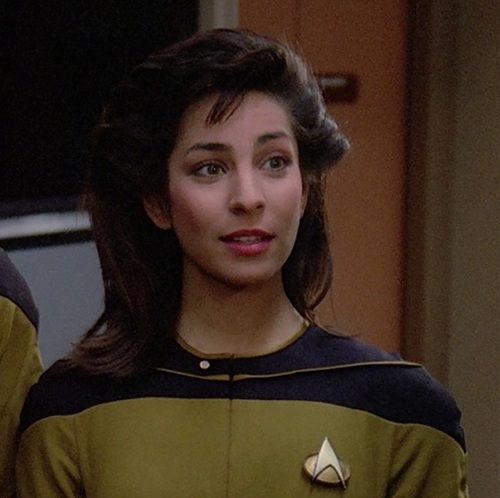
Randon Crewmember
Ensign Sonya Gomez appears again in this episode (after making her debut in the previous one). She and Geordi chat to Wesley about his exams and his upcoming trip with Picard. She advises that Picard knows about a lot of subjects and Wesley could really learn from him. Despite being new she knows how erudite Picard is.
Sonya is involved in the plan to rescue Geordi. She expresses concern for Geordi and asks questions, not that the answers really explained what was happening for me, though she seemed to know what was going on.


Security Breach
Before Geordi is beamed to the alien ship (just after I realised how the plot was going to go), Worf queries whether they should send their Chief Engineer to fix a strange ship. Riker treats Worf like he's being paranoid and obstructive. Worf is just doing his job, he rightly points out they don't know anything about the aliens, but yet again no one listens. Poor Worf. [Do not insert reference to Cassandra of Troy, Worf's name doesn't really sound like anything.]
The crew of the Enterprsie just love sending people into situations without adequate security, nearly as much as they love letting strangers wander around their ship and freely access their systems.

The End
Picard's return to the Bridge is met by applause. He barely acknowledges it then warns everyone that there will be no more talking about his brush with death.


* Seriously, Starfleet is terrible for families.

30 June 2013

Fox Pocket links

I've managed to round up a collection of links about publishers Fox Spirit, their Fox Pocket anthologies and Piracy, the first book in the line.

Neil Williamson talks about how wonderfully designed the Fox Pockets are, including some thoughts on covers.

Tony Lane interviews Adele, the fearless leader of Fox Spirit in a 2-part interview.
Part 1: Adele answers questions about the origins of Fox Spirit, the Fox Pockets line, art and the zompoc.
Part 2: Adele talks about the Fox Spirit editorial team, what stories she likes and desert island books.
Tony also reviews Piracy in a later blog post.

The lovely Alistair Stuart blogs about Fox Pockets over at SFX (I may have been a little excited that I was mentioned by name).

Adele is interviewed at the Bolthole where she talks about stories and gives advice for writers.

Jenny Barber talks about mermaids from her story Past Lives.

Here's the rather fun Fox Spirit gallery for Piracy. I'm dressed as a pirate (pirate being my go-to costume) and my husband painted the undead pirate miniatures.

Here's the list of stories and authors in Piracy:

Becalmed – Den Patrick
The Trouble With Daydreams – Catherine Hill
Black Ethel’s Beast – Kit Marlowe
No Quarter – Rahne Sinclair
Leave the Pistol Behind – Chloe Yates
Past Lives – Jenny Barber
Nora – Margrét Helgadóttir
Plunder – Francesca Terminiello
Insurgent – Christian D’Amico
Geronimo – T.F.Grant
Pieces of 2^3 – Rob Haines
The Real Deal – Ruth Booth
True to The Song – Asher Wismer
Silvermelt – Emma Teichmann
Skyway – K.C.Shaw
X Marks the Spot – S.J.Caunt

Piracy is currently available in print from Lulu and is available as an ebook from Wizard's Tower and on Kindle.

Finally, here's a post I wrote for the Fox Spirit site about How the Fox Pockets were Named.

27 June 2013

Q Who?

Episode: s2, ep16

Guinan's hats are as cool as always. Q disappointingly doesn't have a hat this time. The Borg's view on hats is generally unknown, but they like headgear for babies.

What Happens
Geordi jokes with Sonya, a new ensign, because she thanks replicators.* She accidentally spills hot chocolate on Picard. The Captain goes to change his clothes but the turbolift impossibly opens into a shuttle, which is occupied by Q.
Geordi and Sonya go to 10 Forward, where Guinan senses a disturbance in the force.** She calls the Bridge, which is a first, and asks Riker if everything is OK. When Geordi realises Guinan is concerned he checks on Engineering.*** Troi tries to contact Picard and the computer reveals that he isn't onboard or even in the sector. Riker orders a search.
In a shuttle way out in space Q offers to return the Captain if he'll listen to a request. They appear in 10 Forward and Guinan pops up from behind the bar. She and Q have bad history. Q asks to join the crew; he's been exiled by the Q Continuum and has returned to the ship where he had such fun. He even suggests he might be willing to give up his powers. Picard hears him out, but refuses because they don't trust him. Q says they need him for what's coming. Picard and Riker claim that they're prepared and anger Q with their arrogance, so he knocks the ship way off course. Q announces that they'll get a taster of what's to come, Guinan says they should turn back.
Despite the warnings of the mystical bartender Picard decides he's going to explore before heading home. A
cube-shaped ship approaches. Guinan reveals that the ship belongs to the Borg, they scattered her people across the galaxy. Geordi reports an intruder in Engineering. A pale-skinned, cyborg-looking guy silently scans consoles, ignoring communication and attacks. Worf eventually kills it on Picard's orders. Another one immediately appears and continues scanning, it ignores Worf's phaser, collects something from its fallen colleague and silently leaves.
Guinan says the Borg can't be reasoned with. Troi senses a collective mind. A shadowy Q appears on the screen and asks whether they want him on the crew now. The cube holds the Enterprise in a tractor beam, which slices into the saucer. The ship is able to damage the cube and escape the beam, but not without casualties. Riker says they have to find out more and suggests an away mission.
Riker, Data and Worf beam to the cube. This is one of those away missions where Data says the smart stuff, Riker decides things and Worf looks menacing but says very little. There are loads of Borg stored in slots, they seem to be in sleep mode. The Borg walking around the ship ignore the away team completely. Data figures out that the ship is focused on regenerating and Picard orders the team back. The Enterprise leaves, pursued by the cube. Q appears again and points out how hopeless the situation is. He mocks Picard for his earlier attitude. Picard asks Q for help and admits that he was wrong earlier. Q respects this and spins the ship back to where it was before.


Oh Captain, My Captain
Picard is angered by Q's return and says he agreed to leave his ship alone. Q counters by pointing out that they're in a shuttle far from the Enterprise. Picard describes Q as the most unique of the new and different lifeforms they encounter, and there's a sense that Picard is intrigued even while he recognises how chaotic and dangerous he is. Picard's suspicion of Q and refusal to grant his request are justified, but Picard (and Riker) do seem stubborn and short-sighted when they claim they're ready for whatever they find without Q's help. Q is a trickster and his help is dangerous, but it's foolish to deny his greater knowledge.
Picard doesn't head home when Guinan says he should due to his love of exploration, another example of acting from a place of ignorance. Otherwise his actions are fairly sensible and he does ask Guinan to share her knowledge.
At the end of the episode Q reappears to say I told you so. Picard concedes the point and asks Q to deus ex machina them out of trouble. Q respects Picard asking for help. "Another man would have died rather than ask for help." I don't think such men should be captains of things.

Riker: lover, adventurer, middle-management
Riker believes they must learn more about the Borg rather than escaping. Not sure I agree, but I can understand his thinking. It's really very lucky for the away team that the Borg ignore them.
The Borg ship is industrial and creepy, all girders and walkways. It's interesting that the Borg are a collective and yet the individual Borg are designed differently and each has a customised slot in the ship. Riker finds the Borg nursery, which has babies wired into drawers. I think maybe this is meant to be sinister, but as Riker's reaction to the babies isn't emotional I'm not actually sure. I did think that it made for good baby cosplay.

Does Not Compute
The Borg are robot-looking, they're organic beings enhanced and altered with cybernetic technology. They're also really pale and seem to have no emotions. At no point does the episode make any comparisons between the Borg and Data, even though I reckon there's reason to do so. On the away mission Data examines the Borg ship in his analytical way, and is less interested in the newly discovered aliens than he is in humanity. Data's quest for individuality is a mirror of the Borg's collective consciousness.

Blind Engineering
Geordi and new ensign Sonya Gomez have a good scene at the start. Sonya is chatty and nervous, thrilled to be on the Enterprise, but terrified of making a mistake (which makes her very relatable). Of course her nervousness makes her more mistake-prone. Geordi is clearly bemused and gallantly but pointlessly tries to take responsibility when she spills hot chocolate on the Captain.
Later in the episode Geordi guides Sonya as they try to divert power after the Borg attack. Sonya has trouble concentrating as she keeps thinking about the people who died, Geordi tells her they have to focus on the task at hand, they can grieve later. Geordi's people skills work in professional as well as social contexts.

Guinan's Hat: purple
Guinan senses Q's presence when he takes Picard and the shuttle, she's had that feeling before. When Q appears in 10 Forward it looks like Guinan was waiting for him. (Is it coincidence that he and Picard materialised there?) They have bad history going back 2 centuries. Q says "This creature is not what she appears to be. She's an imp, and where she goes trouble always follows." Picard points out that that sounds like Q. Guinan reveals that not all Q are the same "some are almost respectable". While Q is angered by how far humanity has spread, Guinan believes that their ability to adapt is their greatest strength. Little else is said about how they know each other, it's really intriguing.
Guinan plays a bigger role than usual because she has previous knowledge of the Borg. She wasn't there when they destroyed cities and scattered her people, but she's heard about it. She warns that the Borg will not listen to reason and advocates escaping. She's not exactly scared, but she knows that the Enterprise will not do well from the encounter.


Continuity
The planets near the Borg cube show signs of civilisation, mostly roads. However all the machines have been "scooped" off the surface. Data compares it to the destruction found on planets in and around the Neutral Zone in the last episode of series 1 (though it feels like Worf's discovery since he reports it both times). It was clear then that the Romulans had discovered same thing on their border planets.

Staff Meetings: 1 (with an intermission for weapons fire)
1(a): Picard invites Guinan to the meeting because of her knowledge. She wasn't there at the time but describes the Borg swarming through a system. It's concluded that the Borg intrusion into Engineering was information-gathering. Picard asks if they can reason with them, but Guinan says no. The cube interrupts with a hail that says they can't defend themselves and will be punished if they try. Troi senses a collective mind, and the advantages of this are discussed. The meeting is completely disrupted when Worf reports that they're caught in a tractor beam.
1(b): The meeting restarts with Picard asking Guinan for more information. Q arrives and tells them that the Borg are like nothing else they've encountered. They're only interested in consuming tech. Picard asks Q if it's an illusion, it isn't. The 18 lost crew are mentioned. Riker wants an away mission and Picard agrees, despite Guinan's shock.

No Magic Here
Having a ceature like Q in the show from the start shows that the unexplainable is important. Guinan being a recurring character also shows that there's room for the spiritual and mysterious in the lives of the characters, though she's never treated as a novelty.
The meeting of Q and Guinan is kinda awesome. They have a moment of guarded standoff, making it clear that Guinan can match Q. His name calling and contempt suggests she may have gotten the upperhand over him previously. Q doesn't use his godlike powers that much (nor does he wear any hats), but he does snap his fingers and send the Enterprise spinning 7000 lightyears through space. The visual effect for this is pretty cool. Q's magic is big and flashy and makes the impossible real. Guinan must have magic, but we don't see it, she's a strong presence full of wisdom but also greatly enigmatic. It's no surprise that she's used different names and forms in the past.

Death by Space Misadventure
18 people from the Enterprise are killed when a beam from the Borg cube cuts into the Enterprise and pulls a section into space. Their names are not listed but their loss is felt.
Picard asks Q if it's all one of his tricks, as he normally creates elaborate illusions (if they are illusions) to make his point, unfortunately this time it's real. At the end Picard asks whether the lesson Q was teaching them should have cost 18 lives, Q describes it as "a little bloody nose" and says space is not for the timid.

The End
Picard and Guinan play 3D chess. Guinan warns that Q set things in motion too early (odd since he was the
one who claimed humanity were going too fast). She says borg see them as raw material, but hints that there could have been a relationship, which is a change in tune. Picard says that perhaps they were complacent and a challenge is what's needed. It suggests he's absorbed the lesson but perhaps failed to recognise the full implications of what happened.


* Is that so weird? I sometimes do that with cash machines.
** Guinan is basically a cross between a Jedi and a Time Lord, right?
*** Using a mystical woman as a barometer for Engine problems is almost certainly in the manual somewhere.

17 June 2013

The Road to Bedlam

 The Road to Bedlam 
Mike Shevdon


I got this book at Fantasycon 2012, in fact I got very the last copy they had at the Angry Robot stand. The book itself sustained some damage as I returned home from Fantasycon and was caught in a rainstorm (stupid wet Birmingham). Luckily, after some care from my husband, the book survived totally readable and only a little warped along the edges. In fact the slight wobble on parts of the cover and some of the pages gave the book a slightly 'aged' look and added a tactile element that goes well with fantasy that's steeped in myth and features long-lived characters. Not that I will be purposefully 'aging' my own (or any other) books. To do so would be a sin.

Anyway... this review will contain spoilers for Sixty One Nails, the first book in the series.

The story continues from the previous novel Sixty One Nails and is told mostly by Niall, though the focus shifts towards his daughter Alex. In the first book Niall discovered his feyre heritage, started a relationship with his long-lived guide Blackbird and took the role of Warden in order to find a secure place for himself in the seven courts. The Road to Bedlam sees Niall continuing his training as a Warden and living with Blackbird, who is expecting their baby. A fatal accident means that Niall loses his teenage daughter Alex. An old enemy returns as an envoy and Niall is sent to a northern seaside town to investigate the disappearance of local teenage girls. He becomes convinced that his daughter isn't dead, and is determined to find her.

The characterisation is good. Now that Niall is part of the world of the feyre he has a different outlook and is more prepared for the strangeness he finds, though it's clear he has much to learn about other feyre. His grief over the loss of Alex, his attempts to make sense of the tragedy and the lengths he'll go to in order to get her back show Niall's mettle more than the previous book. Blackbird is still a good character, though her pregnancy forces her to live without magic for a while she still proves to be highly resourceful. There's more detail about Niall's fellow Wardens, and a few characers

The first book struck me as London fantasy with a diversion to the midlands countryside. This book proves that it's fantasy that's willing to explore different locations, thanks to a feyre transportation system that connects sites all over the country. In his first mission as a Warden Niall is sent to a fading northern coastal town, the kind of place that once did well from fishing and seaside holidays, but has declined. There's a strong sense of place and a sense of a community struggling on despite being out of touch with modern life. The minor characters that populate the town are as much part of the setting as the descriptions of the landscape.

The story is well done over all, successfully balancing various strands. The fate of Alex is the most crucial part of the story for Niall. His investigations into the disappearing girls mirrors his search for Alex but it is not directly related. Each part of the search brings its own surprises, shows the differences between the girls and highlights various non-fantastical issues that are faced by modern young women who desire escape. It's interesting that the traditional escape through the discovery of magical powers turns out to be a dead end. There's also plotlines that relate to the series as whole, the reappearance of the self-exiled eighth court of the feyre brings danger to Niall and Blackbird, and also complicates the political situation in the magical world.

This is a fine read and, with its predecessor, a great example of modern British fantasy.

I intended to read this anyway, but it was strongly recommend to me by @pablocheesecake of The Eloquent Page. You should read what he thinks, he knows his stuff.

14 June 2013

Pen Pals

Episode: s2, ep15

What Happens
The Enterprise is the first ship to enter a system with some violent geology. Picard and Troi go to the holodeck so Picard can go horse riding. Riker calls Picard to the Bridge because a once-thriving planet is now barren.
At a staff meeting Riker discusses putting Wesley in charge of the geological survey. Wesley is told to
assemble a team, which is daunting because everyone is older and more qualified than him. He has issues giving commands at first but gets a fair bit of advice.
While Data is pursuing his hobby of checking for unusual scans he finds an unusual scan that turns out to be communication from a lifeform. Data interrupts Picard in another riding session to reveal that he has been in regular communication with a young girl from one of the planets in the system, though he was careful not to give details about himself or where he was from. He's concerned because his friend's planet has bad volcanic activity like others in the system. Picard calls a meeting to discuss the situation, much discussion ensues.
Later Wesley's team reveal the cause of the geological problem has been found. It's something to do with crystals, of the planet-destroying, non-healing variety. They think they can reverse the process and Data is told he can contact his little friend again. Worf and a geologist from Wesley's team work on torpedoes, of the non-destructive, planet-healing variety.
Data beams down to ensure his friend's safety. The girl seems weirdly unperturbed by seeing Data, who must
be unlike anyone/anything she's seen before. Data beams her back to the ship because the volcanic wasteland where she lives is unsafe. Data takes the girl to the Bridge and she watches as her planet is healed. Picard tells Pulaski to erase the child's memory, explaining to Data that it's for her sake too.
Data returns the girl to her home and leaves her a singing stone as a sneaky souvenir. Riker congratulates Wesley and invites him to sit in the Captain's chair, but Wes refuses.


Oh Captain My Captain
Picard starts the episode by going horse riding in the holodeck, while Troi tags along to watch. He's interrupted before he can start riding, but not before he's given a mini lecture on horses and his feelings for them.
Picard has actually gotten as far as riding the holo-horse when Data tells him about what he's been doing. Picard would have every right to have Data punished, however the Captain raises the issue with senior crew and holds discussion about the best course of action. He shows a flexibility that may not be what Starfleet Command would approve of, but is one of the major things that makes him a sympathetic character.
When Data brings the little girl on the Bridge Picard can't look at either of them and communicaties through Riker. We all know how kids freak Picard out, he hates children being on his Bridge, even when there isn't a massive regulation breach involved.

Fringlish
"In for a penny in for pound" says Picard as he grudgingly agrees to Data beaming down onto the girl's planet. I have to say it's a very English expression, though I don't know whether there's an equivalent French saying.

Riker: lover, adventurer, middle-management
Wesley's education seems deeply important to Riker, who convinces Picard to put him in charge of an actual mission. I do wonder how often this happens. Do all the kids on the ship get to do this? Or is it just because the senior staff are effectively raising/supervising Wesley as a loose collective? It seems like an opportunity that a lot of budding cadets would love.
Riker really mentors Wesley, providing him with advice whenever he asks for it and guiding him through how to choose a team and how to give instructions. Though his main advice seems to be: WWPD? (What would Picard do?)

Does Not Compute
Data discovers the little girl's transmissions because he has a hobby of scanning for unusual signals, that presumably qualifies as fun for androids. What's remarkable is that not only does Data not report the communication signal, he actually answers back and ends up making friends with a child.
Data is careful not to let the girl know who or where he is, showing an awareness of the rules and how to bend them. He only reveals what he's been doing when he realises that his friend is in danger. Data advocates taking action to save her and clearly has an emotional connection. When Pulaski advocates saving the girl she is told she is being emotional, which means Data must be too.
Data's concern for the girl is clear when he asks whether he can beam down to ensure her safety, shattering the Prime Directive into tiny pieces. When she's in danger he beams her up to the ship, grinding the broken pieces of the Prime Directive into the ground. The girl manages to be fairly calm while impossibly watching her planet from way up in the sky.
Whilst the girl is in the sickbay, before her memories are wiped, she's interested in Pulaski's singing stone. It turns out that the stone doesn't work for Data because he's a machine, which isn't explored but is kinda interesting.

Poor O'Brien
When Riker takes Data down the transporter bay to beam onto the planet he instructs O'Brien to take a nap so he won't be involved. Despite this Riker then asks O'Brien to ensure that Data is beamed back in 10 minutes, meaning he is definitely involved. When Data requests two to beam up O'Brien does it but comments that "there's going to be hell to pay".

The Boy
Since the first series Wesley seems to have learned some humility, which makes him less insufferable. Possibly he's matured, possibly he's less sure of himself without his mother around. Either way, Wesley's uncertainty about what to do in a leadership role and how to deal with people older and more experienced than him makes him more sympathetic. At least, I can sympathise with someone feeling out of their depth. He confesses his nerves about leadership to Pulaski. He interrupts Riker while he's chatting with a lady in the bar to ask his advice, even though it's clear that he feels awkward about doing so.
When Wesley asks geologists to do extra tests they tell him he's fussing. Later when he's considered WWPD and asks them again they have no problem, which suggests to me that they were just stalling because they had plans when he first asked. Predictably it's those extra tests that save the day (obviously the show can't fully get rid of the Mary-Sue vibe). When briefing the Captain Wesley is businesslike and doesn't smugly gloat, which is a definite improvement.
The real indicator is that Riker offers Wesley a chance to sit in Picard's chair, but Wes refuses. He says he's not qualified yet, which shows he's taking his position on the ship seriously.


The Prime Directive is a Harsh Mistress
...unless there's a sad kid in danger. Then all bets are off, it seems.

Staff Meetings: 3
1. Riker asks Picard, Pulaski, Geordi and Troi for opinions on putting Wesley in charge of the planetary survey mission. Pulaski points out he's a young man, not an officer in training and they shouldn't push him too hard. Picard approves of testing him and giving him command experience. Wesley is called in and told about his assignment, everyone is very formal with him. Picard tells Wesley that the officers are there to guide him and it's better to ask than blunder blindly through pride.

2. Picard invites Riker, Worf, Geordi and Troi to his quarters to discuss Data's illicit communications. Picard starts by staying Data was wrong, but they need to decide what to do next and not cast blame. Worf sees the Prime Directive as absolute so there are no options, Picard dislikes that rigidity. There's much discussion about playing god and deciding when interfere. Picards the point that if they interfere now why shouldn't they always interfere when anyone's in trouble. Pulaski takes the humanitarian view that they should save lives if they can, and because it means something to Data. Worf is scornful of this attitude. Data points out that they are also required to help those how request help, but it's all just discussion. Picard commands Data to cease all communication, allowing the girl to die. Then the Captain hears the lonely little girl searching for her friend and changes his made.

3. Wesley and two of the geologists on his team brief Riker and Picard on their findings. They've found the problem and will work on fixing it. The survey team leaves. Riker and Picard discuss Data, who has been monitoring his friend's planet. Neither like the idea of letting the girl die, nor do they like what they have to do to save her.

The End
Data apologises to Picard again. Picard reflects on friendship and says Data has taken a step closer to understanding humanity.
Personally I think he's taken a giant leap.


8 June 2013

Piracy

I'm excited to announce that Piracy the first of the Fox Pocket* books from Fox Spirit Books is available from Lulu.
My story 'The Trouble with Daydreams' is the second one in the anthology.


The following is from the press release:

Small but perfectly formed collections of stories by a den full of talented writers, put together by Fox Spirit books for your enjoyment.
The stories are flash fiction, giving the reader bite sized introductions to Fox Spirit and the writers we love to work with. All designed to fit perfectly into the pocket so you can take a little fox with you everywhere you go.

There are ten books to the collection being published during 2013 and 2014 and titled:
Piracy, Missing Monarchs, Shapeshifters, Guardians, Under the Waves, In an Unknown  Country, Things in the Dark, The Evil Genius Guide, Reflections, Piercing the Veil

Stories in Fox Pockets will wander unfettered between genres, mixing horror, fantasy, science fiction and crime. The subjects are deliberately loose to invite a wide range of interpretations. This pocket series showcases some of the wealth of new talent coming through in genre fiction.

The books will be available as a paperback through Lulu for 24 months after the release date of each volume. Ebook releases will take place a month after the paperback and will be available for longer, but not forever.

Fox Spirit will be offering a subscription to the paperbacks as part of a giveaway through the newsletter this summer so please subscribe on our home page to make sure you don’t miss out.

More about all our titles at www.foxspirit.co.uk


* I'm a bit proud to say that I inadvertently came up with the name Fox Pockets. It was a bit of a joke between me and Adele Wearing, the fearsome leader and main force behind Fox Spirit.

25 May 2013

The Icarus Factor

Episode: s2, ep14

I don't really understand this episode title, I was expecting something to do with a sun. I like the way the B-plot panned out.

What Happens
The Enterprise goes to a starbase because of some kind of mechanical situation that needs a second opinion. The systems are being checked by inspectors. Geordi isn't happy about this affront to his professional pride, but no one seems to care how he feels.

Daddy Issues*
Picard tells Riker that he's been offered a promotion to Captain of the Ares, he's got 12 hours to think it over. A civilian attache is sent to brief him on the Ares dangerous mission, it's Riker's dad, Kyle. There are clearly issues as they haven't spoken in 15 years and Riker is very cold to his father.
It turns out Dr Pulaski and Kyle Riker used to be in a relationship, and she could've been Riker's stepmother. She has 3 ex-husbands and is friendly with all of them, but Kyle was never properly in touch with his feelings. Will is a bit freaked to see his father and the doctor have a history, he knew nothing about it, and he gets slightly stroppy at them.
Riker Senior hands Riker Junior the briefing on a disc. He didn't have to come, it was all a pretense to see his son again. Will rebuffs Kyle, probably because he's not the slightest bit apologetic about how bad a parent he is, then brings up Riker's dead mother.
When Troi meets Kyle she detects that he's proud of his son and jealous of him too. She suggests he should examine why he feels competitive towards his son. Kyle believes Will will take the Ares promotion because it's a dangerous mission, for a man who hasn't spoken to his son in 15 years Kyle is fairly confident about this opinion.
Will apologises to Pulaski for his earlier stroppiness. She explains that she would have married Kyle but his career came first. She also tells Will that his father suffered badly from survivor's guilt after a tragic mission.
The 2 Rikers argue and Kyle suggests they move the discussion to a martial arts ring, that's is the kind of father this guy is. They gear up and take part in Armoured Martial Arts Game, which involves sightless helmets, a ring and sticks. Kyle is really proud that he has never lost against Will, it turns out he was cheating for years so that he wouldn't get beaten by his own son. He's a bit of a bastard really. As they fight old issues come out, mostly stuff about Will's dead mother and Kyle's inability to communicate. Kyle tells Will he loves him and they hug briefly, but it's horribly tense.

How to cheer up a friend (a Wesley Crusher guide)
-You notice that your friend reacts angrily when you start up a conversation about how you both have dead fathers. You friend is an angry individual, but even so you suspect that something is odd about this interaction.
-You talk to other friends about it. One is unhelpfully distracted by work stuff and doesn't want to get involved. The other is an android who apparently doesn't understand or experience emotions, he agrees that something is up and suggests you take a scientific approach. You decide to discreetly observe your angry friend, even though your stealth skills are limited and he is a short-tempered warrior who is particularly irritable at the moment.
-Your android friend tries to cheer your angry friend up, but in the process tells your angry friend that you have all been discussing his behaviour. This does not help matters.
-You research into your friend's culture and discover that it's an important anniversary and he has none of his own people to share it with. You and the android arrange a traditional celebration for him. Various people are invited, though some have reservations about what such a gathering will be like.
-Your angry friend is brought to the celebration, which largely involves him being attacked by rows of holographic warriors yielding painsticks. It's very intense and kinda confusing but your friend is grateful and in all honesty that's the most important thing.
It's a very different sort of party.


Oh Captain My Captain
Picard apologies to Riker for being so grumpy when they first met, then tells him about the promotion. Riker goes to Picard for advice several times during the episode. Picard tells Will how proud he is, but in a non-pushy way, unlike Kyle. Picard also frames Riker's choice, it's the difference between being first officer on a major ship or having command of a ship that he can make his own.

Klingon Warrior
Worf visits Riker in his quarters and requests that the Commander take him along to the Ares if he decides to go. It's not clear whether Worf wants to protect Riker or is looking for a post that will provide more combat opportunities. I can't help noticing that this request comes after Data tells Worf that other crew members are gossiping about him.
While I think that Worf not wanting to talk to Wesley about his dead father is perfectly acceptable and not strange, it's nice that various crew care about Worf and want to make a familial gesture for him. It's way less messed up than the Riker family, even including painsticks.

Counsellor Pointless
Riker says goodbye to Troi when he decides to take the promotion. She says that she can't read him at that moment. They both declare they are sad, she cries and they hug. They may be well-matched but they are not the most interesting couple.
Troi brings Worf to the holodeck for his ceremony. Worf is grumpy and Troi points out that the surprise was all Wesley's doing. He asks if she's coming in and she says no, in the tone of a person who wouldn't be seen dead at such a function.

Poor O'Brien
O'Brien is in 10 Forward with Riker when Kyle and Pulaski are reunited. He also faces sarcasm from Geordi over the engine checks that are going on in the background. It's the first time Geordi has made clear he's unhappy with the situation, but by that point everyone is helping Worf, so he missed his chance to be focus of the B-plot.
O'Brien agrees to go to Worf's surprise ceremony. Having seen what Klingon celebrations are like I'm surprised he later agrees to go to Worf's bachelor party on Deep Space 9.


Girl Talk
Pulaski and Troi discuss Worf's ceremony and the doctor makes a comment about humans being past 'barbaric display'. Troi points out that the Riker vs Riker grudge match would suggest that's not true, then says it's because they're men. It seems human males are unique because they have generational issues and never really grow up.** Then both women conclude that might be why they're attracted to them. Apparently men are like children and that's attractive, which isn't worrying at all.
This in no way passes the Bechdel test and also fails my own personal Gender isn't a Categorical Difference test (which was recently proved, by science). It seems like the kind of thing I'd hope people in the future would be less hung up about.

The End
Riker walks onto the bridge and asks Picard's permission to stay. The Captain grants it and Riker resumes his duties as though everything is normal. Picard asks why Riker wants to stay, in tones of mild interest. Riker says that the Enterprise is the best place for him to be.


* Daddy issues are everywhere in US TV and film. I assume it's a stock motivation as I refuse to believe that most of a continent of real people actually has daddy issues. I suspect it's just most of the entertainment industry.

** Human males, what do you reckon? This seems a bit unfair to me, but I can't speak from personal experience.

19 May 2013

Iron Man 3

I actually saw this a few weeks ago, but figured I'd leave my review until more people had the chance to see it (I wouldn't want to be accused of being topical). This post contains spoilers.

I really enjoyed Iron Man 3, it is definitely better than the second film, and possibly better than the first. The first film successfully launched the character into the mainstream consciousness, which is quite a feat so this one was building on that foundation. On the other hand the first was by necessity an origin story, and so was constrained by that, though it worked in such a way that those constraints weren't clear. As the first Marvel Studios film post-Avengers (Assembled *sigh*) it was going to be interesting to see how the hero would fit back into his own story after the expansion of the heroic universe. It was also necessary to prove that the Iron Man franchise could rise above Iron Man 2, which was only OK and clearly something of a placeholder. I'm pleased to report that Iron Man 3 managed to do these things and more, not only being better than 2 (which was my base expectation), but in fact being really good.

The story is more intimate, which makes sense as it could hardly be, or even try to be, more epic than  Avengers. Bringing the focus back on Tony Stark as a man, and how that man copes with being a hero, was a good choice. For a time Tony is forced (more or less) to rely on his own wits and must rebuild Iron Man the suit, in the process he realises that he truly is Iron Man. while I suspect he was not quite as cut off as the film would have us believe, I think that getting Tony away from his established workshop were he could constantly tinker (and the climax shows just how much tinkering he was doing) was good because it gave him focus and reminded him of his own abilities.

The interactions with the small-town child were pretty good. Adding children to a film that's not about family and has an adult main character can be iffy, as they easily come across as annoying to adult viewers. In this case the kid actually worked really well. Tony never talked down to him, and the kid didn't give Tony any quarter either, so their scenes seemed much more equal than such interactions usually are.

I liked that Tony was profoundly affected by the events of the Avengers film, but that the specific events were only mentioned briefly. What's important is the effect those events (most particularly almost dying after going through a wormhole/portal and seeing massed ranks of aliens*) had on him. I think the portrayal of Tony's panic attacks is well-handled and an excellent example of a sympathetic portrayal of mental health issues. Tony is not treated as lesser because this is happening to him, it is framed as an expected consequence of what he went through. Even a questioning child is simply curious and displays no judgement of him. The person who seems most annoyed by and judgemental of the panic attacks is Tony, which is fair enough as he's the one having them. He even acknowledges that he should get help, albeit quickly and in an off-handed way and then admits that he probably won't. This fits the character and again is not treated with judgement. These are complex issues and they're dealt with quickly but not clumsily. I've noticed that some people seem dissatisfied that the panic attack storyline was not resolved in the film, but frankly it would have been a cop-out if it had been.

The villain was handled very well. There was an understandable level of concern over using a villain called the Mandarin who was basically written as 70s yellow peril, how could that possibly play out well? They managed it, and in hindsight I'm quite impressed that the secret stayed unspoiled. The reveal that terrorist leader, the Mandarin is in fact Trevor Slattery, a junkie actor from London who plays the role for cash, was brilliant. I'm also impressed not only by Ben Kingsley's performance (which could have gone badly wrong in the hands of a lesser actor) but also in what he said in pre-publicity. I read an interview in which he talked about how theatrical the character was and how he manipulated his image, it just ties in so well with both what the character was and how he was used in-film.
I also liked the henchmen. Rather than being faceless goons they did appear to be actual people. There was some great comedy derived not only from the guard's amusement at Stark's unlikely and increasingly manic threats, but also from the henchman who immediately pleads for his life and says how much he hated his job and weird his bosses were. Why don't more henchmen do that?

Again Pepper saves the day, as she did in the first film (I don't think she did in the second, but I don't remember the plot too well). This time definitely taking the real villain out herself, and I thought it was interesting that she ends up having being super powered where Tony isn't. I think that could be an interesting dynamic going forward, but the ending doesn't make clear how much that situation will remain. I also like Pepper's attitude throughout most of the film, she seems to be the only thing keeping Tony connected to reality, and though that in no way stops him from doing stupid stuff she makes sure he knows how stupid it is. I kinda liked that the main villain wants Pepper for his own creepy reasons, but even he is ashamed enough to baulk from saying it bluntly. It makes clear just how repellent it is, and suggests that he still holds her in enough esteem to want to pretend that's not going to be the arrangement.

I like that Tony has a fandom, and is able to use that to his advantage without harshing the squee of his fan, even if the guy was a bit OTT. Actually the slightly amateurish-but-recognisable tattoo made me think of the science brothers fandom, which I'm bemused by but ultimately think is a good thing. So that was already in the forefront of my mind when Bruce Banner appeared at the end of the credits. I'm sure the science brothers fandom were greatly pleased by that.

The things I didn't like are just niggles, mostly do to with the final big action sequence.
I never felt as though Pepper was in any real peril. I knew that she would pretty much be immune to physical harm so didn't feel emotionally invested when she seemed to die.
All the suits at the end were a bit confusing, as they were just a series of flashes and movement. I couldn't tell what they were all for or how most if them were different. It also seemed a contrived that when Tony needed a suit he could simply fall into one, unless the plot was better served by him being unable to do so.
As I say, niggles really.


* I believe that of all the Avengers featured in the film, Stark was the one who would have been most profoundly affected by that sight. He's the only entirely human civilian on the team, and is also a man with a superiority complex who's used to being top-dog. It would have been a bad experience for anyone, but Stark had the least preparation for such a sight.

12 May 2013

Time Squared

Episode: s2, ep 13

I was hoping that an episode called Time Squared would be more interesting.

What Happens
The Enterprise comes across a powerless shuttle alone in the middle of space, with no indication as to how it got there. It's pulled into a cargo bay where Riker, Worf and Pulaski investigate. All the markings indicate it belongs to the Enterprise, but all the shuttles are accounted for. Inside is an unconscious Picard, even though they just left the Captain on the Bridge. Riker calls Picard and Data down to the cargo bay.
Picard1
PicardA


This is going to get a bit confusing, so I'm calling the version of Picard who started the episode on the Bridge Picard1 and the one who started the episode in the shuttle PicardA.


PicardA is unconscious and taken to sick bay. Troi  senses that PicardA is as much Picard as Picard1, but as he's unconscious she can't tell much more. Picard1 orders Pulaski to wake PicardA, but his brainwaves are out of phase and he can't remain conscious. Meanwhile Geordi and Data have trouble charging the shuttle, despite the connections being identical and idiot-proof (so idiot-proof that the Chief of Engineering was called). The charger is out of phase so they make adjustments and get enough power in the shuttle to extract the logs. In a staff meeting Geordi show the logs, which have footage of the Enterprise exploding while trapped in a swirly space-thingy. The timestamp indicates that this will have happened in about 3 hours time. No one understands. The plan is to simply continue and hope they don't make the same mistake again.
Pulaski belives that PicardA's bio-systems are out of phase because he's misplaced in time, and he'll get better the closer they get to the time he came from. Troi senses that he desperately wants to leave but probably doesn't know where he is. Pulaski thinks the whole thing is unhealthy and the Captain is under too much stress.
The ship wobbles, sirens blare, and a swirly space-thingy suddenly appears (as they seem to do). Its the same as the one from the shuttle cam. The ship is being pulled in and the engines are needed simply to stay in one place. At first Picard decides to stay and investigate, because poking at something that you know will cause an explosion is always a good idea. Racked with doubt he fears that any decision will be the wrong one; a probe is launched, it explodes. Geordi runs the engines nearly flat in order to remain stationery. Both Picards are shot by blue lightning (space lightning is always blue). Wherever Picard1 goes the blue lightning follows and Troi senses it's focusing on him. At this point he thinks that leaving the ship might help, but that's probably what PicardA thought too.
Picard1 goes to the sick bay where PicardA is awake but doesn't understand what's happening and apparently can't see his own double (for reasons I'll bet). PicardA is desperate to get on the shuttle so Picard1 has Pulaski release him and orders all the crew out of the cargo bay. The pair stride down corridors together and Picard1 speeches at his other self to find out what happened. PicardA believes the entity recognises him as the brain of the ship, which is why he/they are being targeted, he tried to leave in order to save the ship. Picard1 phasers his other self to stop the pattern, then orders the ship to fly straight into the vortex.* PicardA disappears and the Enterprise quickly arrives back in regular space.

Oh Captain, My Captain
It is understandable that Picard1 is shocked and suspicious to see a timeslip version of himself. He also seems unreasonably irritated and gruff towards PicardA, who is clearly suffering. Even when he's sure that PicardA isn't a trick, he's still pretty interrogatory and mean to him. At one point he even shakes his other self by the shoulders, which seems inadvisable to say the least.
Picard's main issue seems to be that he is unused to doubt. Knowing that something he will or won't do causes the ship to explode leaves him in the uncomfortable and unfamiliar position of second guessing himself. Welcome to the life of a neurotic, Picard.

Riker: lover, adventurer, middle-management ...and unsuccessful chef
Before the theme tune Riker is cooking omlette, with real eggs and a whisk and everything. Data, Geordi, Pulaski and Worf arrive with gifts. Data points out that cooking is not a very efficient means of feeding yourself, Riker talks about cooking in terms of subtly, flair and individuality. It turns out Riker likes cooking because his father hated it and left it to him. Worf queries why his mother didn't do it because it's his understanding that "in most human families the woman shares in the cooking."** For someone who was raised by humans Worf's understanding seems a few centuries out of date. Riker reveals that his mother died when he was young (as it turns out this will be relevant to the next episode).
Everyone hates the omlette, besides Worf, who finds it delicious. It turns out Riker bought alien eggs at a starbase and either they've gone off or else that kind of egg is gross.

Counsellor Pointless
Troi claims she can't explain what she's sensing from PicardA, then explains it. She often prefaces statements about her empathic abilities with comments like this. It's not just her job to sense these things but also to communicate them to people who can't. Of course no one can tell whether she's just making excuses or not, but I'd be interested to see whether another empath would call her out on this.
When the swirly space-thingy appears Troi senses a mind but not an intent. There's always a mind behind these things, isn't there. Space seems to be full of bloody big brains just floating about the place.

Poor O'Brien
O'Brien is in the cargo bay when the two Picards arrive and witnesses Picard1 phasering PicardA. Seeing a man you respect shooting his other self is pretty alarming. Then O'Brien sees PicardA and the shuttle fade out of existence, without a guitar solo or anything.


Like me Geordi probably can't see 3D films
Staff Meetings: 1
In the observation lounge Geordi plays the shuttle video log which is blurry because of phase shifting or something. The log shows a sad looking Riker, a swirly space-thingy and the Enterprise exploding. This will happen/has happened 3 hours and 19 minutes in the future.
No one can understand why the ship explodes nor why Picard would leave. Data refuses to theorise because he simply doesn't have enough info. Riker thinks the sequence of events is unavoidable, Worf mentions the mobius time-loop theory. Picard decides to keep going as normal and hope it's fine. Personally I would've thought that getting the hell out of dodge was a better idea.


Death by Space Misadventure
Technically everyone on the Enterprise, besides Picard, explodes in one time line. Then that Picard fades out of existance due to surprisingly dull timey-wimey stuff.

The End
Picard sits in the observation lounge and reflects on what just happened. Riker suggests it was a shared illusion, Picard thinks it was meant to happen. He does not recommend meeting yourself.


* Yes folks, the solution to this episode is actually a line from Star Trekkin'.

** FFS, I hate versions of the future where gender roles (among other societal things) are assumed to be entirely the same, or are portrayed very traditionally. Just for the record, in my human family the man does the cooking, mostly because he likes it and I'm not very good at it.

9 May 2013

Forests of the Heart

 I've found it strangely hard to write about books recently, hence the lack of book posts. Sorry about that. I'm determined to get restarted though.
 

Forests of the Heart 
Charles de Lint


Bettina grew up near the desert and was taught magic by her beloved grandmother. She is drawn guided north and follows the signs to Newford, where she ends up modelling in an artist's colony. It is here that she sees los lobos, shadowy men who linger in the spaces between the human world and la epoca del mito (the spirit world).* Sculptor Ellie receives a strange commission from an eccentric and androgynous patron. As a natural sceptic she finds it hard to believe those who say she has mystical powers and is alarmed when spooky stuff starts happening. Irish siblings Miki and Donal have never been well off, but life is better than it was when they were kids and at least they have each other. That is until Donal falls in with a bad crowd and crosses a line Miki can't forgive.

This is the first full novel I've read of Charles de Lint. After reading a collection of his short stories I knew I wanted to read more of his work, it was so interesting the way he mixed mythology, magic and modern life. I'm pleased to say that Forests of the Heart did not disappoint. The story draws on both Irish and Mexican/Indian (as in Native American) mythology and brings them together in a snowbound town in the northern United States. The trajectory of the story was mostly as I expected, but there were a few unexpected twists and some minor characters who proved more significant than I first expected. Due to the nature of magic the characters' backgrounds and internal conflicts are as much part of the story as the external action and danger.

There's a fairly large cast of characters, as when as several viewpoint characters there are linked groups of friends and relatives. Every character feels realistic, even if some of the minor cast are painted in fairly broad strokes and others are referred to more than seen (I assume they feature more prominently in other Newford books). The main characters are nostly sympathetic, even when they're at odds. Even antagonistic characters feel fleshed out and have believable motivations, even if they aren't likeable or what they do is bad. The psychology of the viewpoint characters is very important, especially in the case of Bettina. She is given the most detailed back story and her personal issues are a focus of the story. It was interesting to read the juxtaposition of the snowy northern city and Bettina's powerful memories of the desert.

The book was particularly atmospheric because as I was reading it the UK was hit by the most snow it's had in decades. I saw the deepest snow I've ever seen in my life (except for the time I went up a mountain in Switzerland, but I wasn't in the snow then). Of course I realise that the weather we had this spring is nothing compared to proper blizzards and ice storms such as those described in the book, but still it felt fitting to read it at that time.


* I may have learned a very random selection of Mexican-Spanish words.